


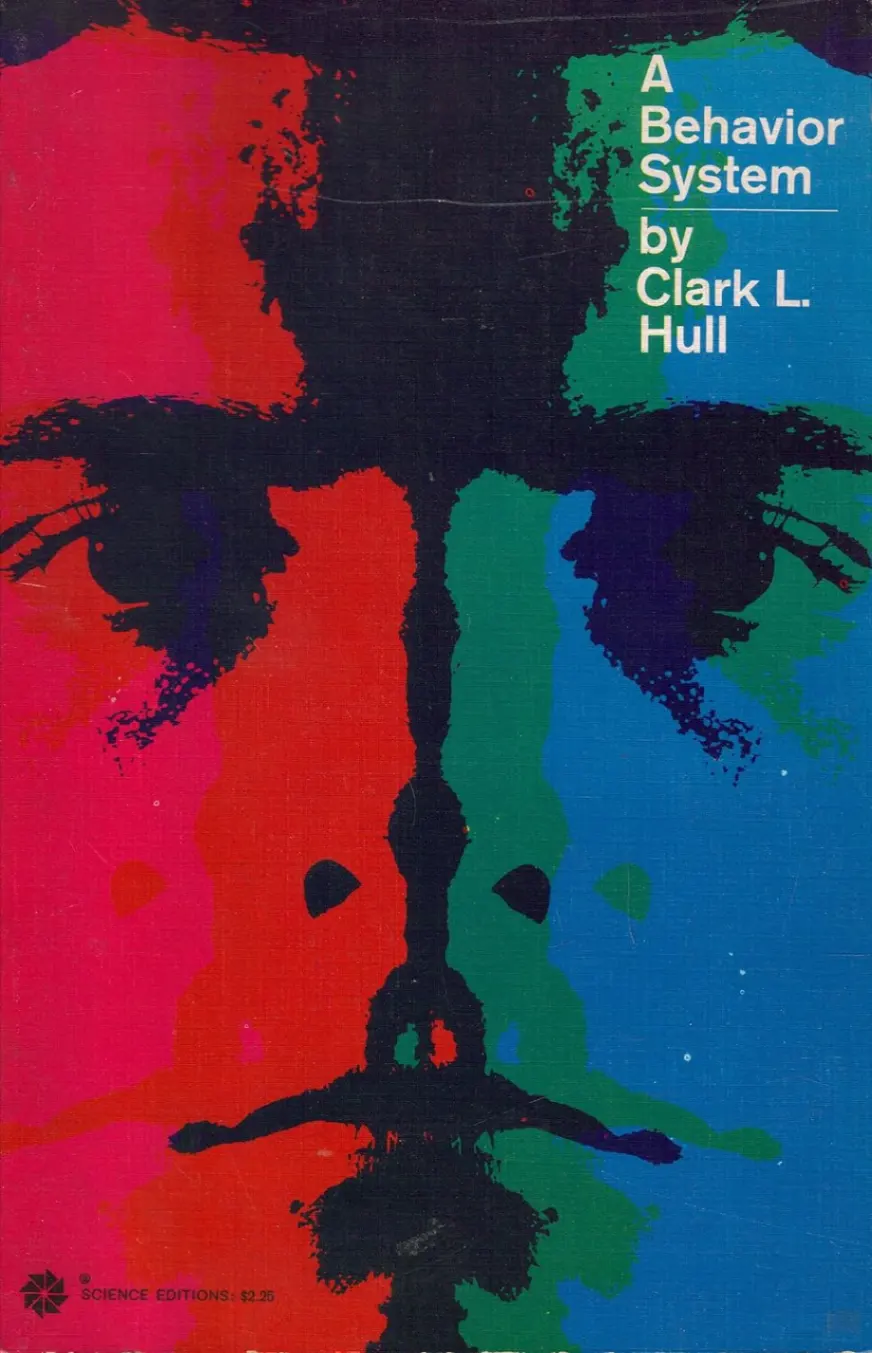
A Behavior System: An Introduction to Behavior Theory Concerning the Individual Organism
 Clark Leonard Hull
Hull argues that the individual organism, not the group or the reflex, is the proper unit of behavioral analysis, and that its behavior can be derived from a compact set of postulates concerning drive, habit, incentive, and inhibition. The book consolidates the revisions made in Essentials of Behavior and extends the system to new domains, including problem solving, social behavior, and the acquisition of language. Written with the collaboration of a small group of associates and published posthumously, it is Hull's final and most comprehensive statement of his deductive behavior theory.
Key Details
Related Books
View AllSimilar books from the same category, ranked by shared topics and reader engagement.



Key Insights — Read in 10 Minutes
What is the central argument of A Behavior System, and how does it differ from Hull's earlier books?
The book argues that the behavior of the individual organism is the proper subject matter of psychology, and that this behavior can be derived from a compact set of postulates concerning drive, habit strength, incentive motivation, and inhibition. It differs from Principles of Behavior (1943) in two ways. First, it incorporates the revisions Hull had made in Essentials of Behavior (1951), particularly the abandonment of drive reduction as the necessary condition for reinforcement. Second, it extends the system beyond laboratory learning to new domains—problem solving, social behavior, and language acquisition—demonstrating the system's generative scope. The book was written with the collaboration of a small group of associates at Yale and was published posthumously, Hull having died in 1952 before the final proofs were corrected.
What was the nature of the collaboration on A Behavior System, and how did Hull's death affect the book's completion?
Hull worked on the book with a small group of associates, including his long-time collaborator Kenneth Spence and other Yale colleagues, who contributed to the derivation and testing of theorems. Hull completed the manuscript shortly before his death in May 1952, and the book was published later that year. Because Hull did not live to see the final proofs, some editorial decisions had to be made by his collaborators. The book thus represents Hull's final theoretical position, but without the opportunity for the last-stage revisions he might have made. Its reception was shaped by this circumstance: reviewers treated it as a summation and a testament rather than as a fresh departure, and they assessed it in light of Hull's declining influence rather than as a new program.
How does the book extend Hull's system to problem solving and complex behavior?
Hull's system had always been strongest in predicting simple learning curves and simple choice behavior. In A Behavior System, he attempts to derive more complex phenomena from the same postulates. Problem solving is analyzed as a sequence of behavioral oscillations in which the organism's responses vary until one produces a reinforcing outcome, at which point the successful sequence is strengthened. This is essentially a trial-and-error account, but formalized through the oscillation postulate and the concept of habit-family hierarchies. The account anticipates later reinforcement-based models of problem solving and is an example of Hull's ambition to show that the deductive system could reach beyond the conditioning laboratory. Critics questioned whether these extensions were genuinely derived from the postulates or were plausible descriptions fitted to the phenomena.
What does the book contribute to the analysis of social behavior and language?
The final sections of the book extend Hullian principles to social behavior and language, though in a speculative and programmatic way. Social behavior is treated as the interaction of two or more organisms whose responses serve as stimuli and reinforcers for each other, with concepts like the "social habit" and "reciprocal reinforcement" doing the theoretical work. Language is analyzed as verbal behavior acquired through the same mechanisms that produce other habits, with the critical innovation being the use of verbal stimuli as cues for further responses. These extensions are less developed than the core theory and were largely superseded by Skinner's Verbal Behavior (1957) and by social learning theories that drew on both Hull and Skinner. They remain evidence of Hull's aspiration to build a unified science of behavior.
What was the critical reception of A Behavior System, and how did it relate to the decline of Hull's influence?
The book was reviewed respectfully but with diminishing enthusiasm. Reviewers acknowledged the clarity and rigor of Hull's final statement, but many noted that the system's core postulates had been undermined by experimental findings and that the extensions to complex behavior were speculative. By 1952, when the book appeared, the intellectual momentum in American psychology was shifting. Skinner's radical behaviorism was attracting a growing following, information theory and early cognitive psychology were emerging, and Hull's formal deductive approach was increasingly seen as laborious and of limited empirical value. The publication of A Behavior System marked the end of the neo-Hullian era rather than its culmination. Subsequent assessments treat it as the definitive statement of a system that had already begun to lose its grip on the field.
How has the book's reputation changed, and what is its significance for contemporary readers?
The book is now read primarily by historians of psychology and by researchers interested in the methodology of formal theory construction. Its significance lies in three areas: as the final and most comprehensive statement of Hull's system; as a case study in the hypothetico-deductive approach to psychology; and as a record of the ambitions and limitations of neo-behaviorism at its peak. The specific postulates are no longer used as a research framework, but the questions Hull raised about how to build a quantitative science of behavior remain live in mathematical psychology and in computational approaches to learning. The book is also valuable as a document of a particular moment in American psychology, when the aspiration to make psychology a deductive science seemed within reach.
Wealthy Psyche is an intellectual archive. We do not host, distribute, or sell book copies — physical or digital. We provide structured knowledge to help you think better, faster.