


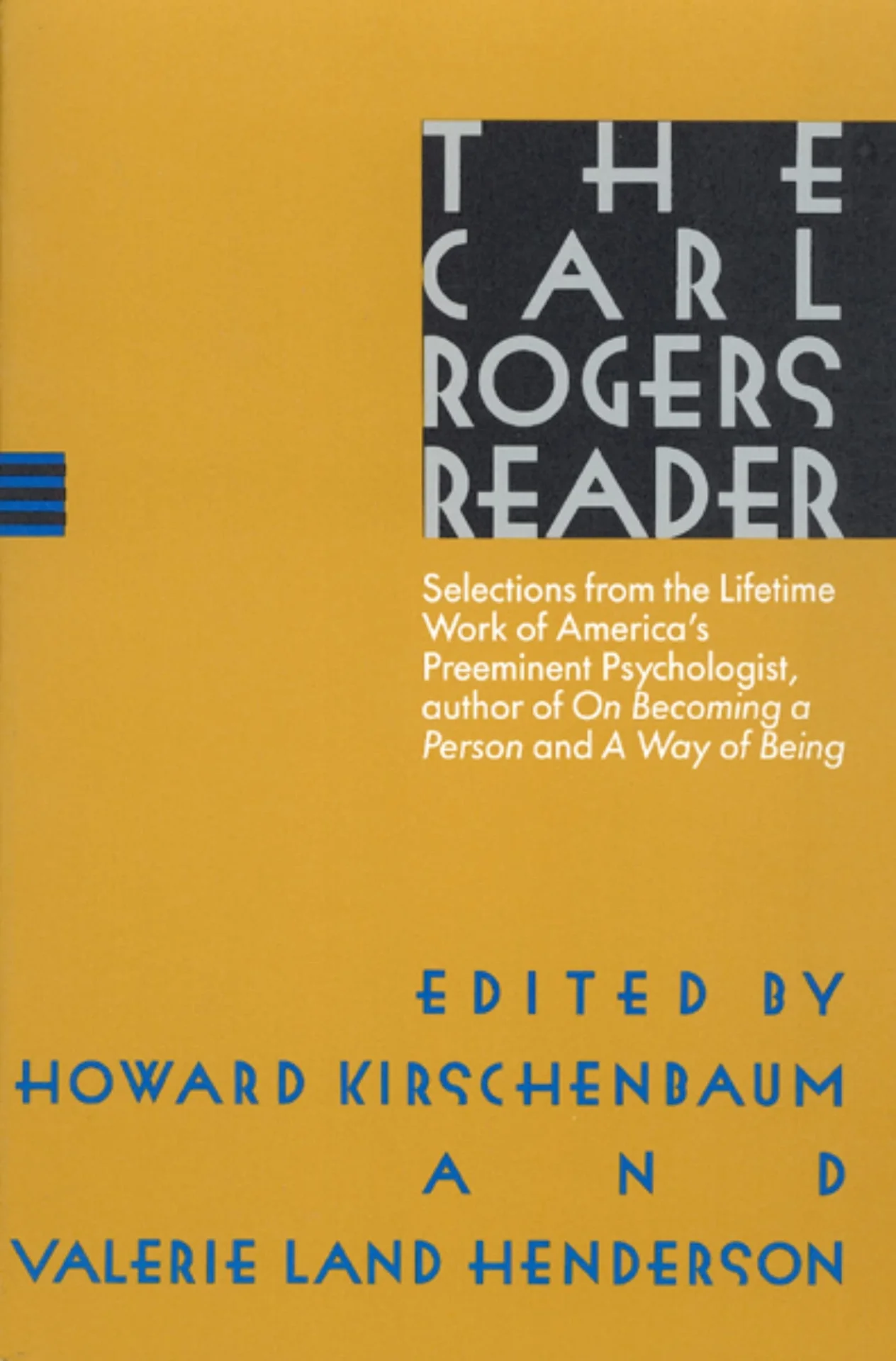
A Carl Rogers Reader
 Carl Rogers
This posthumously completed collection, edited by Howard Kirschenbaum and Valerie Land Henderson, gathers Rogers's most important writings from 1942 to 1987 into a single chronological and thematic portrait. Its central mechanism is the assembly of Rogers's own words—spanning the original non-directive method, the necessary and sufficient conditions, the fully functioning person, and his late-career dialogues on education, community, and nuclear war—to demonstrate that the person-centered approach is a coherent philosophy of living rather than a set of techniques. The editors completed the volume after Rogers's death in 1987, working from selections he had begun to arrange.
Key Details
Related Books
View AllSimilar books from the same category, ranked by shared topics and reader engagement.


Key Insights — Read in 10 Minutes
What is the editorial history of this book, and how did it come to be published after Rogers's death?
During his last year of life, Rogers began work on a one-volume collection of his writings with Howard Kirschenbaum, author of a Rogers biography, and Valerie Land Henderson, his associate of many years. After Rogers died in February 1987, Kirschenbaum and Henderson completed the project . The volume was published in 1989 by Houghton Mifflin . The editors arranged selections from 1942 to 1987 under thematic headings—Speaking Personally, The Therapeutic Relationship, The Person in Process, Theory and Research, A Human Science, Education, The Helping Professions, A Philosophy of Persons, and A More Human World—forming a chronological and topical portrait of Rogers's development .
What does the book include that is not found in Rogers's single-authored volumes?
The Reader's distinctive value lies in its range. It includes early essays such as 'A Newer Psychotherapy' (1942) and 'The Case of Herbert Bryan' (1942), alongside late-career papers like 'On Reaching 85' (1987) and 'Inside the World of the Soviet Professional' (1987) . It gathers material on education (Personal Thoughts on Teaching and Learning, The Politics of Education), group facilitation, nuclear war, and intercultural tensions—domains Rogers addressed in scattered essays but never collected himself. The volume also includes 'Ellen West—and Loneliness' (1961), Rogers's critical response to Binswanger's famous case study, a piece of particular interest to existential and phenomenological readers .
What critical reception did the Reader receive, and what limitations were identified?
A 1990 review in the journal Existential Analysis called the collection 'a success in providing a particularly clear overview of Rogers' work' but noted significant repetition of ideas across the text, acknowledging that extensive editing would have done 'serious injustice' to Rogers's style . The reviewer found the 'Speaking Personally' section the 'least successful—and most irritating,' describing Rogers as 'somewhat shadowy and guarded' and given to 'homilies and vast generalisations' . A Library Journal review praised the arrangement as 'coherent and informative,' noting the volume would interest general readers as well as specialists .
How does the Reader relate to Rogers's earlier major works like On Becoming a Person and Client-Centered Therapy?
The Reader is not a substitute for those volumes but a curated overview that includes representative selections from each. It contains the original 1942 papers establishing non-directive counseling, the 1957 statement of the necessary and sufficient conditions, the 1959 formal theory of therapy and personality, and the 1961 essay on the fully functioning person—the foundational texts later expanded in Client-Centered Therapy and On Becoming a Person . A ThriftBooks reviewer described it as 'an excellent synopsis of Carl Rogers life's work,' a 'short-cut to Dr. Carl' that provides 'an accurate and complete re-telling of the development of Rogerian Client-Centred Therapy' .
What does the book reveal about Rogers's relationship to existential and phenomenological philosophy?
The Reader makes explicit what is often implicit in Rogers's work: his acknowledged debt to existential and phenomenological ideas. The section 'A Philosophy of Persons' includes 'A Note on the Nature of Man' (1957) and 'Do We Need a Reality?' (1978) . The Existential Analysis reviewer found the papers under 'The Therapeutic Relationship' and 'A Philosophy of Persons' particularly valuable for examining 'the phenomenological-existential underpinnings of Rogers' work,' noting that Rogers himself acknowledged the impact of these ideas on his thinking and practice . The volume thus serves as a resource for readers interested in the philosophical foundations of person-centered therapy.
What does the book show about the evolution of Rogers's interests beyond individual therapy?
The Reader's later sections document Rogers's expansion into education, group facilitation, and global conflict resolution. It includes 'Can I Be a Facilitative Person in a Group?' (1970), 'The Politics of Education' (1977), 'Resolving Intercultural Tensions' (1977), 'A Psychologist Looks at Nuclear War' (1982), and 'The Rust Workshop' (1986), an account of a large-group experience in Ireland . The final section, 'A More Human World,' gathers Rogers's late-career writings on social and political applications of the person-centered approach. This trajectory—from individual therapy to education to international conflict—demonstrates that the Reader is as much a record of Rogers's widening ambitions as of his clinical method.
Wealthy Psyche is an intellectual archive. We do not host, distribute, or sell book copies — physical or digital. We provide structured knowledge to help you think better, faster.