


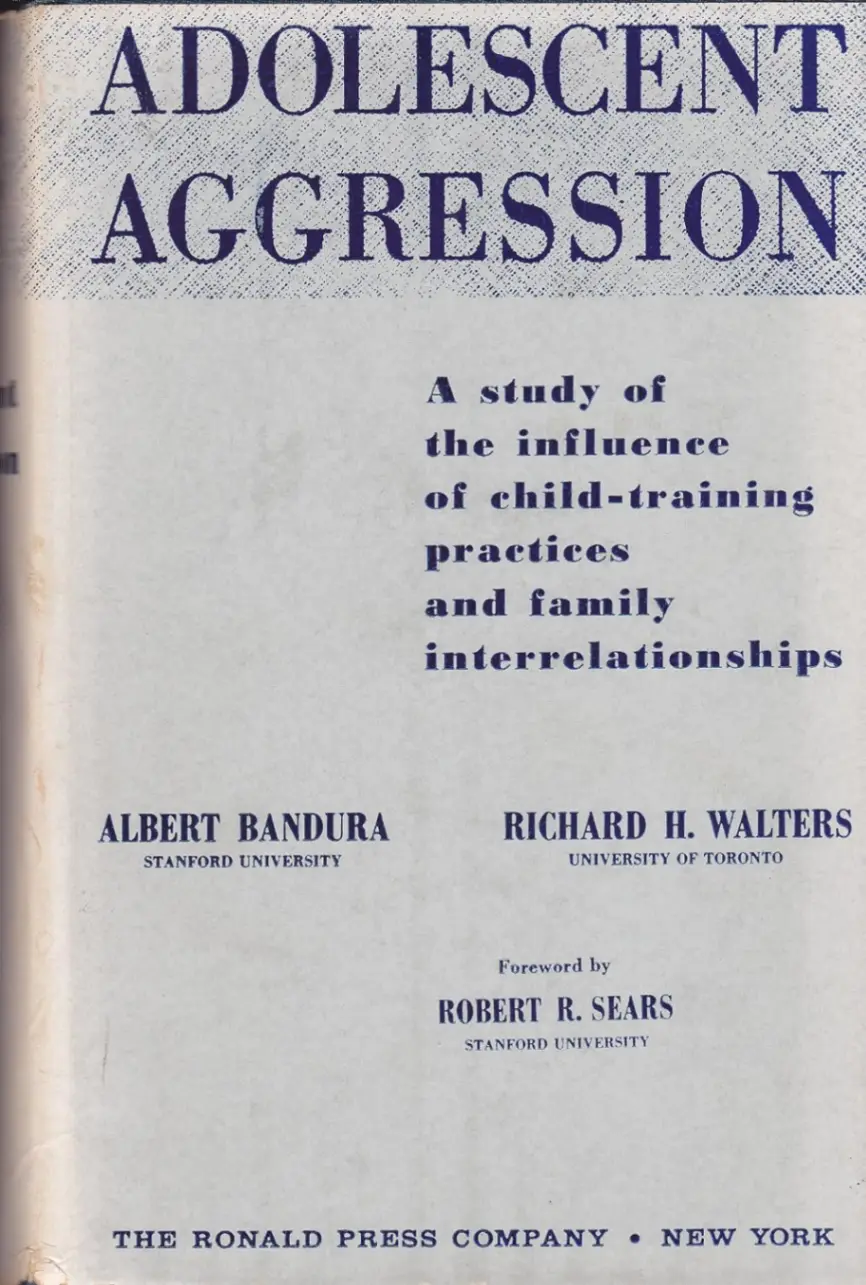
Adolescent Aggression: A Study of the Influence of Child-Training Practices and Family Interrelationships
 Albert Bandura
Bandura and Walters' first book reports a matched-pairs study of 26 aggressive antisocial boys and 26 controls, all white, mid-adolescent, average intelligence, from intact families with employed fathers in non-deteriorated neighborhoods. The central claim is that aggressive antisocial behavior in middle-class boys arises not from constitutional defect or peer-group acculturation but from specific family patterns: affectional deprivation, parental disharmony, inconsistent discipline, and punitive control methods like physical punishment, nagging, and ridicule. The study is the empirical origin of Bandura's social learning approach, showing that family modeling and reinforcement, not simple conditioning, shape aggressive behavior.
Key Details
Related Books
View AllSimilar books from the same category, ranked by shared topics and reader engagement.



Key Insights — Read in 10 Minutes
What was the design of the study reported in Adolescent Aggression?
Bandura and Walters compared 26 adolescent boys with histories of aggressive antisocial behavior against 26 matched controls, all white, aged fourteen-and-a-half to seventeen, of average or above intelligence, from legally intact families with employed fathers in non-deteriorated neighborhoods . The aggressive group had incurred institutionalization, probation, or school guidance referral; controls were described by counselors as neither markedly withdrawn nor aggressive [citation:2]. The selection deliberately eliminated the usual correlates of detected delinquency—social deprivation, broken homes, immigration status—so the study could isolate family dynamics as the distinguishing variable . Data came from guided interviews and Thematic Apperception Tests with both boys and their parents, assessing dependency, aggression, parental restrictions, and identification with parental controls [citation:5].
What were the study's principal findings about parental practices in the aggressive group?
The results confirmed the importance of affectional deprivation and rejection in forming aggressive tendencies. Significant determinants included parental disharmony, inconsistencies in handling the child, and punitive discipline [citation:2]. Parents in the aggressive group relied on physical punishment, nagging, and ridicule to control behavior, while control-group parents more often appealed to reason or withheld privileges [citation:2]. Compared with controls, the aggressive boys were less emotionally dependent on their parents, more anxious about relating to them, more resistant to accepting help or company, and felt significantly more rejected by both parents . Bandura and Walters interpreted these patterns as evidence that frustration of dependency needs, not constitutional defect, predisposed the boys toward antisocial aggression .
How did this study differ from the Healy-Bronner delinquency research that preceded it?
Roy G. Francis noted in his review that both studies emphasized frustration in parent-child relations, but with a key temporal difference. Healy and Bronner's 1936 New Light on Delinquency found delinquents thwarted in early life; Bandura and Walters found that their aggressive boys had experienced sufficient affection during infancy and thus became dependent on their mothers, with frustration occurring later when attempts to obtain dependency gratification were blocked . Methodologically, Healy-Bronner selected subjects from slum areas, while Bandura and Walters deliberately chose middle-class intact families. Francis called the Bandura-Walters monograph the more sophisticated treatment, with a social-psychological theoretical framework and selection that eliminated the usual social correlates of delinquency .
What theoretical framework guided the study's interpretation of its data?
Francis identified the framework as a modified Freudian theory consistent with Robert R. Sears and his associates, who wrote the foreword. The basic motivational root is dependency, emerging from identification with parents in earliest personality formation. Aggression arises when the child cannot handle frustrated dependency needs . This framework was applied using Sears' theoretical and methodological approach, originally developed for nursery-school children, to older subjects. However, the study's emphasis on family modeling and social context rather than simple conditioning marks it as an early step toward Bandura's later social learning theory, which would reject drive-based explanations in favor of observational learning and cognitive mediation [citation:1].
What did reviewers identify as the study's methodological limitations?
John E. Callagan noted that several important variables were uncontrolled, including the presence or absence of the father during World War II, religious influences, and church affiliations [citation:2]. The matched-pairs design, while controlling for socioeconomic status and family structure, could not rule out these unmeasured factors. A more structural limitation is the small sample size—26 pairs—and the specificity of the population: white, middle-class, intact families in non-deteriorated areas. Francis acknowledged that the selection criteria correlated highly with non-delinquency, which was the point: the study isolated family dynamics by eliminating social disadvantage. But this also means the findings do not generalize to delinquency arising from poverty, broken homes, or minority communities, where different causal pathways may operate .
How does Adolescent Aggression relate to Bandura's later book Aggression: A Social Learning Analysis (1973)?
Adolescent Aggression (1959) is the empirical starting point; the 1973 book is the theoretical culmination. The earlier study documents family correlates of aggressive behavior in a specific middle-class adolescent sample using interview and projective data. The 1973 book formulates a general social learning theory of aggression, addressing individual and collective, personal and institutionally sanctioned aggression, and applying social learning principles to reduce harmful aggression [citation:1]. The relationship is one of extension and generalization: the 1959 study provided the initial evidence that family modeling and reinforcement shape aggression; the 1973 book built that evidence into a comprehensive explanatory framework covering media effects, moral disengagement, and social power.
Show 1 more insights
What is the most common misconception about this book's place in Bandura's career?
The most persistent misconception treats Adolescent Aggression as a minor early work preceding the Bobo doll studies, when it is actually the empirical foundation of Bandura's entire theoretical trajectory. Bandura himself stated that his initial research focused on familial origins of antisocial aggression in adolescent boys, finding that social context and modeling within the home played a far more significant role than simple conditioning [citation:1]. This finding directly motivated the social learning approach that later became his signature contribution. A second misconception assumes the book is a study of delinquency generally, when it is specifically a study of middle-class boys whose aggressive behavior cannot be attributed to social deprivation—making family dynamics the only remaining explanation within the study's design .
Wealthy Psyche is an intellectual archive. We do not host, distribute, or sell book copies — physical or digital. We provide structured knowledge to help you think better, faster.