


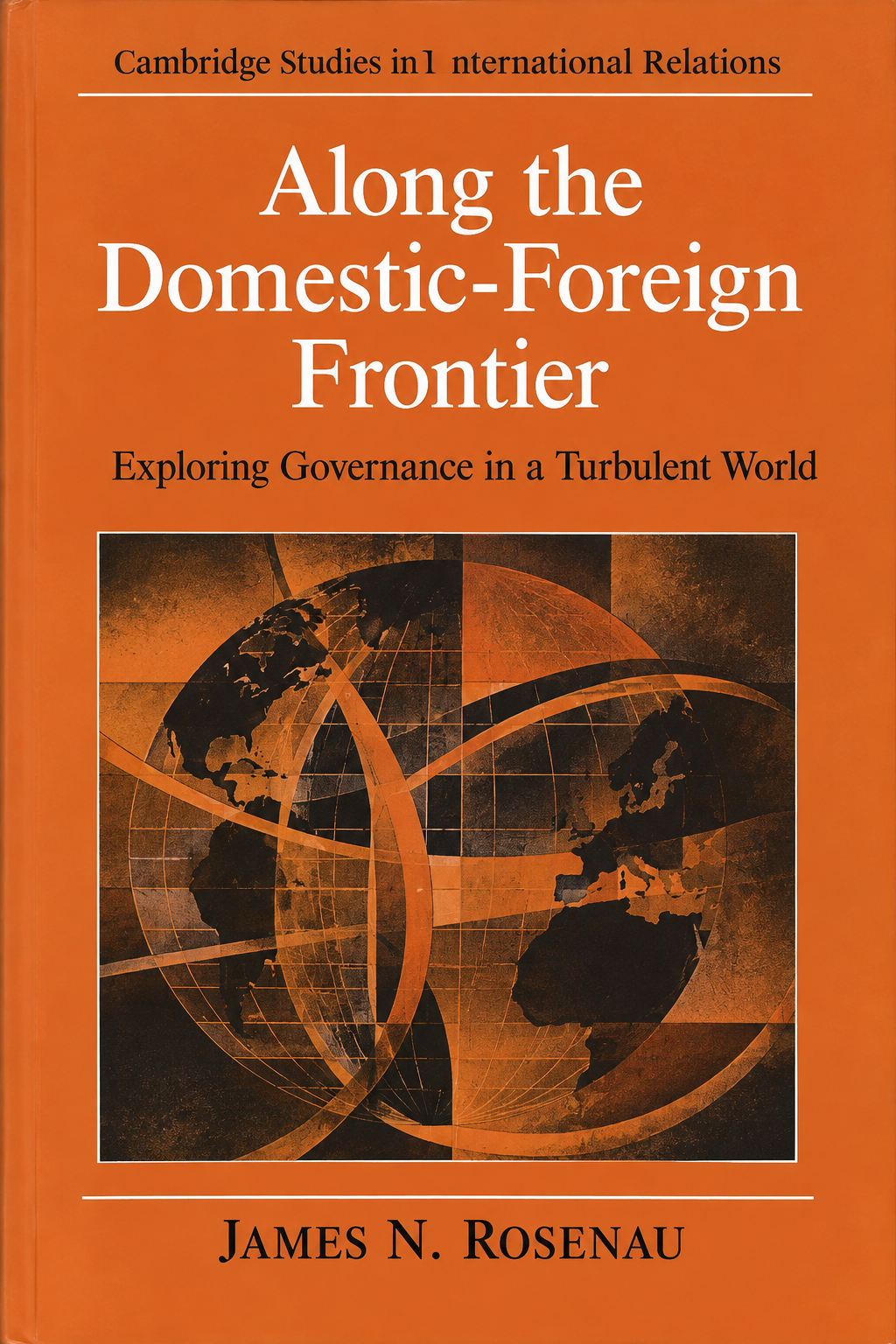
Along the Domestic-Foreign Frontier: Exploring Governance in a Turbulent World
 James N. Rosenau
Rosenau argues that the boundary between domestic and foreign affairs has dissolved, creating a new political space he calls the 'Frontier.' This Frontier is where globalizing forces—economic globalization, new technologies, evolving norms—collide with equally powerful localizing dynamics, producing what he terms 'fragmegration.' The book's central claim is that the quest for control in world politics now unfolds along this Frontier, not in the traditional international arena. States, individuals, NGOs, and other actors compete there to shape outcomes, and effective governance depends on understanding how local, national, and transnational dynamics interweave.
Key Details
Related Books
View AllSimilar books from the same category, ranked by shared topics and reader engagement.

.webp?alt=media&token=a654646a-3c02-4a3a-bb20-421e64251f83)

Key Insights — Read in 10 Minutes
What is the central concept of 'the Frontier' in this book?
Rosenau argues that the traditional boundary separating domestic politics from foreign affairs has eroded, creating a new political space he designates the 'Frontier.' This Frontier is not a geographic border but a conceptual arena where globalizing and localizing forces intersect. It is along this Frontier—not in the conventional international arena—that issues are contested and outcomes configured. The concept challenges the disciplinary divide between comparative politics and international relations, urging analysts to treat domestic and foreign dynamics as a 'seamless web.'
What does Rosenau mean by 'fragmegration'?
Fragmegration is Rosenau's coined term for the simultaneous and interactive processes of fragmentation and integration in world politics. It captures the tension between globalizing forces—economic interdependence, technological diffusion, transnational norms—and localizing forces—ethnic revival, nationalism, and sub-state identities. Rosenau argues these dynamics are not opposites but deeply intertwined, producing the turbulence that characterizes the contemporary era. The concept extends his earlier work on turbulence by specifying the mechanism through which global and local forces collide and reshape political authority.
How does this book build on Turbulence in World Politics?
Rosenau presents Along the Domestic-Foreign Frontier as a direct continuation of Turbulence in World Politics (1990). The earlier book developed the theoretical framework of bifurcated global politics and structural turbulence; this volume applies that framework to specific domains—sovereignty, elections, constitutions, international organizations, and war. In the preface, Rosenau describes the book as 'a set of explorations' using the heuristic model developed in Turbulence, rather than a definitive statement. The Frontier concept operationalizes the earlier theory by identifying where the interactions between state-centric and multi-centric worlds actually occur.
What role does the 'skill revolution' play in Rosenau's argument?
The 'skill revolution' refers to Rosenau's observation that individuals worldwide have become more analytically capable, better able to organize, and more resistant to authority. Francis Fukuyama, reviewing the book, highlighted this as one of Rosenau's most interesting arguments. The skill revolution explains why governance increasingly bubbles up from below rather than being imposed from above: private-sector and non-governmental actors now possess the capacities once reserved for states. This micro-level change is a key driver of the macro-level transformation Rosenau describes, enabling individuals and groups to contest control along the Frontier.
What specific domains does the book examine through the Frontier lens?
The book covers a wide range of contexts and actors, organized into five parts. Part II examines global contexts including globalization, boundaries, norms, and environments. Part III analyzes societal contexts such as sovereignty, constitutions, and elections. Part IV focuses on actors including individuals, publics, leaders, organizations, states, militaries, and the United Nations. Part V concludes with democracy, war and peace, and an exploration of governance in a turbulent world. This breadth reflects Rosenau's stated preference to address 'multiple causes, cope with subtle nuances, and trace contradictions' rather than oversimplify.
What was the critical reception of the book?
The book received substantial scholarly attention upon publication in 1997. Foreign Affairs published a review by Francis Fukuyama, who engaged seriously with Rosenau's argument about long-term shifts in underlying conditions. Choice described it as relocating 'politics and governance from their traditional domestic and international settings to a frontier between the two.' Tony McGrew in the American Journal of Sociology called it 'essential reading for anyone interested in the forces that are transforming modern societies.' A review in American Political Science Review noted the book's complexity, describing it as 'a complex thesis, arguably at the frontier of relevant political thought.'
Show 1 more insights
What is a common misconception about the book's argument?
A frequent misreading is that Rosenau is predicting the disappearance of the state or the end of sovereignty. His argument is more nuanced: states remain important actors, but their authority is increasingly contested along the Frontier by non-state actors with expanding capabilities. The book examines sovereignty as one domain among many, not as a casualty of globalization. Rosenau's recurring theme is the challenge of achieving governance in a turbulent world, not the inevitable triumph of non-state forces. He explicitly acknowledges that questions remain unanswered and gaps need filling.
Wealthy Psyche is an intellectual archive. We do not host, distribute, or sell book copies — physical or digital. We provide structured knowledge to help you think better, faster.