


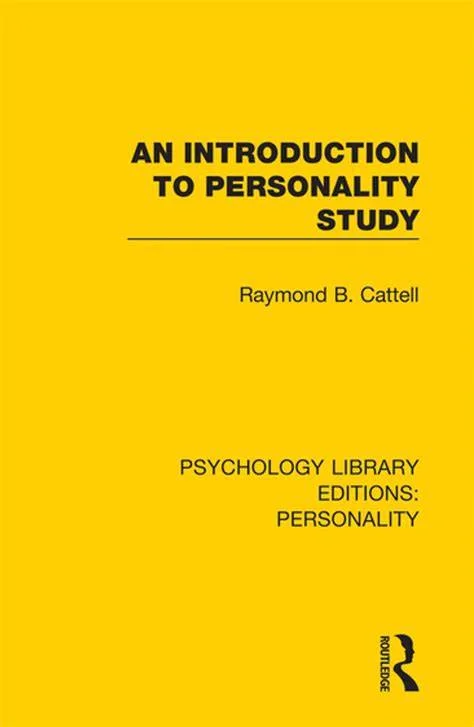
An Introduction to Personality Study
 Raymond Bernard Cattell
Published in 1950 as a concise alternative to Cattell's larger systematic textbook, this book argues that personality study must be grounded in factor-analytic methodology from the outset, even for beginners. Cattell presents his tripartite system—hereditary ergs, environmental metanergs, and the dynamic lattice of sentiments—as the integrated framework capable of unifying clinical, experimental, and psychometric observations. He explicitly substitutes his technical vocabulary for traditional concepts like instinct and drive, and defends the view that personality description, measurement, and development can be treated within a single scientific perspective.
Key Details
Related Books
View AllSimilar books from the same category, ranked by shared topics and reader engagement.


Key Insights — Read in 10 Minutes
What is the central claim of An Introduction to Personality Study, and what does it reject?
Cattell's central claim is that personality must be studied through factor-analytic methodology from the very beginning, even in an introductory text, because only this quantitative approach can yield genuine scientific laws of personality structure and development. He rejects the intuitive, semantic, and popular methods that dominated personality psychology, arguing that students who find simple algebra or geometry too difficult should not be studying so complex a subject as psychology . The book also rejects traditional terminology: Cattell substitutes his own concepts of ergs and metanergs for the older language of instinct, drive, and need, which he regarded as imprecise and burdened by misleading connotations .
What specific conceptual innovations does Cattell introduce in this book?
The book introduces three innovations that Cattell himself identified. First, it presents the essentials of factor analysis in simplified spatial and geometrical form, making the method accessible to beginners . Second, it substitutes the term "erg" for instinct, drive, or need—a concept reflecting hereditary determination of dynamic motivation, paired with "metanerg" for environmentally acquired motives . Third, it introduces "adaptation-adjustment analysis," a system of six dynamic crossroads (stimulated drive, initial frustration, failure of aggression, anxiety and renunciations, fate of repression, and neurotic reactions) that integrates psychoanalytic and experimental studies of adjustment . These innovations are the book's distinctive contribution to Cattell's evolving system.
How does this book relate to Cattell's larger textbook, Personality: A Systematic Theoretical and Factual Study?
The relationship is explicitly derivative. Contemporary reviews describe the 1950 book as a "small book" that compresses "much of the material which went into the same author's larger textbook on Personality: A Systematic Theoretical and Factual Study" . Another reviewer calls it an "abridged version" of the larger text . Cattell intended it as a concise introduction for "the intelligent, analytical student, desiring to come to grips with basic laws," rather than as an independent work . Readers seeking the full exposition of Cattell's system should consult the larger textbook; this volume provides a compressed, accessible summary with the same theoretical commitments.
How did contemporary reviewers evaluate the book's accessibility and its treatment of rival approaches?
Reviews were mixed on accessibility. One reviewer noted the book "would certainly be considered difficult by most students who are not already familiar with the subject," citing the use of technical terms like "factor loading" and "correlation coefficient" before they are explained, as well as frequent neologisms . Alfred Baldwin, reviewing in Psychological Bulletin, observed that despite Cattell's belief that he presented a consensus of psychological opinion, "he generally states only his own position, and unfortunately he frequently treats alternative positions with open contempt" . As a presentation of Cattell's position, however, Baldwin found it "clear and readable, logically organized, and well worth reading" .
What criticisms did reviewers raise about Cattell's treatment of psychoanalytic concepts and clinical material?
The most substantive criticism concerned the status Cattell granted to unverified clinical observations. One reviewer objected that Cattell's "adaptation-adjustment analysis" integrated psychoanalytic mechanisms into a systematic framework despite the fact that such observations "may have a place in the psychiatrist's consulting-room" but "should be sharply distinguished from operational concepts firmly established and isolated by means of proper scientific methodology" . The reviewer regretted that Cattell gave clinical concepts "equal status" after insisting throughout the rest of the book on proper validation and verification. Baldwin similarly noted that "the meaning of differentiation and fusion is not clear," making the distinction between this process and subsidiation unclear . These criticisms target the tension between Cattell's scientific rhetoric and his incorporation of speculative psychodynamic material.
What is a common misconception about this book that readers should avoid?
A frequent misconception is that this is a neutral, ecumenical introduction suitable for any beginner in personality psychology. It is not. Cattell wrote it as a vehicle for his own system, and reviewers consistently noted that he presented his position as if it were the consensus while dismissing alternatives . Another misconception treats the book as a simplified, watered-down version of Cattell's theory that can substitute for his larger works. While it is shorter and more accessible, it retains the technical apparatus of factor analysis and introduces idiosyncratic terminology (ergs, metanergs, dynamic lattice) that requires substantial background. It is an introduction to Cattell's personality study, not to the field as a whole.
Wealthy Psyche is an intellectual archive. We do not host, distribute, or sell book copies — physical or digital. We provide structured knowledge to help you think better, faster.