


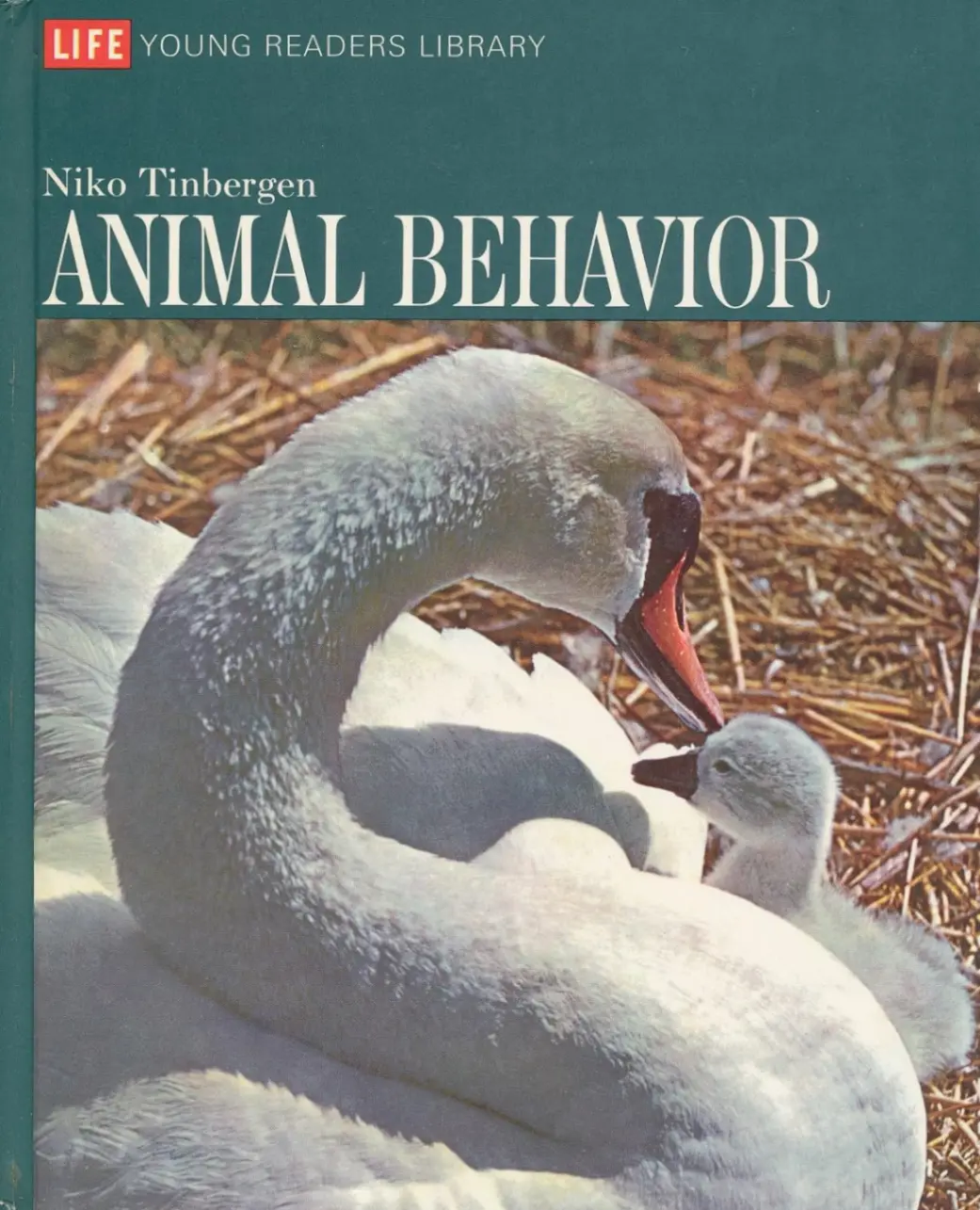
Animal Behavior
 Niko Tinbergen
Tinbergen argues that animal behavior can be understood by asking four distinct questions: what causes it, how does it develop, what is its survival value, and how did it evolve? Written for a general readership as part of the Life Nature Library, the book illustrates these questions through experiments and observations on herring gulls, digger wasps, sticklebacks, and other species. Its central method is to isolate the specific sign stimuli—the red patch on a gull's bill, the shape of an egg—that release behavior, revealing that animals respond to key features of their environment rather than to whole objects.
Key Details
Related Books
View AllSimilar books from the same category, ranked by shared topics and reader engagement.


Key Insights — Read in 10 Minutes
How does Animal Behavior present Tinbergen's four questions, and why are they separated rather than merged?
The book organizes its eight chapters around what would become Tinbergen's canonical four questions: causation (what stimuli and mechanisms produce behavior?), development (how does behavior change with age and experience?), survival value (what does the behavior accomplish?), and evolution (how did it arise in the species' history?). Tinbergen separates them because confusing one with another leads to errors—for example, assuming that because a behavior is useful it must be performed deliberately for that usefulness. Written for the Life Nature Library series, the book uses plain language rather than technical terminology, discussing 'signs animals respond to' and 'the machinery that makes things go' instead of sign stimuli and proximate mechanisms.
What specific studies and experiments does Tinbergen use to illustrate his method?
The book draws heavily on Tinbergen's own field research, particularly his herring gull studies. He describes experiments with artificial eggs of varying shapes and sizes to show that incubating gulls respond to specific features—roundness, size, and position—rather than to their own eggs individually. The gull chick pecking experiments demonstrate that chicks respond to the red patch on the parent's bill, and that a model with an exaggerated red patch elicits even more pecks. He also discusses digger wasps locating their burrows by landmarks, sticklebacks responding to the red undersides of rival males, and the courtship sequences of butterflies and fish. These examples are chosen to show that behavior can be dissected experimentally rather than merely described.
How does this book relate to Tinbergen's more technical work The Study of Instinct?
Animal Behavior (1965) is a popularization of the framework Tinbergen developed in The Study of Instinct (1951). The earlier book was a comprehensive scientific synthesis addressed to a professional audience, introducing ethology's core concepts—innate releasing mechanisms, sign stimuli, fixed action patterns—and establishing the four questions. Animal Behavior adapts that material for general readers, retaining the experimental demonstrations but stripping away academic apparatus and technical vocabulary. Tinbergen wrote it as part of the Time-Life Nature Library, a series aimed at educated laypeople. The book thus serves as an accessible entry point to the same ideas, though it lacks the theoretical depth and scholarly citations of The Study of Instinct.
What did contemporary reviewers say about the book's scientific and educational value?
A review in the French journal La Terre et La Vie praised it as difficult to imagine a better introduction to the study of animal behavior, describing it as an elegant volume written by one of the masters of modern ethology. The reviewer noted that in eight short but rich chapters, Tinbergen exposes readers to the problems ethologists attempt to solve and the techniques used in analysis. The illustrations—diagrams and photographs—were singled out for integrating remarkably well with the text. The book was aimed at a broad audience, and the reviewer predicted it would stimulate vocations among the tens of thousands of young readers who would make it a favorite.
How has the book's treatment of animal behavior aged, and what remains valuable?
Some of the specific experiments described—particularly those involving deprivation, surgical intervention, or stressful procedures on animals—reflect mid-twentieth-century research norms that would not meet current ethical standards. A Goodreads reviewer noted that these famous experiments 'are not commensurate with current ideas about animal welfare'. The book's production values also show their age: most photographs are in black and white, and the diagrams use an old-fashioned color-block printing method. However, the core methodological framework—the four questions and the experimental demonstration that animals respond to sign stimuli—remains foundational in behavioral biology. The book endures as a historical document of ethology's popularization and as a clear introduction to Tinbergen's approach.
Wealthy Psyche is an intellectual archive. We do not host, distribute, or sell book copies — physical or digital. We provide structured knowledge to help you think better, faster.