


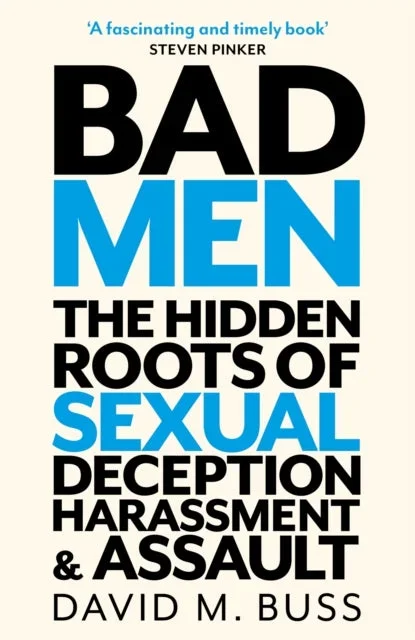
Bad Men: The Hidden Roots of Sexual Deception, Harassment and Assault
.webp?alt=media&token=ead19a6b-0711-40b9-8688-4dd07e665520) David Michael Buss
David Michael BussBuss argues that sexual conflict between men and women arises from a co-evolutionary arms race rooted in ancestral mating strategies. Men evolved short-term mating tactics—including deception, sexual overperception, and coercion—while women evolved defenses against them. The book proposes that a subset of men, particularly those scoring high on the Dark Triad of narcissism, Machiavellianism, and psychopathy, are disproportionately likely to inflict sexual harm. Buss contends that understanding these evolved psychological mechanisms can inform prevention without excusing the behavior.
Key Details
Related Books
View AllSimilar books from the same category, ranked by shared topics and reader engagement.


Key Insights — Read in 10 Minutes
What is the central argument of Bad Men, and what does it reject?
Buss argues that sexual conflict—ranging from dating deception to harassment and assault—originates in a co-evolutionary arms race between male and female mating strategies that unfolded over deep evolutionary time. Men evolved short-term mating tactics including deception, sexual overperception (misreading women's friendliness as sexual interest), and in extreme cases coercion; women evolved defenses against these tactics. The book rejects two opposing views: that sexual violence is purely a product of patriarchal culture with no evolutionary basis, and that evolved tendencies excuse or justify harmful behavior. Buss insists that understanding evolutionary roots is a precondition for effective prevention, not a form of biological determinism.
What specific concept does the book introduce as its unifying framework?
The book's central organizing concept is the "co-evolutionary arms race" of sexual conflict, adapted from evolutionary biology to explain human mating psychology. Buss proposes that men's adaptations for short-term mating—such as sexual overperception bias and commitment deception—created selection pressure for women's counter-adaptations, including vigilance against deceptive suitors and sensitivity to red flags. He identifies the Dark Triad of narcissism, Machiavellianism, and psychopathy as the personality cluster most associated with men who inflict sexual harm. The framework synthesizes over three decades of Buss's research and has been praised by Robert Sapolsky as "a major contribution to the field."
How does Bad Men relate to Buss's earlier work, particularly The Evolution of Desire and The Dangerous Passion?
Bad Men extends the framework Buss developed across his career. The Evolution of Desire (1994) mapped mate preferences and selection strategies; The Dangerous Passion (2000) analyzed jealousy as a defense against infidelity threats. Bad Men shifts focus to the dark side of mating—what happens when sexual strategies conflict rather than align. Buss treats this book as the culmination of a trilogy exploring attraction, retention, and now harm. Reviewers have noted that Bad Men is more explicitly applied than its predecessors, addressing contemporary issues like #MeToo, online dating deception, and workplace harassment while maintaining the evolutionary theoretical spine.
What criticisms have been leveled at the book's argument and methodology?
Critics have raised several concerns. Some argue that Buss overemphasizes evolutionary explanations while understating cultural, structural, and power-based factors that shape sexual violence—a critique voiced by feminist scholars who contend that invoking evolution risks naturalizing male aggression. Others question the Dark Triad framework's specificity, noting that most men high in these traits do not commit assault. Methodological critics point to reliance on self-report surveys and hypothetical scenarios, which may not predict real behavior. Buss has responded that acknowledging evolutionary origins does not entail inevitability, and that he explicitly condemns the behaviors he analyzes.
How has the book been received within and outside academia?
Bad Men received substantial endorsement from prominent scholars including Steven Pinker, Robert Sapolsky, Leda Cosmides, Jonathan Haidt, and Richard Wrangham. The Times called it "fascinating" and comprehensive; Areo praised it as "explanatorily powerful and pragmatically useful." The book also generated discussion in popular media during the #MeToo era, with reviewers noting its timely intervention. Outside academia, some readers found the evolutionary framing uncomfortable or deterministic, while others appreciated what they described as a balanced, evidence-driven approach to painful topics. The book was published simultaneously in the US under the title When Men Behave Badly.
How is the book related to the US edition titled When Men Behave Badly?
Bad Men and When Men Behave Badly are the same book published under different titles for different markets. The UK edition (Little, Brown Book Group) carries the title Bad Men: The Hidden Roots of Sexual Deception, Harassment and Assault, while the US edition uses the title When Men Behave Badly. Both contain identical content. This dual-title strategy is a marketing decision, not an editorial revision. Readers searching for one title should be aware they are obtaining the same work regardless of which cover they encounter.
Wealthy Psyche is an intellectual archive. We do not host, distribute, or sell book copies — physical or digital. We provide structured knowledge to help you think better, faster.