


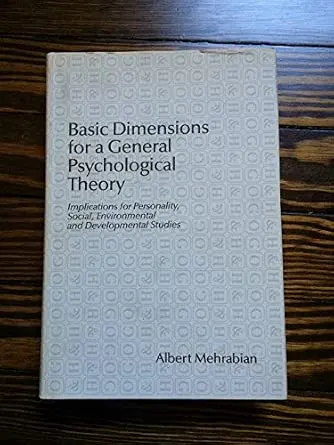
Basic Dimensions for a General Psychological Theory
 Albert Mehrabian
Mehrabian's 1980 book is a unifying manifesto: the pleasure-arousal-dominance (PAD) emotional state model is presented not as one framework among many but as the basic dimensional base for psychological theory itself. It argues that temperament—the average emotional state across representative life situations—can be measured on three nearly orthogonal dimensions (trait pleasure, trait arousability, trait dominance), and that diverse individual-difference measures, from personality scales to environmental responses, can be analyzed in terms of these dimensions. The book extends PAD from environmental psychology into personality, social, and developmental domains.
Key Details
Related Books
View AllSimilar books from the same category, ranked by shared topics and reader engagement.



Key Insights — Read in 10 Minutes
What is the central claim of Basic Dimensions, and how does it differ from Mehrabian's earlier PAD work?
The book argues that the pleasure-arousal-dominance model is not merely a framework for environmental psychology but the foundational dimensional base for psychological theory generally. In An Approach to Environmental Psychology (1974), PAD mediated between environmental stimuli and approach-avoidance behavior. Here Mehrabian extends the model into temperament: an individual's average emotional state across representative life situations. Trait pleasure, trait arousability, and trait dominance become the basic dimensions for analyzing personality measures, social behavior, and developmental patterns. The shift is from PAD as environmental mediator to PAD as universal psychological taxonomy.
What is the temperament model presented in the book, and how is it measured?
Temperament is defined as the average emotional state across a representative sample of life situations. The model consists of three nearly orthogonal dimensions: Trait Pleasure-displeasure, Trait Arousability (an alternative to trait arousal), and Trait Dominance-submissiveness. Reliability and validity data were presented for three orthogonal measures of temperament, with KR-20 reliability coefficients reported for the scales . The book provides evidence relating the PAD Temperament Model to individual difference measures, including analyses of personality scales in terms of the basic temperament dimensions.
How does Robert Hogan's review characterize the book's strengths and its central weakness?
Hogan's 1982 review in Contemporary Psychology, titled 'The Anchor Is Missing,' acknowledged that emotions probably do underlie and give structure to much of social life, and praised the sophisticated statistical analyses—'the quality of the number crunching is of a very high order' . The review's title signals the critique: the book lacks a theoretical anchor. Hogan's assessment positions the work as methodologically rigorous but conceptually unmoored, with the PAD framework applied broadly without sufficient theoretical justification for why these three dimensions, rather than others, should serve as the universal base.
What specific personality analyses does the book present?
The book includes analyses of personality measures in terms of basic dimensions of temperament, drawing on work published in the Journal of Personality and Social Psychology. It examines how standard personality scales map onto trait pleasure, trait arousability, and trait dominance. The framework is applied to diverse individual-difference measures, including arousal-seeking tendency, stimulus screening, and predispositions relevant to eating characteristics. The book's subtitle signals this breadth: implications for personality, social, environmental, and developmental studies. The analyses aim to show that a three-dimensional temperament model can subsume many existing personality constructs.
What did the book promise about psychological research that its review found lacking?
The book opens with a dedication to the ideal that psychological research might someday be conducted free from petty institutional constraints, professional and broader sociopolitical fashions, economic handicaps, and with the researcher's choice of objectives . Hogan's review opens by quoting this passage as 'eloquent and altogether moving.' The tension between this aspiration and the review's 'missing anchor' verdict frames the book as a plea for theoretical unification that, in Hogan's assessment, did not fully deliver the unifying principle it sought.
How does the book relate to Mehrabian's subsequent work on eating characteristics and temperament?
The PAD Temperament Model developed in Basic Dimensions became the foundation for Mehrabian's later applications. His 1987 book Eating Characteristics and Temperament: General Measures and Interrelationships explicitly builds on this framework, analyzing predispositions to obesity and anorexia in terms of the three temperament dimensions. The temperament model also informed analyses of loneliness, shyness, conformity, and optimism-pessimism. These applications represent the 'developmental studies' dimension of the original subtitle, as the basic dimensions were extended to clinical and health-related individual differences.
Wealthy Psyche is an intellectual archive. We do not host, distribute, or sell book copies — physical or digital. We provide structured knowledge to help you think better, faster.