


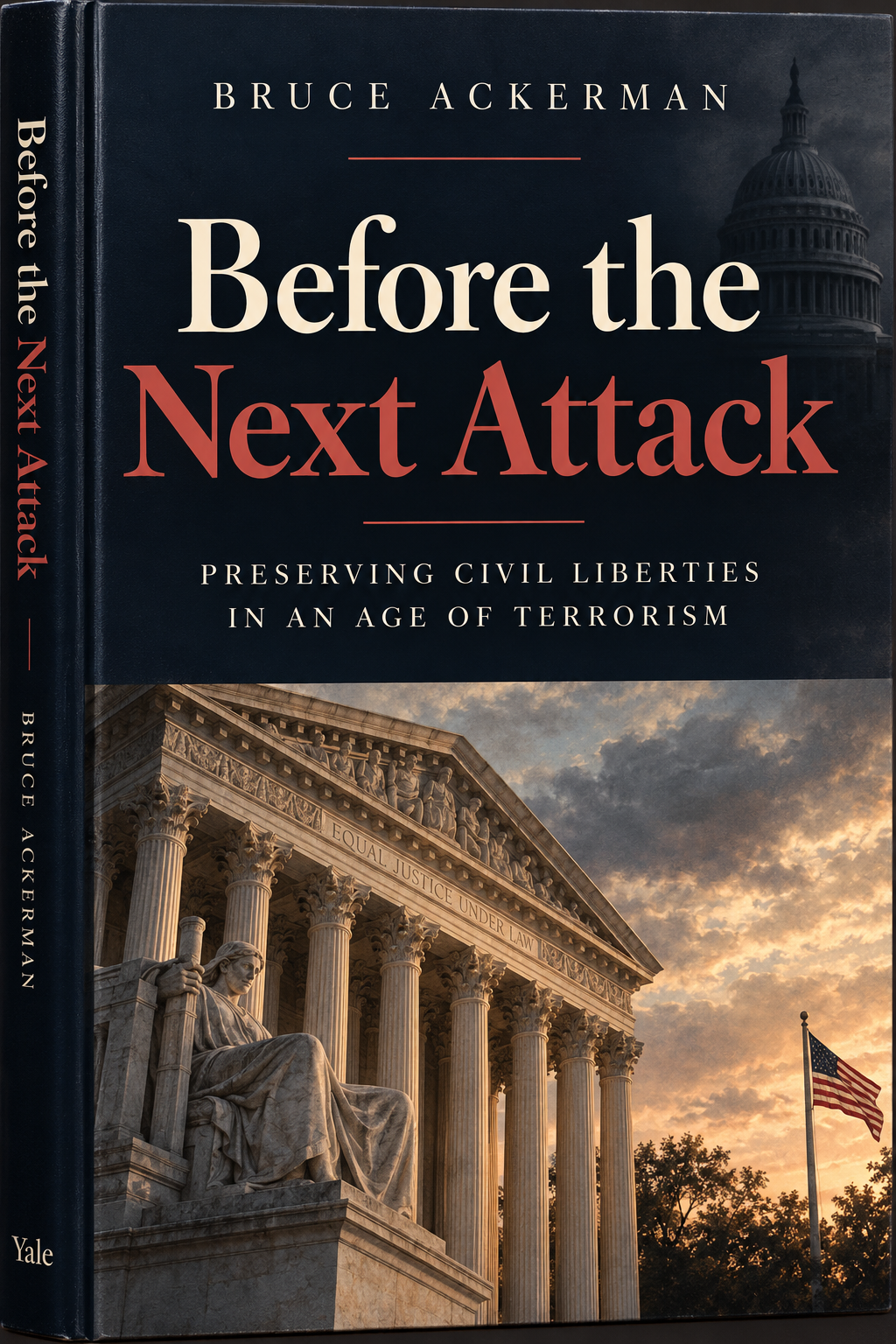
Before the Next Attack: Preserving Civil Liberties in an Age of Terrorism
 Bruce Ackerman
Ackerman's Before the Next Attack argues that the 'war on terror' and criminal justice are both inadequate paradigms for responding to terrorism, and that the correct framework is a legally defined state of emergency. His central mechanism is the 'supermajoritarian escalator': a framework statute that grants the president temporary emergency powers, but requires increasingly large congressional majorities to renew them over time — 60%, then 70%, then 80%. This design aims to enable decisive short-term action to prevent a second strike while preventing the permanent normalization of emergency powers that would erode civil liberties over the long run.
What is the 'supermajoritarian escalator,' and how does it differ from other emergency power proposals?
The supermajoritarian escalator is Ackerman's key innovation: a framework statute that grants the president temporary emergency powers, but requires increasingly large congressional majorities to extend them over time. After an initial short period, a simple majority can extend the emergency for two to three months; beyond that, 60 percent is needed, then 70, then 80 for each subsequent period [citation:4][citation:19]. This differs from both the war paradigm (which grants open-ended authority) and criminal justice (which lacks preventive capacity). The escalator's purpose is to ensure that emergency measures remain temporary and that sustained repression requires ever-broadening political consensus.
Why does Ackerman reject both the 'war' and 'crime' frameworks for counterterrorism?
Ackerman argues that the war paradigm escalates fear and executive power without sufficient evidence, treating terrorists as existential threats when they are not: 'Osama in his cave doesn't remotely resemble the totalizing threat of Hitler in his chancellery' [citation:19]. The criminal justice paradigm, meanwhile, is designed for punishment after the fact, not prevention of catastrophe, and does not speak to how individual rights should be treated outside criminal prosecutions [citation:4]. His alternative is the 'emergency' framework, which acknowledges the need for preventive action while subjecting it to strict temporal and supermajoritarian limits.
What specific emergency powers does Ackerman's proposal authorize?
Ackerman's emergency constitution would permit dragnet arrests, quarantines, warrantless searches, and suspension of habeas corpus, but only in accordance with strict rules and for short, fixed terms [citation:19]. His specific proposal for preventive detention allows the government to detain suspects for up to forty-five days on 'reasonable suspicion,' after which they must be released or charged. Those not charged or acquitted would be compensated at $500 per day, with punitive damages available if prosecutors lied to justify detention [citation:8]. The aim is to give the president decisive short-term power while sharply limiting the duration to preserve long-term liberties.
What is the most common criticism of Ackerman's emergency constitution proposal?
Critics argue that the proposal is fundamentally flawed for three reasons: there is no reason to believe preventive detention without judicial review is necessary or sufficient to protect against a second attack; the provision would not forestall other civil liberties abuses; and the preference for legislative over judicial checks is unsupported by the historical record, which shows courts have been more reliable than Congress in protecting vulnerable rights [citation:8]. Others note that nothing prevents Congress from abandoning the supermajority requirement by simple majority when the time comes, and that the executive's control over threat information would impair Congress's checking capacity [citation:4].
How does this book relate to Ackerman's other work on constitutional moments?
Before the Next Attack applies Ackerman's broader constitutional theory to the specific problem of counterterrorism. Where We the People and The Failure of the Founding Fathers analyze how constitutional change occurs through transformative political moments, this book addresses how constitutional institutions should be designed to withstand the pressures of a sustained security crisis. The 'emergency constitution' is a framework statute — a legislative enactment that structures future decision-making — rather than a constitutional amendment, reflecting Ackerman's interest in how ordinary legislation can serve constitutional functions. It was co-winner of the 2006-2007 Scribes Book Award for best law book [citation:5].
What historical examples does Ackerman draw on to support his argument?
Ackerman explores emergency provisions in constitutions ranging from France to South Africa, retaining aspects that work and adapting others [citation:3][citation:5]. He gives particular attention to the South African constitution's emergency provisions, which were written to correct the previous apartheid regime's long-term abuse of emergency powers — a pedigree that reflects Ackerman's concern about the 'permanent war state' [citation:19]. He also examines British reactions to terrorist attacks and historical American precedents including the Palmer Raids, Japanese internment, and post-9/11 detention campaigns, showing that mass preventive detention has never actually prevented terrorism [citation:8].
Wealthy Psyche is an intellectual archive. We do not host, distribute, or sell book copies — physical or digital. We provide structured knowledge to help you think better, faster.