


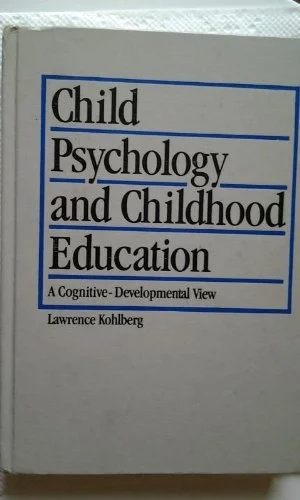
Child Psychology and Childhood Education: A Cognitive-Developmental View
 Lawrence Kohlberg
Kohlberg's final book argues that development itself—not the transmission of fixed content—should be the aim of early education. Written with seven collaborators, it applies the cognitive-developmental paradigm to children aged three to ten, treating the young child as an active philosopher who constructs knowledge through stage-based interaction with the world. The volume reviews three competing educational psychologies—romanticism, cultural transmission, and cognitive-developmental—and defends the third as the only framework that respects the child's constructive role in intellectual, social, and moral growth.
Key Details
Related Books
View AllSimilar books from the same category, ranked by shared topics and reader engagement.



Key Insights — Read in 10 Minutes
What is the central thesis of Kohlberg's final book, and what does it reject about early education?
Kohlberg argues that the aim of early education should be development itself—the stimulation of stage progression—rather than the transmission of culturally prescribed content. He rejects two dominant alternatives: romanticism (Rousseau to A.S. Neill), which leaves the child to unfold naturally without structured stimulation, and cultural transmission (Locke, Thorndike, Skinner), which treats the child as a passive recipient of adult knowledge. The cognitive-developmental view, by contrast, treats the child as an active philosopher whose interactions with the world drive structural reorganization. Education should provoke cognitive conflict that moves children toward more adequate stages of reasoning.
What is the structure of the book, and who were Kohlberg's collaborators?
The book divides into two parts across nine chapters. Part 1 reviews educational psychologies and articulates development as the aim of education. Part 2 covers specific developmental domains: intelligence (psychometric and Piagetian measures), language and thought, social-self theories of Baldwin, Mead, and Vygotsky, moral judgment and action, ego development, and play. Kohlberg wrote or coauthored all chapters with seven colleagues: Rheta DeVries, Greta Fein, Daniel Hart, Rochelle Mayer, Gil Noam, John Snarey, and James Wertsch. The volume runs 452 pages and was published by Longman in 1987.
How does the book treat the tension between behaviorist and cognitive-developmental approaches to early education?
Kohlberg traces this tension to its historical roots: Dewey's progressivism versus Thorndike's behaviorism in early twentieth-century America. He argues that behaviorism's cultural transmission model treats the child as a container to be filled, ignoring the structural transformations that characterize cognitive development. While acknowledging that behaviorist methods can produce surface-level compliance, Kohlberg contends they cannot foster the deeper reorganization of reasoning that constitutes genuine development. The book's first chapter offers a historical account of how cognitive-developmental thinking emerged as a distinct alternative to both romantic laissez-faire and behavioral engineering.
What does Kohlberg mean by treating 'the young child as a philosopher,' and how does this shape his educational recommendations?
Kohlberg means that even very young children actively construct theories about the world—about reality, causation, and morality—rather than passively absorbing adult beliefs. The chapter 'The Young Child as a Philosopher' illustrates this through examples like peek-a-boo, where children explore the nature of reality and appearance. Educationally, this implies that teachers should engage children's existing theories and create situations that provoke cognitive conflict, rather than simply presenting correct answers. The goal is to stimulate the child's own constructive activity, not to replace one set of content with another.
How did contemporary reviewers assess the book's contribution when it was published?
Reviews were mixed. CHOICE Magazine called it a 'landmark exposition of Kohlberg's views' essential for libraries serving psychologists and educators. Peter Sutherland in a British journal, however, described it as 'a curate's egg'—scholarly and wide-ranging but lacking a unifying theme, with dense prose and an unfair treatment of alternative perspectives. He noted that despite Kohlberg's claim to address both development and education, the book remained centered on academic theory rather than practical guidance for teachers. Reviewers agreed it was a major reference work, not an accessible guide for practitioners.
What is the significance of this being Kohlberg's last book, and what does it reveal about his unfinished agenda?
Published in 1987, the year of Kohlberg's death, the book represents his final statement on child development and education. Reviewers noted the absence of a synthetic final chapter that might have addressed criticisms from Gilligan, Fowler, and constructivist critics of stage theory. The volume's range—intelligence, language, ego development, play, moral judgment—shows Kohlberg surveying domains beyond his primary focus on moral reasoning. Sutherland observed that the book would have benefited from Kohlberg's ultimate response to his critics, which never came. It remains a comprehensive sourcebook rather than a culminating synthesis.
Show 2 more insights
How does the book's treatment of ego development connect to Kohlberg's moral stage theory?
The chapter on ego development surveys theorists including Loevinger, Selman, and Kegan, and reassesses Erikson's influence on moral development—a particular feature of the volume. Kohlberg argues that ego development and moral development are related but distinct: ego stages concern the self's organization and boundaries, while moral stages concern justice reasoning. He treats ego development as providing structural conditions that enable but do not determine moral stage progression. The chapter reflects Kohlberg's effort to situate his theory within a broader developmental framework rather than treating moral judgment in isolation.
What practical educational guidance does the book offer, and why have critics found it insufficient?
The book offers broad principles—development as the aim, the child as active constructor, education as provocation of cognitive conflict—but few concrete methods for teachers. Critics like Sutherland noted that references to education are 'so broad and couched in such intellectual terms as to be of little practical use' for teachers of three- to ten-year-olds. Kohlberg claimed the book addressed both child development and education equally, but reviewers found it weighted heavily toward academic theory. The 'just community' approach, which offers more practical guidance, appears more fully in the companion volume Lawrence Kohlberg's Approach to Moral Education (1989).
Wealthy Psyche is an intellectual archive. We do not host, distribute, or sell book copies — physical or digital. We provide structured knowledge to help you think better, faster.