


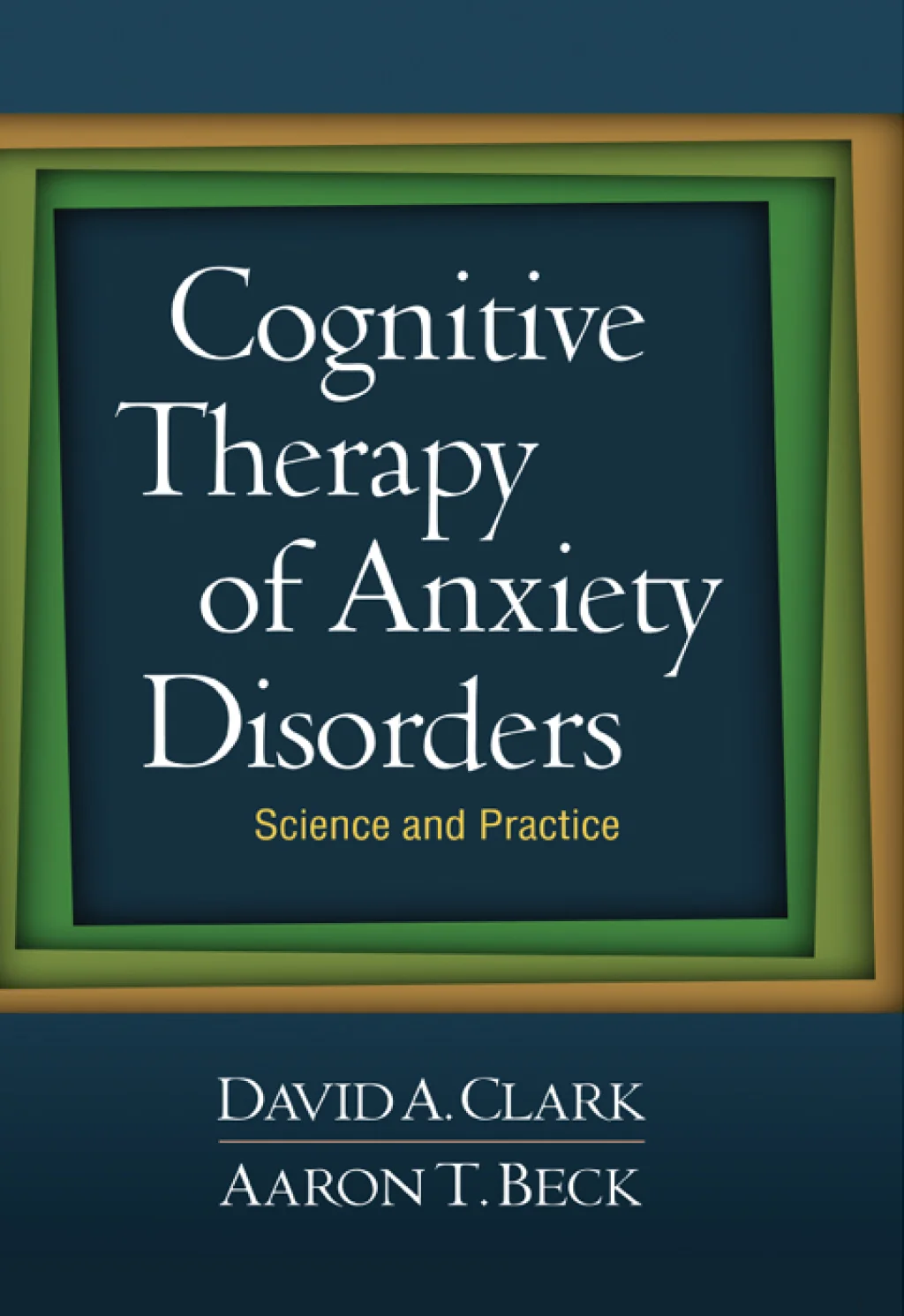
Cognitive Therapy of Anxiety Disorders: Science and Practice
 Aaron Beck
Clark and Beck reformulate Beck's original 1985 cognitive model of anxiety for the evidence-based era, arguing that anxiety disorders share a common cognitive signature: overestimating the probability and severity of threat while underestimating internal and external coping resources. The book synthesizes twenty-five years of empirical research into a unified theoretical framework, then translates it into disorder-specific mini-manuals for panic, social phobia, generalized anxiety, obsessive-compulsive, and posttraumatic stress disorders.
Key Details
Related Books
View AllSimilar books from the same category, ranked by shared topics and reader engagement.


Key Insights — Read in 10 Minutes
What is the risk-resource model at the core of this book's reformulation?
Clark and Beck propose that all anxiety disorders share a common cognitive signature: the overestimation of threat probability and severity, paired with the underestimation of coping resources. A 2015 study citing the book describes this as comprising three specific errors—the probability error, the catastrophic error, and the resource error . This dual-process framing replaces the earlier, more diffuse emphasis on automatic thoughts about danger found in Beck and Emery's 1985 work. The Beck Institute's anxiety course manual similarly instructs clinicians to focus on automatic thoughts related to threat overestimation and coping underestimation . The model serves as the theoretical spine connecting the book's empirical review to its disorder-specific treatment protocols.
How does the 2009 book differ from Beck and Emery's 1985 Anxiety Disorders and Phobias?
The 2009 volume is explicitly a reformulation rather than a sequel. David Clark, in a 2021 Beck Institute interview, describes the book as the product of four years reviewing and synthesizing the enormous research literature that emerged since 1985 . The original model was based largely on clinical insight; the reformulation tests twelve key hypotheses against hundreds of empirical studies. Clark notes a 'paradigmatic shift' in understanding anxiety over the intervening decades, making an update timely . The 1985 book established the cognitive perspective; the 2009 book grounds it in information-processing research, vulnerability studies, and controlled treatment trials, transforming clinical intuition into testable science.
Which anxiety disorders receive disorder-specific treatment protocols, and which is deliberately excluded?
The book provides mini treatment manuals for five conditions: panic disorder, social phobia, generalized anxiety disorder, obsessive-compulsive disorder, and posttraumatic stress disorder . Specific phobia is omitted. Clark explains that exposure remains the first-line treatment for specific phobia, and little has changed in its cognitive understanding since 1985, making a dedicated chapter redundant . Each included chapter follows a standardized structure: diagnostic and phenomenological review, disorder-specific application of the cognitive model, key hypotheses, step-by-step assessment and treatment protocols, and a review of efficacy evidence. The book also includes nearly forty reproducible handouts and forms, making it directly usable in clinical practice .
How has the book been received by the clinical training community?
Reviews have been strongly positive. PsycCRITIQUES predicted it would become 'the gold standard for the assessment and treatment of anxiety' . Trainers described it as the textbook of choice for teaching cognitive conceptualization of anxiety and treatment planning . The Bulletin of the Menninger Clinic called it 'perhaps the most thorough, scholarly, and practical volume on the treatment of anxiety disorders currently available' . Practitioner reviews highlight the value of the 'Clinician Guidelines' boxes and the Quick Reference Summaries at the end of each chapter, which allow experienced clinicians to scan for key points. The book won the American Journal of Nursing Book of the Year Award.
What is the relationship between this book and the broader debate over whether cognitive or behavioral components drive therapeutic change?
Clark and Beck position cognitive change as the mechanism through which anxiety reduction occurs, with behavioral techniques serving as tests of maladaptive beliefs rather than standalone procedures. This stance is contested. Lorenzo-Luaces and colleagues (2016) noted that the relative contribution of cognitive versus behavioral components remains 'widely debated' in the literature . The book incorporates exposure and behavioral experiments extensively but frames them as cognitive interventions when their function is to disconfirm threat beliefs. This differs from manuals treating behavioral and cognitive techniques as parallel modules. The authors' position is that belief modification, not habituation per se, is the active mechanism, a claim that continues to generate research on mediators of CBT outcomes.
How does the book address the transdiagnostic nature of anxiety while still providing disorder-specific protocols?
The book operates on two levels. Theoretically, it argues that all anxiety disorders share the risk-resource cognitive signature, making the model transdiagnostic. Practically, it provides five disorder-specific treatment protocols because the content of threat beliefs and the specific safety behaviors differ across conditions. This dual structure reflects the authors' view that a unified cognitive model can accommodate disorder-specific manifestations without requiring separate theories for each condition. The book predates the surge of explicitly transdiagnostic CBT manuals (such as those reviewed by McManus, Shafran, and Cooper in 2010) but shares their logic: common mechanisms, tailored applications . The disorder chapters allow clinicians to work within a single theoretical framework while addressing the distinctive features of each presentation.
Wealthy Psyche is an intellectual archive. We do not host, distribute, or sell book copies — physical or digital. We provide structured knowledge to help you think better, faster.