


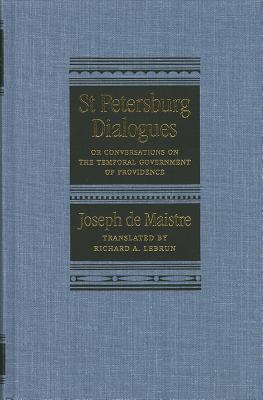
Considerations on France; St. Petersburg Dialogues
 Joseph de Maistre
Maistre argues that the French Revolution was not a political event to be managed but a providential punishment, a divine scourge visited upon a nation that had abandoned God and throne. Against the Enlightenment's abstract "man," he insists only particular Frenchmen, Italians, and Russians exist. Considerations on France (1797) presents this providential reading, calling for a restored Bourbon monarchy and a new alliance of throne and altar. The St. Petersburg Dialogues (written 1809–1820) expands the argument into a theodicy of history: war, the executioner, and sacrifice are instruments through which Providence governs temporal affairs, a dark vision that later readers saw as anticipating the catastrophes of the twentieth century.
Key Details
Related Books
View AllSimilar books from the same category, ranked by shared topics and reader engagement.



Key Insights — Read in 10 Minutes
What is the central claim of Considerations on France, and what does it reject?
Maistre argues that the French Revolution was not a political crisis to be managed or a set of ideas to be debated, but a providential punishment inflicted by God on a sinful nation. He rejects the Enlightenment premise that society can be reconstructed according to abstract reason or a "Declaration of the Rights of Man." There is no such thing as "man," he writes; only particular Frenchmen, Italians, and Russians exist. The Revolution, in his reading, was not made by men but used by Providence to destroy the old order and prepare for a restored Bourbon monarchy allied with the Catholic Church.
What is the specific concept or framework that St. Petersburg Dialogues introduces?
The Dialogues develop a theology of sacrifice and divine governance, arguing that violence and disorder are not anomalies but instruments through which Providence governs human affairs. Maistre explores the social role of the public executioner—whom he treats as a paradoxical pillar of society—and the "divinity" of war, viewing both as ritualized forms through which human barbarity is channeled and limited. He also critiques Locke's sensationalist psychology and meditates on prayer and sacrifice. The literary form is a philosophical conversation among three characters, allowing Maistre to indulge in deliberate provocation and paradox.
How does Maistre's Considerations on France differ from Burke's Reflections on the Revolution in France?
Both works reject the Revolution, but on fundamentally different grounds. Burke defends inherited institutions and gradual reform within a Whig constitutional tradition; Maistre argues from a Catholic providentialism that treats the Revolution as a divine event beyond human negotiation. Burke seeks to preserve a moderate settlement; Maistre demands a restored Bourbon monarchy and a new alliance of throne and altar. Cambridge University Press describes Considerations as the "best known French equivalent" of Burke's Reflections, but Maistre's position is more radical: he does not argue that the revolutionaries made mistakes so much as that God used them as scourges.
How has Maistre's argument held up, and why do modern readers still engage with these texts?
George Steiner observed that the age of the Gulag and Auschwitz, of famine and ecological devastation, is exactly what Maistre foretold—a dark vision of violence and irrationality at the heart of human experience that twentieth-century history appeared to vindicate. Owen Bradley's study argues that Maistre's critique of the Enlightenment bears an uncanny resemblance to central claims of postmodernist thought, and that his theory of sacrifice makes him a more nuanced and modern author than the "inconsistent and retrograde extremist" of caricature. Isaiah Berlin also contends that Maistre raises issues of enduring importance beyond his immediate polemical context.
What is the most common misconception about Maistre's position in these works?
The most common misconception is that Maistre is simply a reactionary extremist or an apologist for pure repression. His argument is subtler: he contends that human disorder is shaped and limited by ritualized behaviors and symbolic forms—punishments, wars, sacrifices—and that the Enlightenment's attempt to abolish these forms leaves violence uncontrolled. Bradley argues Maistre was "less an extremist obsessed with excess and paradox than an important theorist of excessive and paradoxical situations." His critique of Rousseau and the Encyclopédistes is not that they were too rational, but that their rationalism failed to account for the irrational forces that structure social life.
How did these two works relate to Maistre's own political circumstances?
Maistre wrote Considerations on France in 1797 while exiled from revolutionary France, and the book was published in Neuchâtel. It was a piece of propaganda as much as a philosophical treatise, arguing for a Bourbon restoration at a time when such a restoration seemed unlikely. The Directory and then Napoleon delayed his influence within France until the Restoration. The St. Petersburg Dialogues were written between 1809 and 1820 while Maistre served as Sardinian ambassador to Russia, and were published posthumously in 1821. The setting on the banks of the Neva is not incidental: the Dialogues reflect the distance from French political events that allowed Maistre to develop his broader theological framework.
Show 1 more insights
What role do the St. Petersburg Dialogues play in Maistre's larger body of work?
The Dialogues are Maistre's philosophical capstone, developing themes that appear only briefly or not at all in his earlier political writings. Whereas Considerations on France is a direct intervention in French political debate, the Dialogues constitute a broader theodicy—an attempt to justify God's governance of temporal affairs through war, sacrifice, and suffering. They also contain his critique of Locke's psychology and his reflections on "illuminism," topics absent from the Considerations. Together, the two works represent the political and the theological dimensions of Maistre's counter-revolutionary project, with the Dialogues providing the metaphysical foundation for the providential reading of history first sketched in 1797.
Wealthy Psyche is an intellectual archive. We do not host, distribute, or sell book copies — physical or digital. We provide structured knowledge to help you think better, faster.