


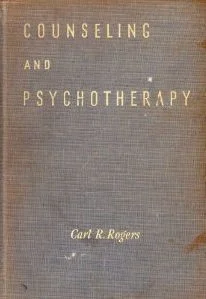
Counseling and Psychotherapy: Newer Concepts in Practice
 Carl Rogers
Rogers's first major book introduces the non-directive method, arguing that the counselor should not diagnose, advise, or interpret, but instead create a relationship in which the client's own capacity for growth is released. The book's mechanism is the counselor's disciplined refusal to direct: by reflecting feelings and clarifying the client's expressed attitudes, the counselor enables the client to achieve insight and make independent decisions. It rejects the directive, advice-giving model dominant in 1940s counseling, and grounds this new approach in recorded case material, including the landmark Case of Herbert Bryan.
Key Details
Related Books
View AllSimilar books from the same category, ranked by shared topics and reader engagement.


Key Insights — Read in 10 Minutes
What is the non-directive method, and what does it reject?
The non-directive method is Rogers's term for a counseling approach in which the counselor deliberately refrains from giving advice, making interpretations, or directing the client toward any particular decision. The book's central argument is that the counselor's role is to create a relationship in which the client can express feelings freely, achieve insight into their own attitudes, and make independent choices . This rejects the directive model dominant in the 1940s, in which counselors gathered information, diagnosed problems, and prescribed solutions. Rogers argues that directive methods impose the counselor's values and short-circuit the client's own capacity for growth. The non-directive approach trusts the client as the expert on their own life.
What is the Case of Herbert Bryan, and why is it significant?
The Case of Herbert Bryan is the final section of the book and one of the earliest detailed published transcripts of an entire counseling process . Rogers presented verbatim excerpts from sessions with a client to demonstrate the non-directive method in action—how the counselor reflects feelings, avoids advice, and allows the client to arrive at his own insights. The case was revolutionary for its time because it treated the therapeutic interview as observable, communicable data rather than private clinical intuition. A contemporary review in the Journal of Abnormal and Social Psychology called the book 'required reading for all workers who use the interview as a treatment device,' noting that Rogers brought interviewing 'down to earth and into the territory of the communicable and observable data of scientific investigation' .
How does this book relate to Rogers's later Client-Centered Therapy?
Counseling and Psychotherapy (1942) introduced the term 'non-directive' and established the basic method. Client-Centered Therapy (1951) represents a significant theoretical expansion: Rogers renamed the approach 'client-centered' to signal that it was not merely a technique of abstention but a positive relational method grounded in a formal theory of personality and behavior . The 1951 book also incorporated a decade of empirical research, including systematic analyses of recorded sessions, and articulated the three core conditions—congruence, unconditional positive regard, and empathy—that were implicit but not yet formalized in the 1942 text. The relationship is one of theoretical development: the 1942 book establishes the method, the 1951 book grounds it in research and theory.
What were the documented criticisms of non-directive counseling from religious and pastoral perspectives?
A significant body of criticism came from pastoral counseling circles, which objected to the method's humanistic assumptions. Critics such as O.S. Walters argued that the 'humanistic premises of client-centered counseling are in standing conflict with the Christian doctrine of man' . The objection centered on Rogers's confidence in the individual's capacity to resolve their own conflicts and his exclusion of the counselor's values from the therapeutic process. Pastoral critics argued that the minister is 'prophet as well as priest' and must communicate moral imperatives, whereas the non-directive counselor remains silent on values . Rogers addressed these concerns in a 1949 article responding to Christian doctrine, but the tension between humanistic and religious frameworks persisted.
How did the book define the counselor's role differently from the prevailing psychiatric model?
The prevailing model treated the counselor or therapist as an expert who assessed, diagnosed, and treated the client's problem. Rogers's book inverted this relationship: the client, not the counselor, is the expert on their own experience and the proper agent of change. The counselor's task is to create a particular kind of relationship—one characterized by acceptance, warmth, and a refusal to judge or direct . A French catalog description of the book notes that it 'abandonne tout a priori de jugement, de soutien et de contrôle'—abandons all a priori judgment, support, and control—and bases the helping relationship on 'optimisme et confiance dans les capacités évolutives de chaque individu' . This reconceptualization of the therapeutic role was among the book's most lasting contributions.
What is the publication history of the book, and how was it received at the time?
Counseling and Psychotherapy was published in 1942 by Houghton Mifflin, under the editorship of Leonard Carmichael . It runs 450 pages and includes a selected bibliography . A contemporary review by John G. Darley in The Journal of Abnormal and Social Psychology (1943) called it 'one of the few real contributions to an understanding of counseling or psychotherapeutic interviewing,' describing it as 'an excellent and indispensable book' and 'the most lucid and comprehensive statement that Rogers has yet made' . German, Japanese, and other translations followed in subsequent decades . The book remains in print and is available through the Internet Archive .
Show 1 more insights
What was the book's relationship to Rogers's earlier work with children?
Rogers came to the non-directive method through his clinical work with children and families at the Rochester Society for the Prevention of Cruelty to Children in the 1930s. His earlier book, The Clinical Treatment of the Problem Child (1939), documented this work and began developing the idea that the therapist's role was to facilitate rather than direct . Counseling and Psychotherapy generalized these insights into a method applicable to adults. The book's opening chapters acknowledge this lineage, presenting the non-directive approach as a 'newer concept in practice' that emerged from clinical experience rather than theoretical speculation. The emphasis on recording and studying actual interviews—a practice Rogers pioneered at Rochester—carried over directly into the 1942 book's methodology.
Wealthy Psyche is an intellectual archive. We do not host, distribute, or sell book copies — physical or digital. We provide structured knowledge to help you think better, faster.