


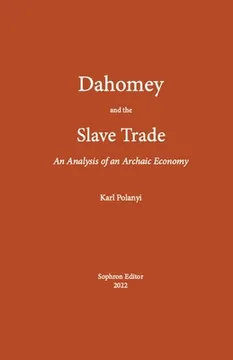
Dahomey and the Slave Trade: An Analysis of an Archaic Economy
 Karl Polanyi
Polanyi argues that the Kingdom of Dahomey's involvement in the Atlantic slave trade was not driven by market motives but by political and redistributive logic. The Dahomean state controlled foreign trade, set prices through administered equivalencies rather than supply and demand, and treated war captives as a byproduct of political expansion rather than a commodity produced for profit. By analyzing the encounter between a fully monetized European economy and a non-market archaic economy, Polanyi demonstrates that trade can exist without price-making markets, extending his substantivist framework to precolonial West Africa.
Key Details
Related Books
View AllSimilar books from the same category, ranked by shared topics and reader engagement.


Key Insights — Read in 10 Minutes
What is the central argument of Dahomey and the Slave Trade?
Polanyi argues that Dahomey's participation in the Atlantic slave trade was not motivated by profit-seeking market logic but by political and redistributive imperatives. The state controlled foreign trade through the port of Whydah, set prices through administered equivalencies rather than fluctuating market prices, and supplied slaves as a byproduct of wars fought for political reasons. The book demonstrates that trade can exist without market institutions, and that a state-centered archaic economy could engage with European market traders without adopting market principles. Polanyi's target is the ethnocentric assumption that trade and money must function as market phenomena.
What specific concepts does Polanyi develop through the Dahomean case?
Polanyi extends his substantivist framework by analyzing the 'port of trade' as an institutional mechanism that mediated between radically different economic systems. He develops the concept of 'householding' as a fourth principle of economic integration alongside reciprocity, redistribution, and exchange. The book also refines his analysis of 'equivalencies'—state-administered exchange rates that function unlike market prices because they do not fluctuate with supply and demand. These concepts allowed Polanyi to explain how a non-market economy could sustain complex long-distance trade with European merchants without internalizing market logic.
How does this book relate to Polanyi's earlier Trade and Market in the Early Empires?
Dahomey and the Slave Trade grew directly from Polanyi's earlier research project. His interest in Dahomey began when a student contributed papers on the kingdom to Trade and Market in the Early Empires (1957). Polanyi then read extensively on the subject and developed the full-length study as a concentrated application of the substantivist framework to a single case. Where the earlier volume offered broad comparative surveys, Dahomey provides depth, tracing how a specific archaic state managed its encounter with European market traders. The book was prepared for publication after Polanyi's death by his widow, Ilona Duczynska Polanyi.
What is the most serious criticism of Polanyi's argument in this book?
Economic historian Ralph Davis argued that Polanyi presented no consistent view of whether traditional non-market exchange or adaptive responses to European methods dominated Whydah's slave trade. Davis noted that European slave traders were highly flexible, moving ships between ports in fierce competition, which made it implausible that the King of Dahomey could fix prices with no relation to supply and demand. Later historian Werner Peukert demonstrated that the slave trade at Whydah was not a royal monopoly and that Brazilian and indigenous merchants participated alongside the state. These criticisms challenge the empirical basis of Polanyi's strong substantivist reading.
How was the book received by historians of Africa?
Basil Davidson called it a 'really solid work in the field of precolonial economic analysis' and praised it for giving African economic history a place it had long been denied. He described it as 'an important enlargement of our historiography.' French historian Catherine Coquery-Vidrovitch found it perceptive but criticized Polanyi's fragmentary sources, his projection of a static picture across the entire eighteenth century, and his reliance on Herskovits for all background. Reviews in the late 1960s broadly agreed the book made a significant contribution to comparative economic history even where its specific historical claims were contested.
What controversy arose over the book decades after its publication?
In 2002, philosopher Raymond Tallis, reviewing Roger Sandall's The Culture Cult in the Times Literary Supplement, accused Polanyi of commending Dahomey's 'barbaric autocracy' as a model for the twentieth century and ignoring the king's 2,000 wives and state violence. Kenneth McRobbie responded in the TLS letters page that Polanyi explicitly warned against 'idealizing backward worlds' and that the book records 'repulsive cruelty' and 'suicidal wars of revenge' in Dahomey. McRobbie argued Polanyi criticized all modelers, whether of command communism or liberal free markets. The exchange illustrates how Polanyi's nuanced critique of market society is sometimes misread as romanticizing premodern coercion.
Show 1 more insights
How has the book's argument held up since its publication?
Scholars generally agree that Polanyi's empirical claims about Dahomey are overstated. The slave trade at Whydah was not a royal monopoly, and internal and export economies were more interconnected than his framework suggests. Patrick Manning characterized Polanyi's approach as of 'heuristic rather than historical' value. Yet the book remains productive for research: the formalist-substantivist opposition it exemplifies continues to generate debate in economic anthropology and African economic history. As one assessment put it, criticism of Polanyi's Dahomey case limits but does not refute his broader theoretical framework.
Wealthy Psyche is an intellectual archive. We do not host, distribute, or sell book copies — physical or digital. We provide structured knowledge to help you think better, faster.