


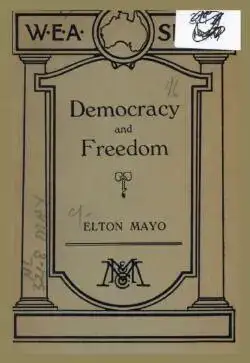
Democracy and Freedom: An Essay in Social Logic
 George Elton Mayo
Mayo's early essay argues that democracy, as practiced, rests on a misunderstanding of human nature and social organization. Its distinctive mechanism is a psychological diagnosis of political failure: democratic institutions presume a rationality and cooperativeness that industrial civilization has eroded, producing conflict rather than the harmony democracy promised. Mayo contends that genuine freedom requires the deliberate cultivation of social skill — the capacity to understand and collaborate with others — and that without it, democracy remains apparent rather than real. The essay is the philosophical groundwork for his later human-relations research, framing industrial cooperation as a condition of democratic survival rather than merely a management technique.
Key Details
Related Books
View AllSimilar books from the same category, ranked by shared topics and reader engagement.



Key Insights — Read in 10 Minutes
What is the central claim of Democracy and Freedom, and what does it reject?
The central claim is that democracy, as currently practiced, is based on a misunderstanding of human nature and social organization, and that it often produces division rather than the harmony it promises . Mayo rejects the assumption that democratic institutions automatically secure freedom or cooperation. He argues that genuine democracy depends on social skill — the capacity to understand and collaborate with others — which industrial civilization has neglected. Without that skill, voting and representation remain superficial, and society splits into hostile camps . The essay's distinctive move is to treat political failure as a psychological and social deficit rather than a purely institutional or economic problem, laying groundwork for his later human-relations framework.
What is the book's publication history and context?
Democracy and Freedom was published in Melbourne by Macmillan in 1919, under the auspices of the Workers' Educational Association of Australia, as the first in its W.E.A. series . It is a short essay of 74 pages, written in the aftermath of the First World War and during Australian postwar reconstruction debates . This context matters because Mayo was responding directly to the political and industrial conflicts of his time, including the difficulty of conducting detached inquiry into economic problems in Australia, where every difficulty was immediately generalized as a political issue . The book predates his Hawthorne research by more than a decade and is the earliest statement of themes he developed later.
How does this essay relate to Mayo's later work on industrial civilization?
The essay historicizes Mayo's later books by showing that his human-relations framework originated as a political argument about democracy, not merely as a study of workplace productivity. Themes introduced here — the critique of democracy's assumptions, the importance of social cooperation, the role of enlightened administration — recur in The Human Problems of an Industrial Civilization and The Social Problems of an Industrial Civilization. A biographer notes that the later work shares the assumption that society is a cooperative system of groups bound by personal understanding and tradition, and that civilized administration requires leadership whose technical skills are supplemented by social skills . Reading Democracy and Freedom first reveals that Mayo's industrial research was always in service of a broader social thesis.
How was the book received when it was published?
Contemporary reception was mixed but largely engaged. The Sydney Morning Herald called it 'distinctly original... interesting... thought-provoking,' and the Australian Christian Commonwealth praised it as vigorous and stimulating . A New Zealand newspaper review summarized Mayo's argument that democracy is based on a misunderstanding of human nature, and observed that his views were 'distinctly original' and would interest even those who disagreed . The Melbourne Argus, however, condemned the work as not constructive, while acknowledging that inducing workers to think seriously about politics and economics would be a valuable service regardless of the author's views . The pattern suggests the book was recognized as provocative and original rather than definitive.
What is a common misconception about this book?
A common misconception is that Democracy and Freedom is a minor early work with little connection to Mayo's famous industrial research. In fact, it is the foundational statement of the social-philosophical commitments that shaped his later career. The essay's argument that democracy requires cultivated social skill, and that industrial organization must provide the conditions for cooperation, directly anticipates the human-relations program. Biographers note that late in 1919 Mayo restated the book's main ideas in an essay on industrial autonomy, arguing that competition must give way to social cooperation and that company directors must take on community responsibilities . Treating the book as marginal misses its role as the intellectual seedbed of Mayo's later thought.
Wealthy Psyche is an intellectual archive. We do not host, distribute, or sell book copies — physical or digital. We provide structured knowledge to help you think better, faster.