


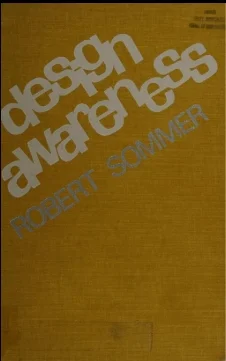
Design Awareness
 Robert Sommer
Sommer's 1972 book argues that designers and planners have traditionally excluded users from decisions about their own environments, producing spaces that reflect professional values rather than inhabitant needs. It proposes a more modest role for the design professional and a more active one for the user, drawing on examples of grassroots environmental modification—from guerrilla graphics and junk sculpture to the Berkeley People's Park. The book's central practical contribution is a framework for building evaluation, insisting that no design should exist without assessment and no assessment without redesign.
Key Details
Related Books
View AllSimilar books from the same category, ranked by shared topics and reader engagement.



Key Insights — Read in 10 Minutes
What is the central argument of Design Awareness, and how does it revise Sommer's earlier position?
The book argues that design professionals must cede primary responsibility for environmental decisions to users. David Alpaugh's review in The School Review notes that Sommer's earlier work in environmental psychology and spatial behavior is 'amended here to allow for involvement of the user in the design process and to reject the deterministic tendencies implied by unitary studies in proxemics and personal space' . Where Personal Space documented how people defend territory and regulate interaction, Design Awareness prescribes a normative role: users should actively shape environments rather than merely occupy or resist them. Sommer proposes a 'far more modest role' for designers, one that 'would defer to the user the major responsibility for dealing with the environment' .
What two types of user environmental control does Sommer identify, and which does he consider more significant?
Alpaugh's review distinguishes two categories. The first is 'People's Art'—impromptu personal expression including junk sculpture, graffiti, and 'guerrilla graphics,' ranging from small visual play to 'enormous murals on the blank walls of buildings in dense urban areas' . Sommer sees these as evidence of 'an inevitable and necessary state of dynamic tension between free expression and social order.' The second type, which Alpaugh calls 'more significant,' is direct user input into problem-solving processes, exemplified by the Berkeley People's Park of 1969, where residents transformed a neglected lot into a functioning park . This second type implies a problem orientation rather than mere expression.
What is the 'New Evaluator Cookbook' chapter, and why did reviewers consider it important?
A Progressive Architecture review identified 'The New Evaluator Cookbook' as one of the book's most important chapters, noting it 'tells how to go about a building evaluation' . Sommer's rationale is explicit: 'This is a cookbook rather than a theory of food preference—designers are often advised to go back and evaluate their work, but no one tells them how it is done.' The chapter provides sample question types, evaluation forms, and 'helpful hints and warnings concerning pitfalls.' The reviewer credited Sommer as 'one of the first to provide a selection of mechanisms and methods for building evaluations,' and praised the approach as 'honest, matter-of-fact and pragmatic' that 'eliminated the mystique' .
How does Sommer's treatment of People's Park function as a case study in user-generated design?
Sommer devotes the better part of a chapter to the 1969 Berkeley People's Park, where 'a large and diverse group of community residents took over a neglected lot and in a matter of days transformed it into a vital, living, used neighborhood park' . The community had recognized two problems: the need for a park and the empty land's blight on the neighborhood. Alpaugh notes that 'the tragic consequences of that action are well documented by Sommer, but the design significance of People's Park and of other similar efforts since then is made clear.' Sommer draws the lesson that 'the traditional standards of design are not necessarily the ones that matter,' but rather 'excitement, spontaneity, flexibility and participation' .
What obstacle to environmental action does Sommer identify, and how does the book propose overcoming it?
Sommer identifies 'habituation and adaptation to incrementally worsening conditions' as a major factor producing a kind of numbness toward environmental problems . The book's mission is to propose 'measures and methods for wakening an awareness of the environment.' Sommer's strategy centers on 'environmental workshops' and learning through action: 'Developing awareness is not simply a matter of studying facts and figures but rather of stripping the blinders from one's eyes and finding an active mode of perceiving the environment.' Alpaugh notes that cognitive knowledge alone is insufficient: Sommer starts with 'small concrete problems, especially with children,' treating awareness as a practical skill acquired through problem-solving rather than passive observation .
How did reviewers in architecture and design professions receive the book?
A Progressive Architecture review called Sommer's contributions important, noting he 'accurately sensed the immediate need for a volume of this type and provided it: a cookbook outlining ways and means instead of another compendium of research findings' . The reviewer hoped the book would create 'transformations within the design and environmental research fields... leading to the ultimate goal of providing better habitations for people.' A Journal of Popular Culture review described it as a 'highly readable little book' likely to surprise those who think of architecture as 'a peculiarly elitist blend of aesthetics and big business,' noting that architectural students had spearheaded an ideological change comparable to shifts in planning and social work .
Show 1 more insights
What specific evaluative principle does Sommer articulate about the relationship between design and assessment?
The Progressive Architecture review quotes Sommer's core principle: 'The feedback process from existing structures must be developed and institutionalized; no design should exist without evaluation, no evaluation without redesign' . This three-part formula—design implies evaluation, evaluation implies redesign—functions as the book's practical manifesto. It rejects the linear model in which a building is designed, constructed, and occupied without systematic assessment of whether it works. Sommer's cookbook chapter provides the concrete tools for institutionalizing this feedback loop, positioning building evaluation not as an optional research activity but as an integral phase of the design process itself.
Wealthy Psyche is an intellectual archive. We do not host, distribute, or sell book copies — physical or digital. We provide structured knowledge to help you think better, faster.