


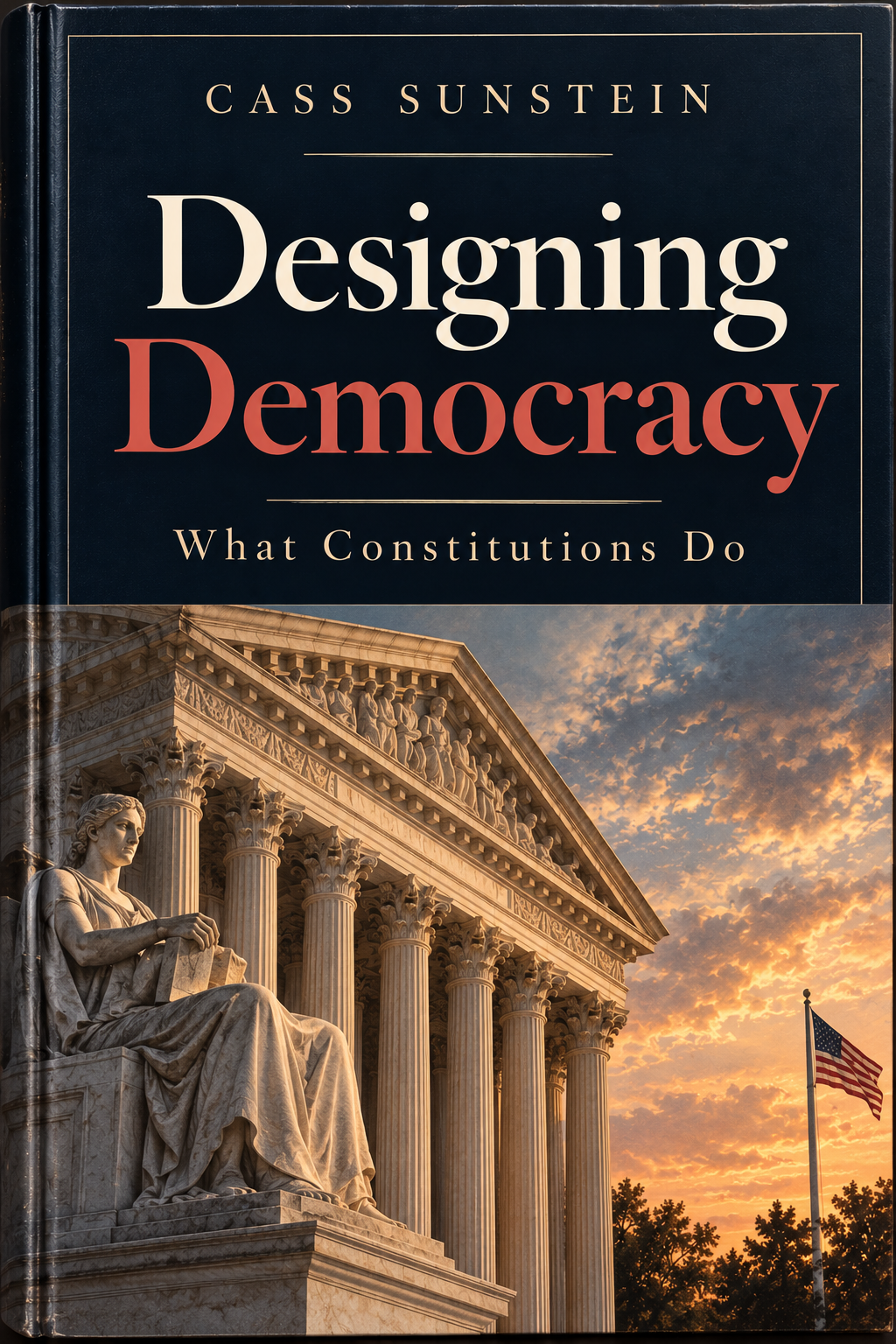
Designing Democracy: What Constitutions Do
 Cass R. Sunstein
Sunstein's Designing Democracy argues that political disagreement is not a threat to democracy but its greatest safeguard, if constitutional design properly channels it. The central mechanism is the paradox of group polarization: like-minded deliberating groups predictably move to more extreme positions, yet a well-designed constitution can use this very tendency to protect diversity. Constitutions foster a 'republic of reasons' through incompletely theorized agreements — enabling people with opposing ethical and religious commitments to agree where agreement is necessary and to remain in productive disagreement where it is not. The work extends Sunstein's earlier analysis of deliberation into a systematic account of constitutional purpose.
What is the central argument of Designing Democracy, and what does it reject?
Sunstein argues that political disagreement — the source of both democracy's gravest danger and its greatest security — should be constitutionally channeled rather than suppressed. The book rejects the assumption that constitutionalism must tame democracy's unruly diversity. Instead, a well-designed constitution protects 'deliberative enclaves' where minority groups can deliberate free from dominant pressure, while also checking the group polarization that predictably pushes like-minded deliberators toward extremes [citation:4]. The paradox at the book's core is that a nation's threatening diversity of opinion can ensure its integrity, if constitutional structures foster a 'republic of reasons' [citation:1].
What is 'group polarization,' and why is it central to Sunstein's argument?
Group polarization is the phenomenon in which members of a deliberating group predictably move to a more extreme point in the direction indicated by their pre-deliberation tendencies [citation:4]. Sunstein extends this beyond political groups to courts: a panel of three like-minded judges may reach a more extreme position than a single judge would alone. This creates a conundrum: isolating minority groups protects them from majority pressure but leaves them susceptible to internal extremes. The constitutional answer, Sunstein argues, is design that both ensures deliberation and checks its harmful consequences through structural mechanisms like incompletely theorized agreements.
What is an 'incompletely theorized agreement,' and how does it function in constitutional law?
An incompletely theorized agreement occurs when people converge on a specific practice or outcome without agreeing on the abstract theory that justifies it. Sunstein argues this is a central constitutional virtue: it enables people of opposing ethical and religious commitments to reach agreement where agreement is necessary, while making it unnecessary to reach agreement when agreement is impossible [citation:1]. Courts, for example, can decide a case on narrow grounds that leave larger theoretical questions unresolved, allowing diverse citizens to accept the outcome without abandoning their deeper convictions. This concept, developed earlier by Sunstein, is deployed here as a constitutional design principle [citation:5].
What is the 'anticaste principle,' and why does Sunstein place it at the book's normative center?
The anticaste principle holds that a central obligation of a government committed to equality is to eliminate the caste-like features of contemporary society — systematic disadvantages linked to characteristics like race, sex, or sexual orientation that are unrelated to individual choices or capacities . Sunstein argues this principle should guide constitutional interpretation, endorsing affirmative action policies that equalize wealth, status, and the ability to participate effectively in civic life. He reads the Equal Protection Clause as a 'transformative' rather than 'preservative' command, requiring government to dismantle entrenched hierarchies rather than merely refrain from creating new ones .
Why does Sunstein dedicate a chapter to praising the South African constitution?
Sunstein calls South Africa's constitution 'the most admirable constitution in the history of the world' [citation:4]. His admiration stems from its inclusion of positive social and economic rights — guarantees of food, shelter, and health care — which American constitutional law has traditionally resisted. The South African model demonstrates that constitutional design can be transformative, using judicial leverage to address material deprivation rather than merely protecting negative liberties. Sunstein uses this example to argue against the American tradition of treating social rights as non-justiciable, showing that constitutions can and should do more than limit state power .
What is the most common criticism of Designing Democracy?
A significant critique, articulated by Martin Edelman, is that Sunstein provides an 'incomplete argument' for seeing the American Constitution as supporting deliberative democracy. Edelman notes that Sunstein systematically ignores social science literature on American political culture, Congress, and the electorate, all of which suggest deliberation is unlikely to emerge in the near future . The book's reliance on previously published law review articles also produces disconnected chapter topics — impeachment, homosexuality, sex equality — whose relationship to the deliberative democracy thesis is not always clear [citation:4]. Sunstein's claim that the Clinton impeachment was 'clearly unconstitutional' has also drawn scholarly objection.
Show 1 more insights
How does Designing Democracy relate to Sunstein's other work on constitutionalism?
Designing Democracy develops themes from Sunstein's earlier work on incompletely theorized agreements and group polarization, applying them to constitutional design. It stands alongside One Case at a Time (2001) in advocating judicial minimalism — the preference for narrow rulings that leave fundamental questions open [citation:10]. The book also reflects Sunstein's practical experience advising constitution-makers in South Africa, Ukraine, Poland, and elsewhere, giving it a comparative orientation absent from his more purely theoretical work [citation:10]. Its central claim — that constitutions should foster deliberation rather than merely constrain power — represents a distinctively deliberative democratic approach to constitutionalism.
Wealthy Psyche is an intellectual archive. We do not host, distribute, or sell book copies — physical or digital. We provide structured knowledge to help you think better, faster.