


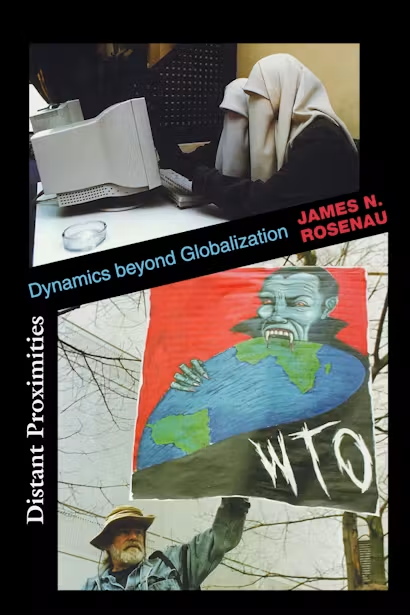
Distant Proximities: Dynamics beyond Globalization
 James N. Rosenau
Rosenau argues that globalization is an insufficient concept for understanding world affairs. His central thesis is that contemporary politics must be viewed as an endless series of 'distant proximities'—situations in which distant events intrude on local routines and local actions reverberate globally. These interactions are driven by 'fragmegration,' the simultaneous and causally linked processes of integration and fragmentation. Culminating the theoretical project begun in Turbulence in World Politics, the book treats people-in-the-street as central actors and distinguishes twelve 'worlds' defined by how their inhabitants orient themselves toward distant developments. The book examines how issues from human rights to corruption become distant proximities and explores governance in 'fragmegrative space.'
Key Details
Related Books
View AllSimilar books from the same category, ranked by shared topics and reader engagement.


.webp?alt=media&token=a654646a-3c02-4a3a-bb20-421e64251f83)
Key Insights — Read in 10 Minutes
What is the central thesis of Distant Proximities?
Rosenau argues that the concept of globalization has outgrown the phenomenon it describes. The world is undergoing an epochal transformation driven by technological advances that collapse time and distance, altering political space. The best way to grasp world affairs is to view them as an endless series of distant proximities, in which forces pressing for globalization and forces inducing localization interactively play themselves out. This framework challenges the disciplinary separation of domestic and foreign politics, urging analysts to treat local and global dynamics as inseparable.
What does Rosenau mean by 'fragmegration'?
Fragmegration is Rosenau's term for the pervasive interaction between fragmenting and integrating dynamics unfolding at every level of community. It captures the simultaneous and causally linked processes of decentralization and centralization, localization and globalization. Rosenau argues these forces are not opposites but intertwined: every integrative increment tends to give rise to a disintegrative increment, and vice versa. The concept was introduced in earlier work but receives its fullest development here as the driving mechanism of distant proximities.
What are the 'twelve worlds' Rosenau identifies?
Rosenau distinguishes twelve 'worlds' based on how their inhabitants orient themselves toward developments elsewhere. Four are local, oriented primarily toward proximate concerns. Four are global, where people think and act on a scale exceeding local context. Four are private, including Cynics, Illegals, Tuned-Out Passives, and Circumstantial Passives, whose occupants are so remote from events that they inhabit no public world at all. This typology allows Rosenau to analyze how different populations experience fragmegration and distant proximities in divergent ways.
How does Distant Proximities relate to Rosenau's Turbulence in World Politics?
The book is described as culminating the reassessment of international relations Rosenau began in 1990 with Turbulence in World Politics. Where the earlier book developed the theoretical framework of bifurcated global politics and structural turbulence, Distant Proximities extends that analysis to the post-Cold War and post-September 11 world. It offers the first systematic analysis of how complex global changes have become, introducing new concepts like distant proximities and fragmegration while retaining the micro-macro focus on individuals and collectivities that defined the earlier work.
What is the 'skill revolution' and why does it matter?
The skill revolution refers to Rosenau's observation that individuals worldwide have become more analytically capable, better able to organize, and more resistant to authority. This micro-level change enables people to engage with global processes in ways previously reserved for states and elites. Rosenau treats it as a key driver of the transformation he describes: as individuals' skills expand, they become central to the course of events, and governance increasingly involves micro-macro interactions rather than top-down authority alone. The concept grounds his structural analysis in changes in human capability and orientation.
What are the main criticisms of Distant Proximities?
A critical review in the University of Chicago Law School's journal argues that Rosenau's concepts—distant proximities, fragmegration, micro-macro interactions—are, once past the labels, so obvious as to be unhelpful. The reviewer contends that Rosenau fails to back contentious claims with sufficient empirical evidence, offering argument by anecdote and sweeping assertions supported by little more than a few New York Times stories. The critique also notes that Rosenau never takes a position on the relative influence of the opposing forces in his dichotomies—fragmentation versus integration, micro versus macro.
Show 2 more insights
What was the reception of the book upon publication?
Foreign Affairs called it a sweeping study that convincingly illustrates the increasing complexity of global relationships, while noting it was top-heavy in concepts. The Journal of Economic Issues described it as Rosenau's magnum opus. Reviewers praised Rosenau's conceptual creativity and his willingness to move beyond state-centric frameworks, though some questioned whether the changes he describes are as epochal as he claims. The book was published by Princeton University Press in 2003 and became a standard reference for postinternational approaches to globalization.
How does the book treat anti-globalization protests and September 11?
Rosenau examines both as quintessential distant proximities. Anti-globalization protests illustrate how local actions can reverberate globally, while the terrorist attacks on America demonstrate how distant events intrude on domestic routines with transformative force. These cases serve as empirical anchors for his theoretical framework, showing how fragmegration operates in concrete political events. Rather than treating them as anomalies, Rosenau integrates them into his broader argument about the collapsing distinction between domestic and foreign affairs and the emergence of an epoch defined by the interpenetration of near and far.
Wealthy Psyche is an intellectual archive. We do not host, distribute, or sell book copies — physical or digital. We provide structured knowledge to help you think better, faster.