


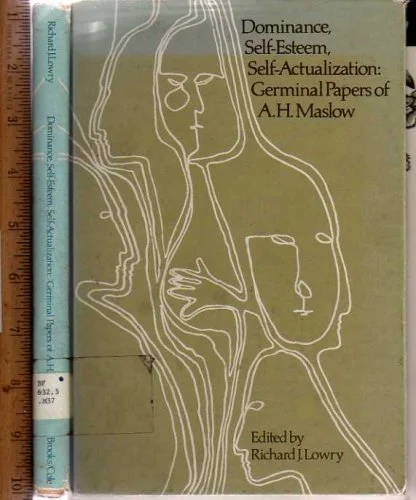
Dominance, Self-Esteem, Self-Actualization: Germinal Papers of A. H. Maslow
 Abraham Harold Maslow
This volume is not a single authored monograph but a curated collection of Maslow's early empirical papers from the 1930s and 1940s, edited by Richard J. Lowry. Its central contribution is to trace the empirical origins of Maslow's later humanistic psychology back to his neglected research on dominance hierarchies in primates and the construct he called "dominance-feeling" in women. The book argues that self-esteem, not aggression or simple social rank, is the psychological core of dominance behavior, and that this early work laid the groundwork for his eventual theory of self-actualization.
Key Details
Related Books
View AllSimilar books from the same category, ranked by shared topics and reader engagement.


.webp?alt=media&token=413f638b-4d70-40f1-8217-367deb754ca8)
Key Insights — Read in 10 Minutes
What is the central argument linking these scattered papers into a coherent volume?
The unifying thesis, articulated by editor Richard J. Lowry, is that Maslow's concept of self-actualization did not emerge fully formed from his later humanistic writings. Instead, it evolved directly from his empirical investigations into dominance behavior in primates and the psychological experience of "dominance-feeling" in humans. The papers demonstrate that Maslow initially understood dominance not as raw aggression but as a syndrome correlated with inner security and self-esteem. This early insight—that healthy dominance stems from confidence rather than coercion—became the conceptual seed for his later model of the self-actualizing person who is autonomous yet socially effective.
How does the "dominance-feeling" research in this volume relate to Maslow's later, more famous hierarchy of needs?
The connection is foundational but often overlooked. In papers such as "Dominance, Personality, and Social Behavior in Women" (1939) and "Self-Esteem (Dominance-Feeling) and Sexuality in Women" (1942), Maslow treated self-esteem as a measurable, empirically grounded variable. He found that women with high dominance-feeling reported greater sexual satisfaction and less neurotic guilt, suggesting that psychological health and self-regard were intertwined. This empirical link between self-esteem and well-being became a cornerstone of the hierarchy's "esteem needs" and the eventual goal of self-actualization. The volume effectively historicizes the hierarchy by showing its clinical and observational prehistory.
What is the significance of Maslow's primate research at the Vilas Park Zoo for his later personality theory?
The 1936 papers on infra-human primates represent Maslow's attempt to ground personality psychology in observable, evolutionary biology. He observed that dominance hierarchies among monkeys were not solely determined by physical aggression; rather, dominant individuals displayed a "confident" bearing that others deferred to. This led him to theorize that dominance in humans is likewise primarily a psychological phenomenon—a feeling of security and superiority—rather than a mere behavioral reflex. Later critics, notably Dallas Cullen, have argued that subsequent primatological research has invalidated Maslow's specific interpretations of primate social structure, raising questions about the empirical durability of this foundation.
How has feminist scholarship received Maslow's early work on women's self-esteem and sexuality?
Reception has been sharply divided. Betty Friedan drew upon Maslow's research for The Feminine Mystique, finding in his work a validation of women's need for achievement beyond domestic roles. However, later feminist critics have been more skeptical. Scholars such as those cited in the 1994 work "Feminism, Management and Self-Actualization" argue that Maslow's early studies, despite their empirical ambition, encoded a masculine bias: they valued traits like dominance and autonomy while implicitly pathologizing or marginalizing traditionally feminine modes of selfhood. The papers in this volume are therefore central to debates about the gendered assumptions embedded in humanistic psychology's very foundations.
Is this volume a primary source written by Maslow, or a secondary interpretation?
It is primarily a primary-source collection, but a mediated one. The book consists of Maslow's original journal articles from the 1930s and 1940s, reproduced in facsimile or reset form. However, Richard J. Lowry, the editor, provides substantial introductions before each paper or group of papers. These editorial interventions frame the historical narrative, explaining why each paper matters and how it connects to Maslow's later work. Readers should be aware that the "argument" of the book is partly Lowry's retrospective construction of a coherent developmental arc, imposed upon a set of discrete empirical studies that Maslow himself did not originally present as a unified program.
What is a common misconception about this book that readers should avoid?
A frequent error is to assume that Dominance, Self-Esteem, Self-Actualization is a late-career summation of Maslow's mature thought, akin to The Farther Reaches of Human Nature. It is the opposite: it is a collection of his earliest professional work, published posthumously as a historical document. The "germinal" in the subtitle is precise—these are seeds, not fruits. Another misconception is to treat the volume as a straightforward endorsement of social hierarchy. Maslow's early work was diagnostic and descriptive; he sought to understand the psychology of dominance, not to celebrate domination. The papers contain ambivalences and complexities that his later popularizers often smoothed away.
Show 1 more insights
How does the dominance research in this volume conflict with or complicate the standard image of Maslow as a purely optimistic humanistic psychologist?
The standard image presents Maslow as the prophet of human goodness and potential. The early papers complicate this by revealing a hard-edged empiricist concerned with power, social rank, and sexual behavior. His observations of primate hierarchies and his statistical studies of women's dominance-feeling are clinical and unsentimental. Furthermore, later critics have pointed out that Maslow's early dominance research contained assumptions about social stratification that he never fully critiqued. The volume thus reveals a more conflicted, observational Maslow—one whose humanism was a destination reached through, rather than a starting point that bypassed, the messy realities of social power.
Wealthy Psyche is an intellectual archive. We do not host, distribute, or sell book copies — physical or digital. We provide structured knowledge to help you think better, faster.