


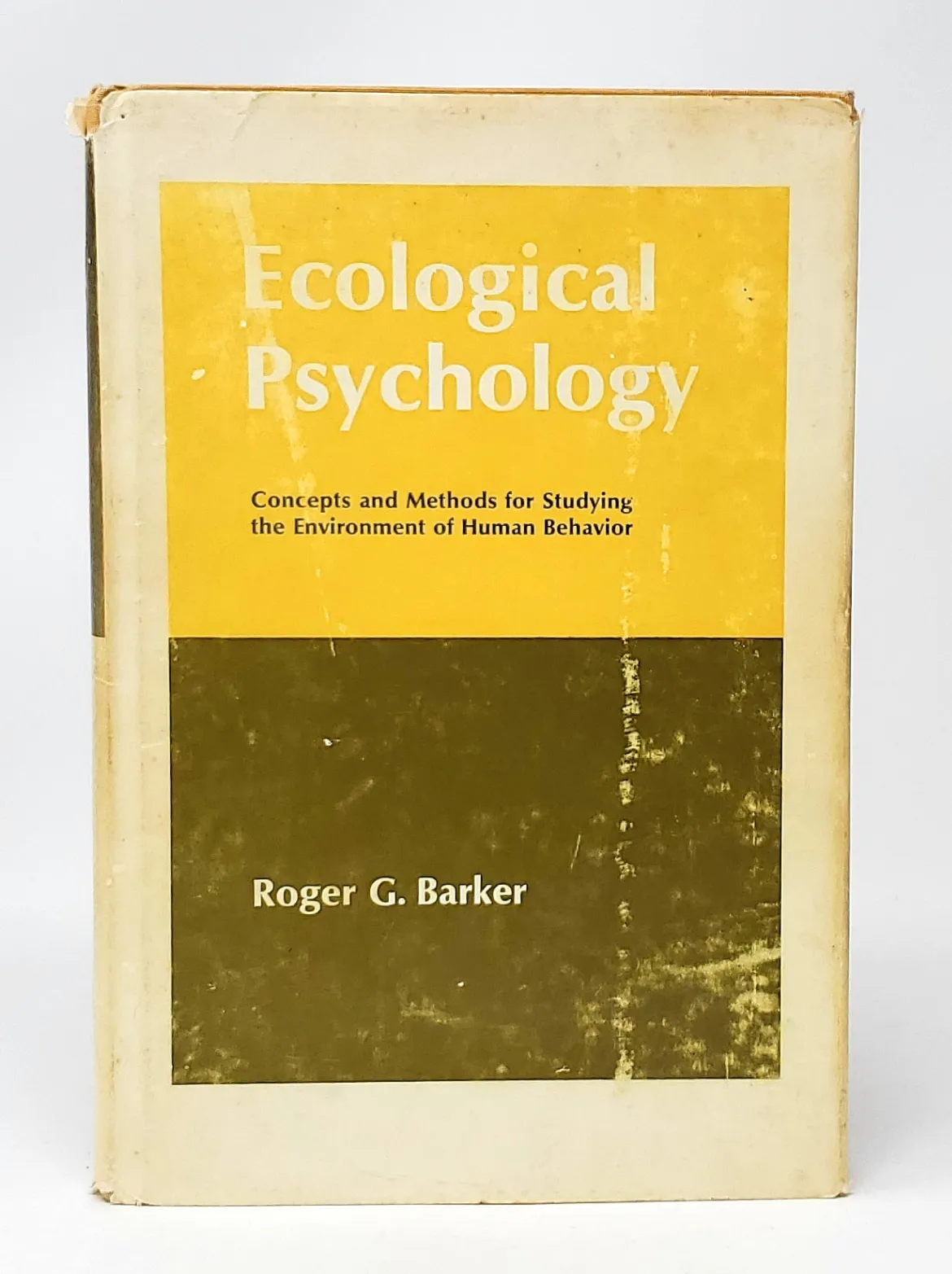
Ecological Psychology: Concepts and Methods for Studying the Environment of Human Behavior
Barker's 1968 book is the classical formulation of behavior setting theory, arguing that the environment of molar human behavior consists of extra-individual, time-space bounded units—behavior settings—that persist despite turnover of participants. A behavior setting is defined structurally by standing patterns of behavior-and-milieu that are synomorphic (similar in structure) and circumjacent (surrounding), and dynamically by synomorphs whose internal interdependence exceeds their interdependence with neighboring settings. The book presents the behavior setting survey method developed at the Midwest Psychological Field Station and introduces undermanning theory.
Key Details
Related Books
View AllSimilar books from the same category, ranked by shared topics and reader engagement.



Key Insights — Read in 10 Minutes
What is a behavior setting, and what makes it a distinct unit of analysis?
A behavior setting is an extra-individual, time-space bounded unit consisting of one or more standing patterns of behavior-and-milieu, where the milieu is circumjacent and synomorphic to the behavior . It is extra-individual because the standing pattern persists despite turnover of the particular persons involved—the same basketball game continues when players substitute, the same worship service continues when congregants change . Barker's dynamic criterion is that synomorphs within a setting have a specified degree of interdependence among themselves that is greater than their interdependence with parts of neighboring settings . This makes behavior settings the relevant environment of molar, goal-directed behavior, distinct from both individual psychological processes and purely physical surroundings.
How did Barker discover behavior settings, and what empirical problem led him to them?
Barker founded the Midwest Psychological Field Station in Oskaloosa, Kansas, in 1947 to study children's behavior in situ . His early specimen records revealed a puzzle: antecedent social inputs from others predicted a child's subsequent actions only about half the time, leaving behavior seemingly unpredictable at the individual level . But he noticed that variability among different children in the same community region was less than variability of the same child across different regions—when a child moved from church to drugstore to football game, their behavior changed congruently with the setting . Barker realized the environment itself, not individual-level stimulus-response chains, provided the lawful structure he sought. The behavior setting was the unit that captured this regularity.
What is undermanning theory, and how does it explain behavior in understaffed settings?
Undermanning theory describes what happens when a behavior setting operates with fewer inhabitants than the optimal number required to fill its essential roles . Barker observed that understaffed settings tend to carry out their programs unchanged; with fewer people available, each occupant must take on more varied and responsible actions to maintain the setting . This produces greater interdependence, internal cohesion, and forced involvement. In overmanned settings, by contrast, participants become redundant and can choose passive, peripheral roles. The theory was tested most famously in Big School, Small School, where Barker and Gump showed that students in small high schools participated in more activities and held more responsible positions than students in large schools .
What methodological tests did Barker develop to determine whether something is a behavior setting?
Barker developed two sequential tests . The structural test determines which potential settings contain synomorphs—behavior-milieu units where the milieu is synomorphic and circumjacent to the behavior. The internal dynamic test, called the K-21, then assesses whether pairs of synomorphs constitute one behavior setting or two by rating their interdependence across seven facets: behavioral, population, leadership, spatial, time, behavioral objects, and behavior mechanisms . A single behavior setting must show greater internal interdependence among its synomorphs than interdependence with neighboring settings. Barker recommended multiple raters over a one-year period for rigorous application, though he acknowledged smaller-scale studies could adapt the method.
What is the relationship between this book and Barker's earlier Midwest and Its Children?
Midwest and Its Children (1955), co-authored with Herbert F. Wright, was the first major research report from the Midwest Psychological Field Station and the first published account of behavior settings . Almost half of that book was devoted to the behavior setting method and its application to the town of Midwest. Ecological Psychology (1968) presents the mature theoretical formulation of behavior setting theory, incorporating the basic statement that first appeared in Barker's 1960 Nebraska Symposium on Motivation paper 'Ecology and Motivation' . The 1968 book also reports new data from behavior setting surveys of Midwest conducted in the intervening years. It is widely regarded as the classical formulation of the approach .
Why did Barker eventually abandon the term 'ecological psychology' in favor of 'eco-behavioral science'?
Barker came to believe that the laws governing behavior settings are incommensurate with the laws of scientific psychology that govern individual behavior . He argued it was impossible to understand the ecological environment of molar behavior using concepts and theories designed for individual persons. In a 1969 paper, he called for a new science of the ecological environment—an eco-behavioral science—that would study the environment of behavior as a phenomenon worthy of investigation in its own right, not merely as an instrument for understanding behavior-relevant programming within persons . He renewed this call in 1978. What began as a specialty within child psychology thus separated into an independent science, and Barker stopped calling it ecological psychology.
Show 2 more insights
What criticisms has behavior setting theory received from community psychology and other perspectives?
A 1988 critique in the Journal of Community Psychology identified significant limitations: behavior setting theory's operational definition of 'community' is narrow, and its predictions regarding direct influences on behavior have not been adequately validated in natural settings . From a community psychology perspective, the theory's fundamental emphasis on the structural form of settings rather than the functions they fulfill for participants is problematic. The critique recommended adopting new units of analysis and placing greater emphasis on intended and unintended satisfactions that settings produce. Another limitation is practical: a typical behavior setting survey takes over a year to complete, restricting the approach to small communities .
How has behavior setting theory been applied in contemporary research?
Contemporary applications include health research, where behavior setting theory has been used to evaluate and shift environments for healthier living—studies have examined clean water use, substance abuse correlated with environmental conditions, and mental health in social settings . Gibson and Werner's airport waiting area studies applied the theory to smoking regulation compliance, finding that ambiguous areas had significantly more smokers than clearly defined no-smoking areas. A 2023 guide for early career researchers demonstrates the K-21 method in a university art gallery, showing how the structural and dynamic tests can be applied at smaller scales . Wicker's 1987 extension added temporal stages (pre-convergence, convergence, continued existence, divergence) and greater recognition of individual factors .
Wealthy Psyche is an intellectual archive. We do not host, distribute, or sell book copies — physical or digital. We provide structured knowledge to help you think better, faster.