


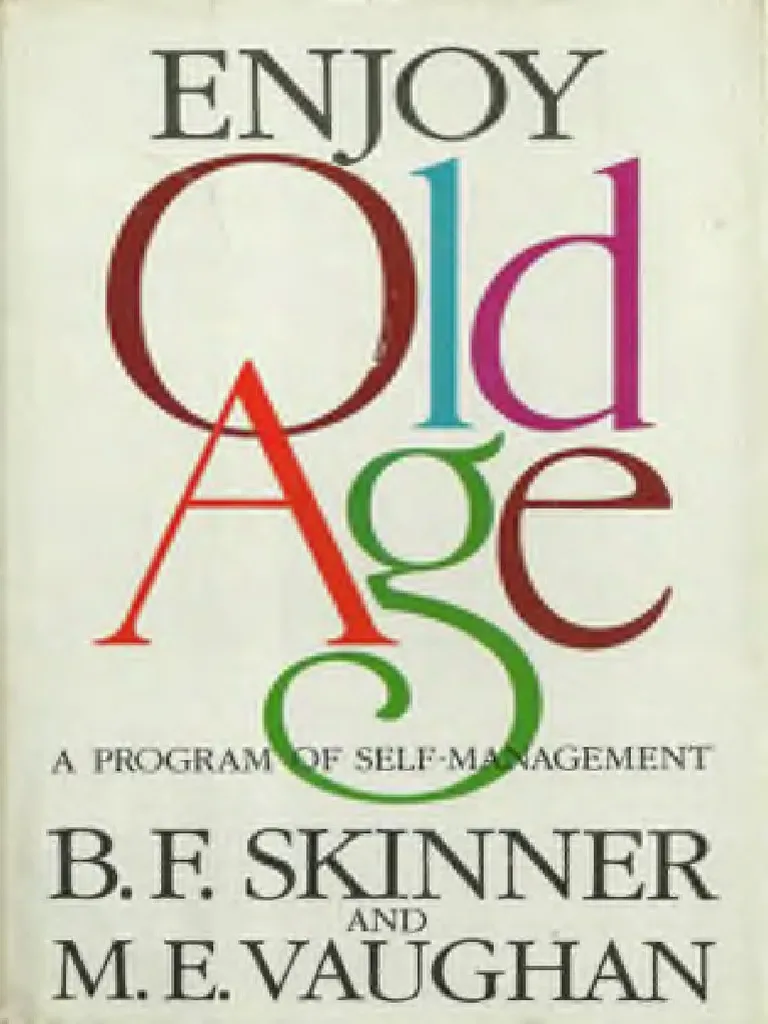
Enjoy Old Age: A Program of Self-Management
 B. F. Skinner
Skinner and Vaughan argue that old age is not merely a period of decline to be endured but a set of behavioral problems to be solved through deliberate environmental design and self-management. Applying operant principles to the practical difficulties of aging—failing eyesight, short-term memory loss, reduced mobility, changed social roles—the book proposes concrete techniques: arranging cues, altering surroundings, and establishing new reinforcement contingencies. The central claim is that satisfying old age must be planned from youth, since stable habits of self-management allow individuals to compensate for diminishing capacities rather than surrender to them.
Key Details
Related Books
View AllSimilar books from the same category, ranked by shared topics and reader engagement.



Key Insights — Read in 10 Minutes
What is the central argument of Enjoy Old Age, and how does it apply Skinner's behavioral principles to aging?
Skinner and Vaughan argue that old age presents a set of behavioral problems that can be solved through deliberate environmental design and self-management, rather than accepted as inevitable decline. They apply operant principles to the practical difficulties of aging: failing eyesight, short-term memory loss, reduced mobility, and changed social roles. The solution is not exhortation or positive thinking but concrete environmental modification—arranging cues, altering surroundings, and establishing new reinforcement contingencies. The book's central precept is that a satisfying old age must be planned from youth, since stable habits of self-management allow individuals to compensate for diminishing capacities rather than surrender to them. A review in a Brazilian psychology journal describes the message as being that enjoyable old age must be prepared from youth, with stable self-management habits guaranteeing greater control over physical and social environments.
Who was Margaret Vaughan, and what was her contribution to the collaboration?
Margaret E. Vaughan was an expert on aging and a former research associate at Harvard who co-authored the book with Skinner. While Skinner provided the behavioral framework and the authority of his name, Vaughan contributed expertise in gerontology and the practical concerns of older adults. The book's tone—pragmatic, unsentimental, yet comforting—reflects this collaboration. One reviewer noted that Skinner and Vaughan offer commonsense advice for mitigating the problems brought on by growing older, while another observed that the book can make being old much nicer than you anticipate or may now be experiencing. The book was published when Skinner was approaching eighty, giving it the character of personal testimony as well as practical guidance.
What specific techniques does the book propose for managing the practical problems of aging?
The book offers concrete strategies for common age-related difficulties. For failing eyesight, Skinner describes attaching an eye-drop bottle to his toothbrush with a rubber band so he would not forget to use it. For memory problems, the authors recommend arranging environmental cues and establishing routines that reduce reliance on short-term recall. For mobility and balance issues, they suggest modifying living spaces to minimize hazards. The general approach is captured in the book's subtitle: self-management. Rather than fighting decline through willpower, the older person arranges antecedents and consequences—the ABCs of behavior analysis—to make desired behaviors more likely and undesired ones less likely. An appendix maps the plain-spoken advice to technical behaviorist terms.
How has the book been received by readers and reviewers since its publication?
The book has been consistently well-received as a practical guide. Vogue called it a cheering book to read, to give to someone you love who is growing older. The New York Times described it as commonsense advice for mitigating the problems brought on by growing older that can make being old much nicer than you anticipate or may now be experiencing. Time praised it as a collection of sensible tips for the elderly. A Goodreads reviewer with behavioral psychology training called it one of the best self-help books I've ever read, noting that instead of being filled with cheer-up nostrums, it offers a pragmatic, face-reality view of old age, as a time of diminished capabilities that can be worked around. Another reviewer observed that the book is surprisingly practical and that Skinner's lifetime of careful observation gave him insight into the practical difficulties of aging.
What is the relationship between this book and Skinner's article 'Intellectual Self-Management in Old Age'?
The book grew out of an earlier article Skinner wrote titled 'Intellectual Self-Management in Old Age,' which detailed a case study of his own efforts to manage behavioral deficits resulting from aging. The B. F. Skinner Foundation notes that the content of this paper served as the basis for Enjoy Old Age. The article and the book share the same central concern: how to use behavioral principles to maintain intellectual functioning and compensate for age-related losses. The book expands the scope beyond intellectual self-management to address the full range of practical problems—social, emotional, and physical—that aging presents. This genesis in personal experience gives the book an authenticity that distinguishes it from more abstract gerontological advice.
How does Skinner's approach to aging differ from conventional self-help or positive-thinking approaches?
Skinner's approach rejects both denial and cheerfulness as strategies for coping with aging. One reviewer noted that the book is permeated with Skinner's behavioralism but does not label it as such until an appendix, and that its central precept is a pragmatic, face-reality view of old age, as a time of diminished capabilities that can be worked around. A Brazilian review observes that the book is without illusions or illusionism, showing old age in its greatness and in its miseries, but without the usual grandiloquence—neither the attitude of what an uncomfortable reality, oh what a total disgrace nor what a wonder are the golden years. Skinner and Vaughan treat aging as a problem to be solved, but gradually, step by step, so that one can like this autumn instead of deploring its fallen leaves.
Show 1 more insights
What practical legacy has the book had in gerontology and applied behavior analysis?
The book is cited in behavior-analytic literature as a foundational example of applying operant principles to older populations. A Taylor & Francis textbook on behavior analysis notes that for older people living at home, contingencies of reinforcement can be used to help keep them motivated to do some very basic activities like eating properly and exercising, citing Enjoy Old Age as the key reference. The same source observes that while there is not a great deal of research in this field, it will become increasingly important as populations age, and that nursing homes should consider hiring behavior analysts to help them prevent their residents from becoming dependent on staff for things they can do for themselves. A Japanese review in the Journal of Behavior Analysis calls Skinner a splendid model of adaptive aging and discusses how his ideas have been applied to treating inappropriate behaviors associated with aging since the early 1970s.
Wealthy Psyche is an intellectual archive. We do not host, distribute, or sell book copies — physical or digital. We provide structured knowledge to help you think better, faster.