


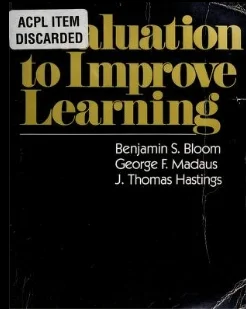
Evaluation to Improve Learning
 Benjamin Samuel Bloom
Bloom, Madaus, and Hastings argue that classroom evaluation exists to improve teaching and learning, not to sort students by ability. The central mechanism is the integration of formative, diagnostic, and summative evaluation into a feedback cycle: evaluate to identify what has not yet been mastered, correct instruction, and bring students to mastery. The book operationalizes this through the Taxonomy of Educational Objectives, providing item-writing techniques for each cognitive and affective level. It rejects the selection function of evaluation in favor of a development function, arguing that most students can reach mastery if instruction responds to evidence of learning.
Key Details
Related Books
View AllSimilar books from the same category, ranked by shared topics and reader engagement.



Key Insights — Read in 10 Minutes
What is the central claim of Evaluation to Improve Learning, and what does it reject about the purpose of educational assessment?
The book's spine is the argument that evaluation in education should serve a development function, not a selection function . Bloom, Madaus, and Hastings state that their primary concern is evaluation's use 'to improve teaching and learning,' and they define evaluation as the systematic collection of evidence to determine whether changes are taking place in learners and to what degree . This rejects the conventional view of evaluation as a mechanism for sorting students by ability or predicting future achievement. The authors champion the view that the future of evaluation lies in improving instruction, evidencing accomplishment of goals, and providing feedback—not in selecting those with higher levels of skill . The practical instrument is formative evaluation: systematic assessment during instruction to identify what has not been mastered and correct it before the summative judgment.
What is the relationship between this book and Bloom's earlier Handbook on Formative and Summative Evaluation?
Evaluation to Improve Learning is a major revision of Part I of the Handbook on Formative and Summative Evaluation of Student Learning, published in 1971 by the same authors [citation:1]. The chapter organization remains largely the same, but a new chapter on item writing and item selection was inserted, while chapters on cooperative development of evaluative systems and emerging developments in evaluation were removed . The revision was substantial within chapters, with major additions, changes, and restructuring . The 1981 book distills the 1971 handbook's practical content for classroom teachers, focusing on the fifty to sixty teacher-made quizzes, progress tests, and examinations that the typical student takes each year .
How does the book use Bloom's Taxonomy of Educational Objectives, and what specific evaluation techniques does it provide?
The book is organized around the taxonomies of educational objectives, with chapters 8 through 11 presenting models and techniques for constructing evaluation instruments for different types of objectives at all levels of education . The appendix contains a condensed version of the Taxonomy of Educational Objectives [citation:1]. The taxonomy classifies cognitive objectives into six levels: knowledge, comprehension, application, analysis, synthesis, and evaluation [citation:4][citation:9]. The book provides guidance for writing items targeting each level, from objective tests for knowledge and comprehension to essay examinations for synthesis and evaluation. For affective objectives—interests, attitudes, values—the book also offers assessment techniques [citation:1]. The detailed tables of contents and index enable test constructors to find models and illustrations for the specific objectives they want to evaluate .
What role does mastery learning play in the book's argument?
Mastery learning provides the pedagogical framework for the book's evaluation philosophy. Chapter 3 argues that 'most students (perhaps more than 90 percent) can master what we have to teach them,' and that it is the task of instruction to find the means to enable that mastery . The authors note that the widespread use of mastery learning during the 1970s improved students' learning, increased their interest in the subject, and gave them increased confidence in their ability to learn . Evaluation's role in mastery learning is diagnostic and formative: it identifies what has not yet been mastered so instruction can be corrected before students fall too far behind. This aligns with the book's broader argument that evaluation should serve learning rather than sorting.
How was the book reviewed by the educational measurement community?
A review in the Journal of Educational Measurement described the book as a handbook intended for present and future classroom teachers, organized with chapter highlights, summaries, and exercises to facilitate use as a reference rather than a cover-to-cover read . The reviewer noted that the chapter outlines are 'very helpful for the intended use as a handbook' and define important topic areas . The review observed that the chapter on formative evaluation contains the main focus of the handbook, with the authors stressing corrective feedback to improve instruction . A separate review in a teacher education context noted that the book is 'well adapted to a variety of teacher education courses,' covers both the construction of objectives and assessment procedures, and includes checklists that enable teachers to check quickly the instruments they construct .
What is the most common misconception about the book's approach to evaluation?
The most persistent misconception treats Evaluation to Improve Learning as a test-construction manual or a guide to measuring student achievement more accurately. The book is explicitly a handbook for using evaluation to improve teaching and learning, not for ranking students or certifying competence . The authors distinguish evaluation from measurement: measurement assumes constant characteristics can be measured in all people for comparison, while evaluation observes a prescribed change in an individual and uses results to foster further change [citation:12]. A second misconception assumes the book is solely about formative evaluation, when it covers summative, diagnostic, and formative approaches—though the formative chapters carry the book's central argument [citation:1]. The authors' intent is to present a broader view of evaluation and its place in education .
Wealthy Psyche is an intellectual archive. We do not host, distribute, or sell book copies — physical or digital. We provide structured knowledge to help you think better, faster.