


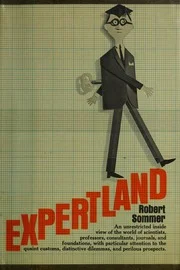
Expertland
 Robert Sommer
Sommer's 1963 book is a satirical anatomy of the professional researcher's world, treating 'Expertland' as a place outside ordinary time and space whose inhabitants—professors, scientists, consultants—live by credential hierarchies, perpetual projects, and conventions where everyone hobnobs looking for the next job. Beneath the comedy lies a sociological observation: experts constitute a mobile, voteless, house-renting class whose impersonal service relationships and rootlessness mark them as poor citizens in outsiders' eyes. Sommer challenges the myth that expert work is beyond evaluation.
Key Details
Related Books
View AllSimilar books from the same category, ranked by shared topics and reader engagement.



Key Insights — Read in 10 Minutes
What is the central claim of Expertland, and what does it reject?
The book argues that the professional researcher's world constitutes a distinct social formation—'Expertland'—with its own geography, hierarchies, and customs, and that this world can be analyzed sociologically rather than merely celebrated or dismissed. Sommer explicitly challenges the myth that expert work is beyond evaluation . The inhabitants—professors, scientists, research men—live by credential rankings where a Ph.D. outranks an M.A. and below the B.A. one simply does not exist . Kirkus Reviews noted that beneath the breezy satire lie 'a few cunning, even chilling sociological observations' about grant culture, meetings, and memo-writing as status games .
How does Sommer's analysis of the expert's citizenship status function as social criticism?
Sommer observes that experts often do not vote in local elections, join service clubs, or own their homes, leading outsiders to view them as poor citizens. He reports that experts, in turn, reject this judgment, arguing that the rules disqualifying them were made by outsiders to penalize mobility and that paying taxes fulfills their civic obligation . The analysis identifies a structural tension: experts prefer impersonal service relationships—phoning City Hall and speaking to whoever is on duty—while laypeople prefer knowing 'Joe' or 'Alderman Shultz.' Sommer frames this as a clash between community rootedness and expert mobility, a critique that anticipated later discussions of cosmopolitan professionalism.
What does the book reveal about the daily texture of academic and scientific work?
Kirkus Reviews summarized the satirical taxonomy: meetings that 'can go on for five years, usually with coffee breaks'; projects that continue indefinitely in a 'hit-and-run grant culture'; conventions where 'lots of papers are read but anyone found taking notes must be a graduate student'; and memo-writing 'like musical chairs: no one wants to get caught with the last one.' The secretary emerges as a potential tyrant who rushes in asking 'What have you written now?' the moment she runs out of things to type . These vignettes anatomize the institutional rituals that structure research life, treating them as objects of sociological observation rather than mere anecdotes.
How did Sommer himself characterize the book's relationship to his later scholarly work?
Expertland is anomalous in Sommer's publication record, which is otherwise dominated by environmental psychology research and textbooks. A LibraryThing reviewer described it as 'a set of largely satirical essays on the interrelations of the personalities encountered as a consultant academic,' adding that it is 'readable, and often entertaining' . The book's concern with how professional settings shape behavior—the ways credential hierarchies, spatial arrangements of meetings, and institutional incentives structure conduct—connects thematically to Sommer's later work on how environments constrain and enable human activity. It is satire in form but environmental psychology in substance.
What is the publication history and subsequent reception of Expertland?
The book was published by Doubleday in 1963 as a 210-page first edition . It received a German translation as Im Reiche der Experten in 1964, suggesting some international reach . Sommer's own publication list confirms the 1963 Doubleday edition and notes that an excerpt appeared in The New York Times Magazine in July 1963 under the title 'Dark Journey into Expertland' . The Library of Congress classified it under Scientists—Anecdotes, reflecting its ambiguous status between humor and social commentary . LibraryThing records only two copies held by members, indicating that the book has not been widely collected despite its author's later prominence .
Wealthy Psyche is an intellectual archive. We do not host, distribute, or sell book copies — physical or digital. We provide structured knowledge to help you think better, faster.