


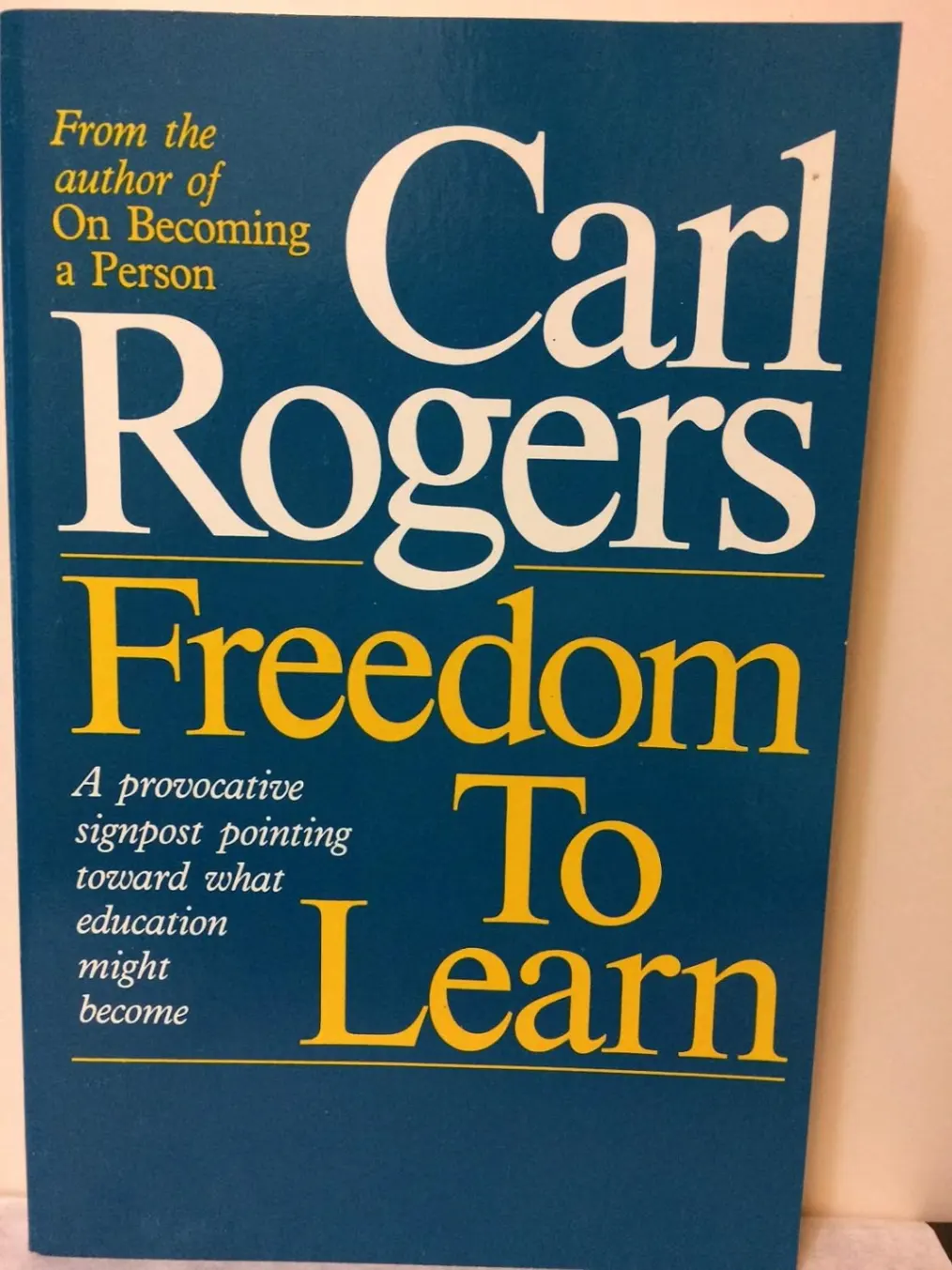
Freedom to Learn: A View of What Education Might Become
 Carl Rogers
Rogers extends his person-centered approach from therapy into education, arguing that the impetus to learn lies within the student and that the teacher's role is to become a facilitator of that natural drive rather than a purveyor of knowledge. The book's mechanism is the creation of a classroom climate characterized by congruence, acceptance, and empathic understanding, in which students choose what and how to learn. It rejects the traditional model of education as transmission, insisting that learning which is self-initiated and personally meaningful produces the autonomous, self-starting learner a changing world requires.
Key Details
Related Books
View AllSimilar books from the same category, ranked by shared topics and reader engagement.


Key Insights — Read in 10 Minutes
What is the central argument of Freedom to Learn, and what does it reject?
Rogers argues that the impetus to learn lies within the student, and that the teacher's role is to support the expression of that impetus rather than to transmit knowledge . He rejects the traditional model of education as the passive transfer of information from teacher to student, proposing instead that learning which is self-initiated and personally meaningful is the only kind that produces the autonomous, adaptable person a rapidly changing world requires . The book's title states the thesis: students must be given the opportunity to break away from the constraints of a formal syllabus and benefit from the richer learning possible through experiential and flexible experiences .
What are the core conditions Rogers applies from therapy to the classroom?
Rogers transfers the three core conditions of client-centered therapy—congruence, unconditional positive regard, and empathic understanding—to the educational relationship. The teacher must be a real person to students, not a faceless embodiment of curricular requirements, and must accept the student's true needs and feelings without judgment . The book argues that these relational conditions, rather than teaching technique or curriculum design, create the climate in which self-directed learning flourishes. Rogers believes that the quality of the relationship between student and teacher is more important than curriculum content, a position that distinguishes his approach from both traditional and progressive educational models that focus on subject matter or method .
How does the book's argument relate to Rogers's work as a psychotherapist?
Freedom to Learn is a direct application of the person-centered principles Rogers developed in Client-Centered Therapy (1951). The same confidence in the individual's actualizing tendency that grounds his therapeutic approach—the belief that people possess an innate drive toward growth given the right relational conditions—is extended to the learner. Rogers explicitly frames the teacher as a facilitator whose role parallels the therapist's: creating a relationship characterized by acceptance, empathy, and genuineness in which the other person can discover their own direction . The book's first-person narrative style and case examples are also adapted from his clinical writing, aiming to communicate the felt experience of person-centered practice rather than merely its theoretical rationale .
What is the publication history of Freedom to Learn across its editions?
The first edition was published in 1969 by Charles E. Merrill Publishing Company in Columbus, Ohio . A second edition, retitled Freedom to Learn for the 80s, appeared in 1983, providing new research data on person-centered education and additional examples from elementary through college settings . The third edition (1994), co-authored with H. Jerome Freiberg after Rogers's death in 1987, updated the text with twenty years of evidence and added five new chapters on topics including learning from children who love school, the administrator's role as facilitator, and classroom management with the learner . The 1994 edition runs 406 pages and includes both Rogers's original first-person narrative and Freiberg's contemporary research contributions .
What is the documented critical reception of the book's educational philosophy?
Reception has been divided. A Michigan Quarterly Review assessment called it a book with the 'ring of phenomenological truth,' capturing 'the excitement, the rewards, the wonderful successes, the dilemmas, the failures' of programs that give students increased freedom . A Michigan Quarterly Review reviewer praised its unapologetic statement of liberal principles and its research findings rebutting conservative claims that progressive education ruined American schooling . However, a scholarly essay-review in Teaching and Teacher Education argued that Rogers and Freiberg's reflections on education are 'rather romantic than humanistic,' criticizing the transfer of therapeutic concepts to schooling and the approach's ignorance of the social and societal dimensions of education, including the fact that both education and development are conflictual by nature .
How has Rogers's concept of freedom to learn influenced contemporary education?
Rogers's work has informed current movements in both schools and higher education, particularly co-created curriculum and 'students as partners' in learning and teaching . A 2016 paper from the University of Edinburgh examined whether academic staff have time for freedom to learn in the contemporary higher education context, noting that Rogers's argument for students to influence their own learning remains a reference point for critical pedagogy . A Chinese scholarly study described Rogers's view as a 'soundless revolution,' emphasizing self-directed learning of personally meaningful knowledge to promote individual development and self-actualization, with implications for basic education reform . The book's first-person narrative technique has also influenced how educational texts communicate practice.
Show 1 more insights
What did Rogers say about the practical difficulty of implementing freedom in the classroom?
In a 1984 interview, Rogers cautioned against sudden, wholesale shifts to student-directed learning. He advised that freedom 'is built on experience and that is achieved by taking it in small steps that you can really stand by' . He warned: 'Don't grab freedom if you are uneasy about it. Better to have a little freedom that you can be easy with than to try to go all the way... and then getting cold feet and trying to pull it back to yourself. That can be disastrous' . Rogers also acknowledged that giving students freedom means they will make mistakes in handling responsibility, and that this requires a complete rethinking of ordinary classroom procedure, with mistakes treated as the most valuable way of learning provided students are encouraged to examine them .
Wealthy Psyche is an intellectual archive. We do not host, distribute, or sell book copies — physical or digital. We provide structured knowledge to help you think better, faster.