


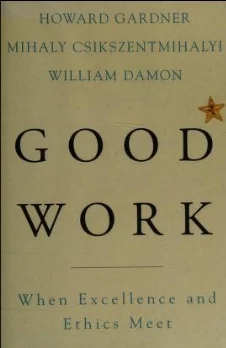
Good Work: When Excellence and Ethics Meet
 Howard Earl Gardner
Gardner, Csikszentmihalyi, and Damon investigate how professionals maintain ethical standards and produce socially responsible work when market forces and technological change exert relentless pressure. Through hundreds of interviews with geneticists and journalists, they identify three components of 'good work'—excellence, engagement, and ethics—and analyze how these fundamentals can fall out of harmony. The book introduces 'humane creativity': high-level performance coupled with social responsibility. Genetics and journalism serve as contrasting case studies, one well-aligned, the other in crisis, showing how domain values, institutional pressures, and personal stands determine whether good work survives.
Key Details
Related Books
View AllSimilar books from the same category, ranked by shared topics and reader engagement.



Key Insights — Read in 10 Minutes
What is the central definition of 'good work' in the book, and what three components constitute it?
The authors define good work as work that is both of expert quality and socially responsible . Their research identifies three principal components, later formulated as the 'Three Es': Excellence (high competence and quality), Engagement (deep involvement and personal meaningfulness for the practitioner), and Ethics (seeking and living up to the highest moral standards) . The central question is what happens when these fundamentals fall out of harmony. The authors argue that if excellence and ethics are in harmony, a person leads a personally fulfilling and socially rewarded life, but under market pressure these components often conflict . The framework was developed through extensive empirical research and subsequently became the foundation of The Good Project at Harvard Project Zero .
Why did the authors choose genetics and journalism as their case study fields, and what contrasts did they find?
The authors selected genetics and journalism because both fields generate and manipulate information that affects human lives—one has the potential to control the content of our bodies, the other the content of our minds . They found a sharp contrast between the two. Genetics was 'well-aligned': scientists, the general public, and corporate shareholders substantially agreed on goals and values . Journalism had 'emerged as a field in which reporters, the general public, and shareholders differ sharply in their aspirations' . Journalists were deeply disillusioned by the conflict between commerce and ethics, with practitioners reporting that integrity had been compromised, market share demanded priority over truth, and time to practice the craft had eroded . This contrast allows the authors to analyze how domain values, institutional pressures, and market forces interact differently across professions.
What research methodology did the authors employ, and what was the scope of the study?
The Good Work Project began in 1995. The authors conducted hundreds of in-depth interviews with practitioners and subject matter experts in genetics and journalism—over 100 people in each field, including figures such as Katharine Graham, Bob Woodward, Tom Brokaw, James D. Watson, and Craig Venter . Interviews probed participants' goals and visions, obstacles and fears, and how they pass on cherished practices and values . The research extended beyond the book: the larger GoodWork® Project conducted interviews with more than 1,200 people from nine professions, including journalism, genetics, theatre, higher education, philanthropy, law, medicine, business, and pre-collegiate education . The study was designed as a model for evaluating the relationships among ethics, commerce, and technology in other professions .
What practical strategies or 'levers' do the authors identify for maintaining good work under pressure?
The authors identify five 'levers for good work' that professionals can use: creating new institutions, expanding functions of existing institutions, reconfiguring existing institutions' membership and reaffirming their values, and taking personal stands . They advocate continually revisiting 'the traditions of the domain' that initially attracted practitioners, to fortify integrity and commitment to the profession's mission . The book includes stirring examples of individuals who took personal stands when values were compromised, including Ray Suarez leaving commercial news for NPR, Carol Marin resigning when Jerry Springer was hired for commentaries on her nightly news, and Linus Pauling urging scientists not to be co-opted by weapons projects . These strategies operate at multiple levels: individual, institutional, and domain-wide.
How was the book received by reviewers, and what criticisms were raised?
Publishers Weekly called it a 'somewhat bloated tome' with 'unsurprising research results, unquestioning reporting and plodding prose' that 'don't live up to previous work by these prestigious psychologists' . CHOICE Magazine noted that while the authors' objectives were 'important and highly relevant,' their findings and analyses were 'not clearly and concisely presented, making for difficult reading' . The Nieman Reports review found the journalism section told a 'drearily familiar story' but credited the book for being 'more than an atrocity tale' by documenting journalism's 'proud legacy of moral standards' . The book's strongest sections were identified as the historical and interview material, while the analytical framework was seen as insufficiently novel to justify the length.
How does Good Work relate to Csikszentmihalyi's concept of flow and Damon's work on moral development?
The book synthesizes the collaborators' prior research programs. Csikszentmihalyi's Flow (1990) established that optimal experience occurs when challenges match skills and attention is fully invested in the task. The concept of Engagement in the Three Es framework draws directly on this: good work is deeply involving and meaningful for the practitioner . Damon's work on moral development, including The Moral Child and The Youth Charter, informs the Ethics component: good work seeks to discern and live up to the highest moral standards . Gardner's contribution includes the concept of 'humane creativity'—high-level performance coupled with social responsibility—which integrates his longstanding interest in creativity and ethics . The book represents a convergence of three distinct research trajectories around a shared question about professional life.
Show 1 more insights
What is the most common misconception about the book's argument?
The most persistent misconception treats Good Work as a prescriptive manual for ethical behavior or a simple moralistic tract. The authors' project is empirical and analytical: they investigate how professionals in two fields actually navigate the tension between excellence and ethics under market pressure, not how they ought to. A second misconception assumes the Three Es framework was fully formulated in the 2001 book, when the authors have since explicitly named the components and developed them into a more elaborate framework through subsequent research . A third misreading treats the genetics-journalism contrast as a simple good-versus-bad comparison, when the authors describe genetics as 'well-aligned' rather than ethically superior—a contingent condition that could change as market pressures intensify.
Wealthy Psyche is an intellectual archive. We do not host, distribute, or sell book copies — physical or digital. We provide structured knowledge to help you think better, faster.