


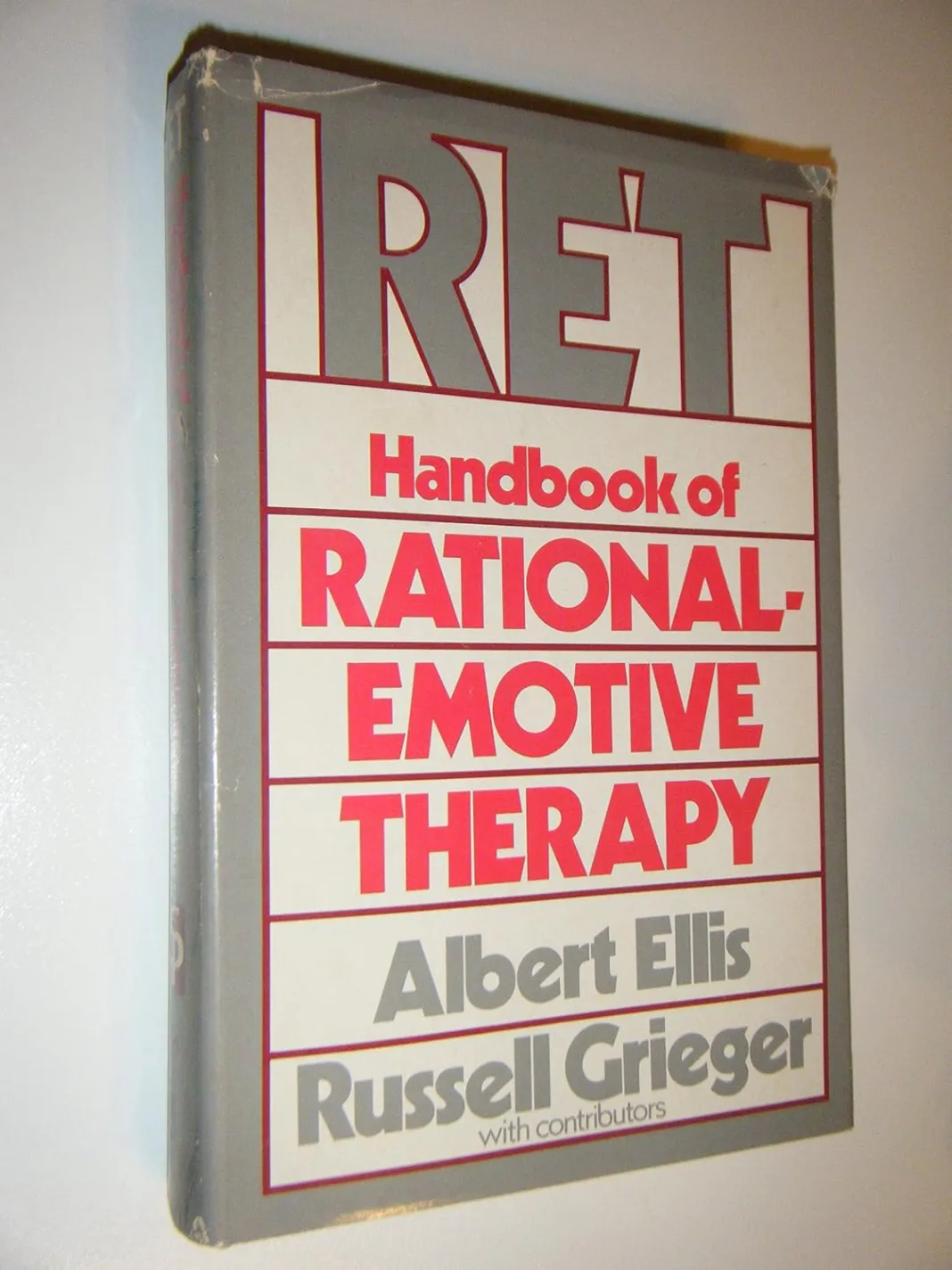
Handbook of Rational-Emotive Therapy
 Albert Ellis
Ellis and Grieger assemble the first comprehensive handbook of rational-emotive therapy, arguing that RET is not merely a clinical technique but a comprehensive theory of personality and disturbance. The volume collects original chapters from leading cognitive-behavioral figures—including Beck, Meichenbaum, Lazarus, and Mahoney—alongside Ellis's statements on the basic clinical theory, outcome research, and applications to sex, love, marriage, and psychotic disorders. Its central mechanism is the ABC framework applied across the full range of clinical and theoretical domains, establishing RET's place within the broader cognitive revolution in psychotherapy.
Key Details
Related Books
View AllSimilar books from the same category, ranked by shared topics and reader engagement.


Key Insights — Read in 10 Minutes
What is the purpose of the Handbook relative to Ellis's earlier theoretical books?
The Handbook is Ellis's attempt to establish RET as a comprehensive system rather than a collection of techniques. Where Reason and Emotion in Psychotherapy (1962) presented the clinical rationale and A Guide to Rational Living (1961) translated it for lay readers, the Handbook assembles original contributions to demonstrate RET's theoretical breadth and empirical grounding. It includes Ellis's foundational chapters on the basic clinical theory, research data supporting RET's hypotheses, and a review of outcome studies by DiGiuseppe and Miller . The volume also collects chapters from leading cognitive-behavioral researchers, positioning RET within the broader cognitive revolution and showing its applicability across the full range of clinical phenomena.
Why does the Handbook include chapters by Beck, Meichenbaum, Lazarus, and Mahoney?
The inclusion of these figures is deliberate: Ellis wanted to situate RET within a shared cognitive-behavioral movement rather than present it as an isolated school. Aaron Beck and Brian Shaw contribute a chapter on cognitive approaches to depression; Donald Meichenbaum and Roy Cameron write on modifying what clients say to themselves; Arnold Lazarus addresses the egoless state of being; and Michael Mahoney presents 'personal science' as a cognitive learning therapy . A 1979 review in Contemporary Psychology noted that RET 'expands in this book from papers by Ellis of mid-'60s vintage to Beck, Mahoney, and Meichenbaum's explorations of cognitive causes' . This editorial strategy framed RET as part of a broader convergence rather than a singular innovation.
What empirical evidence for RET did the Handbook present at the time?
The Handbook included two chapters directly addressing the evidence base: Ellis's own review of research data supporting the clinical and personality hypotheses of RET and other cognitive-behavior therapies, and DiGiuseppe and Miller's review of outcome studies on rational-emotive therapy . This made the 1977 volume one of the first books to systematically compile outcome evidence for a cognitive-behavioral approach. However, the evidence base was limited at the time, and later reviewers noted that Ellis's institute produced relatively little original research compared to Beck's group. The Handbook's inclusion of these reviews signaled Ellis's awareness that RET needed empirical validation, even if his own institute never became a major research producer.
What did reviewers identify as the Handbook's limitations?
A 1979 review in Contemporary Psychology was notably critical of the volume's usefulness for experienced practitioners. The reviewer, Walter O'Connell, wrote that the Handbook is 'essentially geared for the novice in the cognitive-behavioral world,' while 'the old campaigner in the fight against mental dis-ease may find that the Handbook fails to be very handy' . O'Connell also found the book repetitive, describing it as 'excessively pounds, repeats, and inundates the left brain: 29 chapters and 433 pages of rampant rationality' . These criticisms suggest the Handbook functioned better as an introduction to RET for newcomers than as a reference for seasoned clinicians.
How does the Handbook relate to Volume 2, published in 1986?
Volume 2 (1986) was published nearly a decade later, also edited by Ellis and Grieger, and shifted from the first volume's theoretical and empirical breadth toward more practical clinical guidance. A 1988 review in PsycCRITIQUES by Timothy Smith noted that the practice component of Volume 2 was 'generally quite satisfying,' praising Ellis's chapters on discomfort anxiety, resistance, and love as 'required reading for all cognitive therapists' . Smith also observed that Volume 2 was 'mislabeled; it is an anthology, not a handbook' —a criticism that applies equally to the first volume. Together, the two volumes document RET's transition from an emerging theoretical system to an established clinical approach.
What is the significance of the Handbook's chapters on sex, love, and marriage?
The Handbook devotes substantial space to application domains rarely addressed in cognitive-behavioral literature at the time. Ellis contributed chapters on sex and love problems in women, the nature of disturbed marital interactions, and the rational-emotive approach to sex therapy . These chapters reflect Ellis's longstanding interest in human sexuality and his view that RET's principles apply with equal force to intimate relationships. The inclusion of these topics distinguished the Handbook from narrower clinical manuals and signaled RET's ambition to address the full range of human functioning, not merely symptom-focused psychopathology. Ellis's willingness to address sexual and relational dysfunction directly was consistent with his broader therapeutic philosophy of confronting avoided topics.
Wealthy Psyche is an intellectual archive. We do not host, distribute, or sell book copies — physical or digital. We provide structured knowledge to help you think better, faster.