


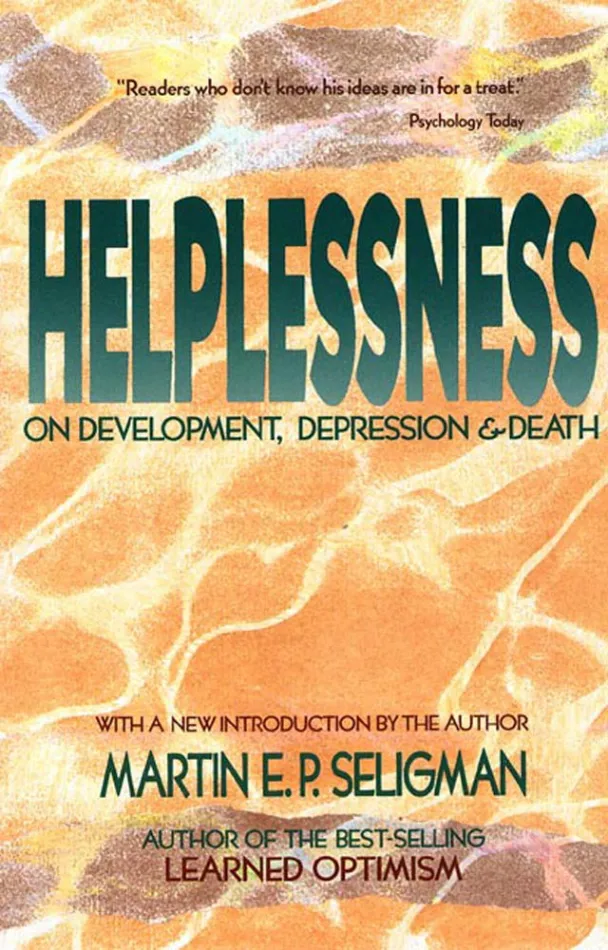
Helplessness: On Depression, Development, and Death
 Martin Seligman
Seligman's 1975 book is the foundational statement of learned helplessness theory—the claim that exposure to uncontrollable aversive events produces passivity, motivational deficits, and cognitive impairment that resemble clinical depression. The mechanism is not mere failure but the learned expectation that outcomes are independent of one's responses. Seligman extends this laboratory finding into a broad account of depression, childhood development, and even sudden death, arguing that helplessness can be unlearned through restored control. The book is the empirical origin point for the attributional reformulation that followed and for the entire trajectory of Seligman's later work.
Key Details
Related Books
View AllSimilar books from the same category, ranked by shared topics and reader engagement.


Key Insights — Read in 10 Minutes
What is the central claim of Helplessness, and what does it reject about depression?
The book's spine is Seligman's argument that learned helplessness—the expectation that outcomes are independent of one's responses—produces motivational, cognitive, and emotional deficits that closely resemble clinical depression. It rejects the then-dominant behavioral view that depression is simply reduced reinforcement or the psychoanalytic view that it is internalized anger. Seligman's alternative is cognitive-behavioral: organisms learn from uncontrollable aversive events that responding is futile, and this expectation generalizes, undermining future attempts to escape or cope. The 1975 book presents the animal laboratory evidence, extends it to human depression, and argues that helplessness can be unlearned through experiences of restored control. The theory became the empirical foundation for the attributional reformulation and for Seligman's entire subsequent career.
What specific experimental paradigm produced the initial learned helplessness findings?
The original research by Seligman and Maier (1967) used dogs in a shuttle-box apparatus. Dogs first received inescapable electric shocks; a control group received no shocks or escapable shocks. In the second phase, all dogs were placed in a situation where escape from shock was possible. Dogs previously exposed to inescapable shock typically failed to escape, often passively enduring the shock, while control dogs quickly learned to escape. Seligman theorized that the experimental dogs had learned that outcomes were independent of their responses—that nothing they did mattered—and this learning undermined subsequent escape attempts. This triadic design (inescapable shock, escapable shock, no shock) became the standard paradigm for helplessness research in animals and was later adapted for human studies using unsolvable problems.
How did the 1978 attributional reformulation change the original helplessness theory?
Abramson, Seligman, and Teasdale's reformulation addressed two problems with the original theory when applied to humans: it did not distinguish between universal helplessness (uncontrollable for everyone) and personal helplessness (uncontrollable only for oneself), and it did not explain when helplessness is general versus specific or chronic versus acute. The reformulation proposed that once people perceive noncontingency, they make causal attributions about why they are helpless. These attributions vary along three dimensions—stable/unstable, global/specific, internal/external—and determine the severity and persistence of helplessness. Attributing failure to stable, global, internal causes predicts chronic, pervasive helplessness and low self-esteem, the pattern associated with depression. This reformulation introduced the concept of explanatory style, which became a major individual-differences construct in clinical and personality psychology.
What did the 2016 neuroscience research by Maier and Seligman find about the original theory's mechanism?
Maier and Seligman's fifty-year retrospective concluded that the original 1967 theory got the mechanism backward. Passivity in response to prolonged aversive events is not learned; it is the default, unlearned response mediated by serotonergic activity in the dorsal raphe nucleus, which inhibits escape. What animals learn, when control is possible, is that they can control aversive events. This learning is mediated by the medial prefrontal cortex, which detects control and automatically inhibits the dorsal raphe nucleus. So the original formulation—that helplessness is learned and control is the baseline—is inverted: passivity is default, and control must be learned. This revision has implications for depression treatment: interventions should focus on teaching control and building medial prefrontal cortex pathways rather than merely disputing helpless beliefs.
How does Helplessness relate to Seligman's later book Learned Optimism?
Learned Optimism (1990) is the direct practical extension of the attributional reformulation developed after Helplessness. Where the 1975 book establishes the phenomenon and its depressive consequences, Learned Optimism provides the cognitive techniques for changing explanatory style from pessimistic to optimistic. Seligman developed the ABCDE method—Adversity, Beliefs, Consequences, Disputation, Energization—as a structured procedure for disputing pessimistic attributions and generating alternative explanations. The reformulation's three attributional dimensions (stable/unstable, global/specific, internal/external) provide the theoretical basis for identifying pessimistic explanatory style, and Learned Optimism supplies the intervention. The relationship is one of theory to applied method: Helplessness diagnoses the cognitive pattern that produces passivity, and Learned Optimism prescribes how to change it.
What alternative explanations and critiques have been offered for the learned helplessness findings?
Several competing accounts have challenged Seligman's cognitive interpretation. One early critique by Munton (1985) and others argued that the empirical phenomena could be explained as a schedule-shift effect—essentially an extinction-like process following a shift from continuous to partial reinforcement—without invoking cognitive mediation. Critics contended that the theory was a 'patchwork' that did not cohere as a single explanation. Additionally, the original theory's claim that animals learned response-outcome independence was difficult to test directly. The 2016 neuroscience revision resolved some disputes by showing that passivity is unlearned and biologically mediated, but it also undercut the cognitive learning claim. For human depression, attributional models have been challenged by findings that negative attributions may be consequences rather than causes of depressive episodes, and that the helplessness model overstates the generality of the laboratory findings.
Show 1 more insights
What is the most common misconception about what learned helplessness actually claims?
The most persistent misreading treats learned helplessness as a personality trait or a general tendency toward passivity that people either have or lack. Seligman's theory is situationally specific: it describes a response to a history of uncontrollable aversive events, not a stable disposition. The attributional reformulation later introduced individual differences in explanatory style, but the core phenomenon remains an acquired expectation, not an innate characteristic. A second misconception conflates learned helplessness with laziness or lack of motivation. The theory specifies that helplessness involves a specific cognitive deficit—the expectation of response-outcome independence—not simply low energy. A third misreading treats the 2016 revision as invalidating the theory when it actually refines the mechanism while preserving the behavioral phenomenon and its clinical relevance.
Wealthy Psyche is an intellectual archive. We do not host, distribute, or sell book copies — physical or digital. We provide structured knowledge to help you think better, faster.