


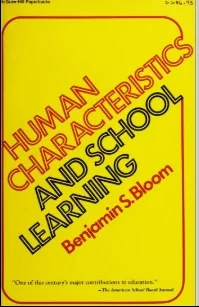
Human Characteristics and School Learning
 Benjamin Samuel Bloom
Bloom's theoretical synthesis argues that what any person can learn, almost all persons can learn if provided with appropriate prior and current conditions of learning. School learning is modeled as a function of three variables: cognitive entry behaviors (what the student already knows), affective entry characteristics (motivation, self-concept as a learner), and quality of instruction. When these are properly managed—especially through corrective feedback and sufficient time—individual differences in achievement shrink dramatically. The book rejects the assumption that aptitude predicts learning limits, proposing instead that aptitude predicts learning speed, which instruction can accommodate.
Key Details
Related Books
View AllSimilar books from the same category, ranked by shared topics and reader engagement.



Key Insights — Read in 10 Minutes
What is the central claim of Human Characteristics and School Learning, and what does it reject about aptitude?
The book's spine is Bloom's argument that what any person in the world can learn, almost all persons can learn if provided with appropriate prior and current conditions of learning [citation:2]. It rejects the traditional assumption that measured aptitude sets a ceiling on what a student can achieve. Bloom's alternative is that aptitude predicts learning speed, not learning limits. In John Carroll's model, which Bloom adopts and extends, aptitude is the time required to master a task. If instruction provides sufficient time and corrective feedback, the correlation between initial aptitude and final achievement approaches zero. Bloom reports that in conventional instruction this correlation is around .70, but in mastery learning it would be close to zero [citation:11]. The book is thus a theoretical case for environmental over dispositional explanations of school achievement.
What three variables constitute Bloom's theory of school learning, and how do they interact?
Bloom models school learning as a function of cognitive entry behaviors, affective entry characteristics, and quality of instruction [citation:2]. Cognitive entry behaviors are the prerequisite knowledge and skills the student brings to a new learning task. Affective entry characteristics include motivation, interest, and self-concept as a learner—the student's history of success or failure. Quality of instruction encompasses cues, participation, reinforcement, feedback, and correctives. Bloom argues these variables are not independent: prior learning shapes motivation, and instructional quality determines whether cognitive gaps are corrected before they compound. The theory's practical implication is that teachers can reduce individual differences by managing entry behaviors and instruction rather than by adjusting expectations to perceived ability.
How does the mastery learning model proposed in the book work in practice?
Bloom describes a mastery learning model based on three fundamental variables defined for each learning task: cognitive entry behavior, affective entry characteristics, and quality of instruction [citation:11]. The procedure requires diagnosing what students already know, teaching to explicit objectives, administering formative assessments to identify what has not been mastered, and providing corrective instruction before moving on. Students who achieve mastery proceed to enrichment or tutoring roles; those who do not receive additional time and alternative instructional approaches. The goal is to bring nearly all students to the same level of mastery before advancing, reducing the cumulative gap that conventional instruction produces. Bloom's research with his students showed that under these conditions, students with initially large differences in learning capacity could achieve comparable results [citation:11].
What is the relationship between this book and Bloom's earlier Stability and Change in Human Characteristics?
The relationship is one of empirical foundation to theoretical synthesis. Stability and Change (1964) synthesized longitudinal growth studies to show that human characteristics develop most rapidly early and that the early period is when environment exerts its greatest influence. Human Characteristics and School Learning (1976) takes that developmental insight and builds a theory of school learning around it. If early cognitive and affective entry behaviors are shaped by prior learning and home environment, then schools can either perpetuate those differences or correct them through appropriate instruction. Bloom's 1976 book argues for the corrective option, using the developmental data from 1964 to justify the claim that individual differences in school achievement are modifiable rather than fixed.
How was the book received by contemporary reviewers, and what did they identify as its significance?
Reviews in 1977 described the book as logical and systematic in organization, characteristic of Bloom's taxonomic work [citation:3]. Penelope Peterson's review in the American Educational Research Journal summarized the major thesis as the proposition that almost all persons can learn what any person can learn given appropriate learning conditions, noting it was buttressed by a well-defined theoretical framework and mounds of research findings [citation:2]. A Kirkus review observed that Bloom was optimistic about education but uncertain about the adaptability of schools, and that traditional distinctions between fast and slow learners tend to disappear under favorable learning conditions [citation:9]. A French reviewer noted some considered it one of the most important books on education in half a century, though it ran counter to many current trends [citation:11].
What are the documented limitations or critiques of Bloom's theory?
Critics raised several concerns. The theory's practicality in real classrooms was questioned given the time and resources required for individualized corrective instruction. Some reviewers noted that the book uses technical jargon and presents a mass of graphs and charts, making it accessible primarily to a scholarly audience [citation:9]. A more fundamental critique is that Bloom's theory assumes schools can be restructured around mastery learning, when the evidence suggests schools are resistant to the degree of individualization required. The Kirkus review captured this tension: Bloom was uncertain about the adaptability of schools to his own theory [citation:9]. The book thus presents a vision of what schooling could accomplish rather than a description of what most schools actually do.
Show 1 more insights
What is the most common misconception about Bloom's argument in this book?
The most persistent misconception treats Bloom's claim as a version of the self-esteem movement's premise that all students are equally capable and should be told so. Bloom's argument is not about praising students or lowering standards; it is about adjusting instruction to learning histories and providing corrective feedback until mastery is achieved. The theory assumes high standards and requires students to meet them, but provides the time and support to do so. A second misconception assumes Bloom claims that aptitude is irrelevant. He claims aptitude predicts speed, not limits. A third misreading treats mastery learning as a single method, when Bloom presents it as a framework with multiple possible implementations depending on subject matter, grade level, and available resources.
Wealthy Psyche is an intellectual archive. We do not host, distribute, or sell book copies — physical or digital. We provide structured knowledge to help you think better, faster.