


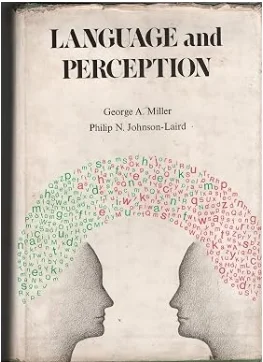
Language and Perception
 George A. Miller
Miller and Johnson-Laird's central thesis is that the meanings of words can be grounded in perceptual and conceptual structures rather than treated as arbitrary linguistic conventions. They propose that lexical concepts are built from attentional-judgmental abstractions from perception—predicates like Red(x) or Hold(x,y)—organized into decision tables that specify the conditions under which a linguistic label applies. The book argues that a realistic psychological account of word meaning must connect semantic memory to perception, identifying the procedural routines by which speakers verify that an object falls under a concept. This psycholexicological framework treats the lexicon as an interface between perceptual judgment and linguistic communication.
Key Details
Related Books
View AllSimilar books from the same category, ranked by shared topics and reader engagement.


.webp?alt=media&token=34bd26c3-d0b0-4cd7-a235-153b0182ef19)
Key Insights — Read in 10 Minutes
What is the central claim of Language and Perception, and what does it reject?
Miller and Johnson-Laird argue that a plausible psychological account of word meaning must start from perception, not from language-internal relations alone. They reject the crude associationist view that knowing a word is merely habitually associating a vocalization with a percept. Instead, they propose that the basis for learning meanings is "attentional-judgmental abstractions from perception"—predicates like Red(x) or Hold(x,y) that capture what a perceiver extracts from the sensory field. These predicates, with unknown neurophysiological correlates, can be organized into routines that specify how to verify whether an object falls under a concept. The book's programme is to spell out the modifications needed to develop this procedural account of lexical knowledge.
What specific framework did the book introduce, and how does it relate to WordNet?
The book introduced "psycholexicology"—a research programme treating lexical meaning as a psychological phenomenon grounded in perception and conceptual structure. Donald Norman's review identified this as the book's true subject: not language broadly, but words and their meanings . The framework attempted to identify "concept atoms" and define meaning through perceptual predicates, but by Miller's own later admission, a complete inventory of concept atoms never materialized. This failure directly motivated WordNet: Miller described an "automated dictionary" idea in 1978, built a small semantic net in 1984, and by the late 1980s had developed WordNet as an alternative approach organizing words into synonym sets rather than decomposing them into perceptual primitives .
How did contemporary reviewers assess the book's ambitions and limitations?
Reviews acknowledged the book's extraordinary scope while noting significant shortcomings. Donald Norman called it "difficult, valuable, and yet unfulfilling," praising its exhaustive coverage of psychological, philosophical, and computational issues but noting that its true subject was words rather than language, and objects rather than perception . Lance Rips described it as "the most sophisticated examination to date of the psychology of word meanings," whose shortcomings stemmed from its inclusive approach straining current knowledge of mental processes . A reviewer in the Journal of Psycholinguistic Research criticized the detail as sometimes "boring," with psychological questions bypassed for philosophical and linguistic issues . These assessments capture the tension between the book's foundational ambition and its incomplete execution.
What is the "conceptual schema" the book proposes, and how does it work?
The conceptual schema combines information about an object's form with information about its function—a recognition that identification routines often require more than perceptual data alone. The authors' example for TABLE(x) includes predicates like THING(x), MOVABLE(x) and CONN(x) and RIGID(x), and proper-part relations linking the table to its worktop and support . These schemata are represented using decision tables, which list conditions and correlated actions, providing a maximally abstract representation of the decision process without constraining sequential order . The system thus specifies not merely what features an object has, but the procedural routines by which a language user would verify that a word applies—making meaning an active, judgment-based achievement rather than a static list of features.
How does the book's approach differ from generative semantics and other linguistic frameworks of the period?
The book engages extensively with contemporary linguistics but from a distinctively psychological angle. One reviewer noted that as a statement of current linguistic research—particularly generative semantics—it was "less successful," partly because the notion of structure in semantics appeared to fall outside its framework, and an important omission was the work of Jim McCawley . The authors' focus was on procedural routines and perceptual grounding, not on formal grammatical derivations. The reviewer also took issue with the decision to base the work on words rather than meanings, arguing that "words do not 'have' meaning: they are associated with it" and that semantic structures are logically prior to lexical items . This tension between psychological and linguistic priorities runs through the book.
What misconceptions about this book arise from its title?
The title suggests a broad treatment of language and perception, but as Donald Norman observed, the book is really about words and objects—more precisely, it is a work of psycholexicology rather than a general theory of language . It does not attempt to explain sentence processing, discourse, or the full architecture of language; its focus is the lexicon and how word meanings connect to perceptual and conceptual knowledge. Readers expecting an early precursor to embodied cognition or a comprehensive psycholinguistics text may be surprised by the book's narrow but deep concern with lexical semantics. The 760-page length reflects exhaustive discussion of word meaning, not breadth across language phenomena.
Wealthy Psyche is an intellectual archive. We do not host, distribute, or sell book copies — physical or digital. We provide structured knowledge to help you think better, faster.