


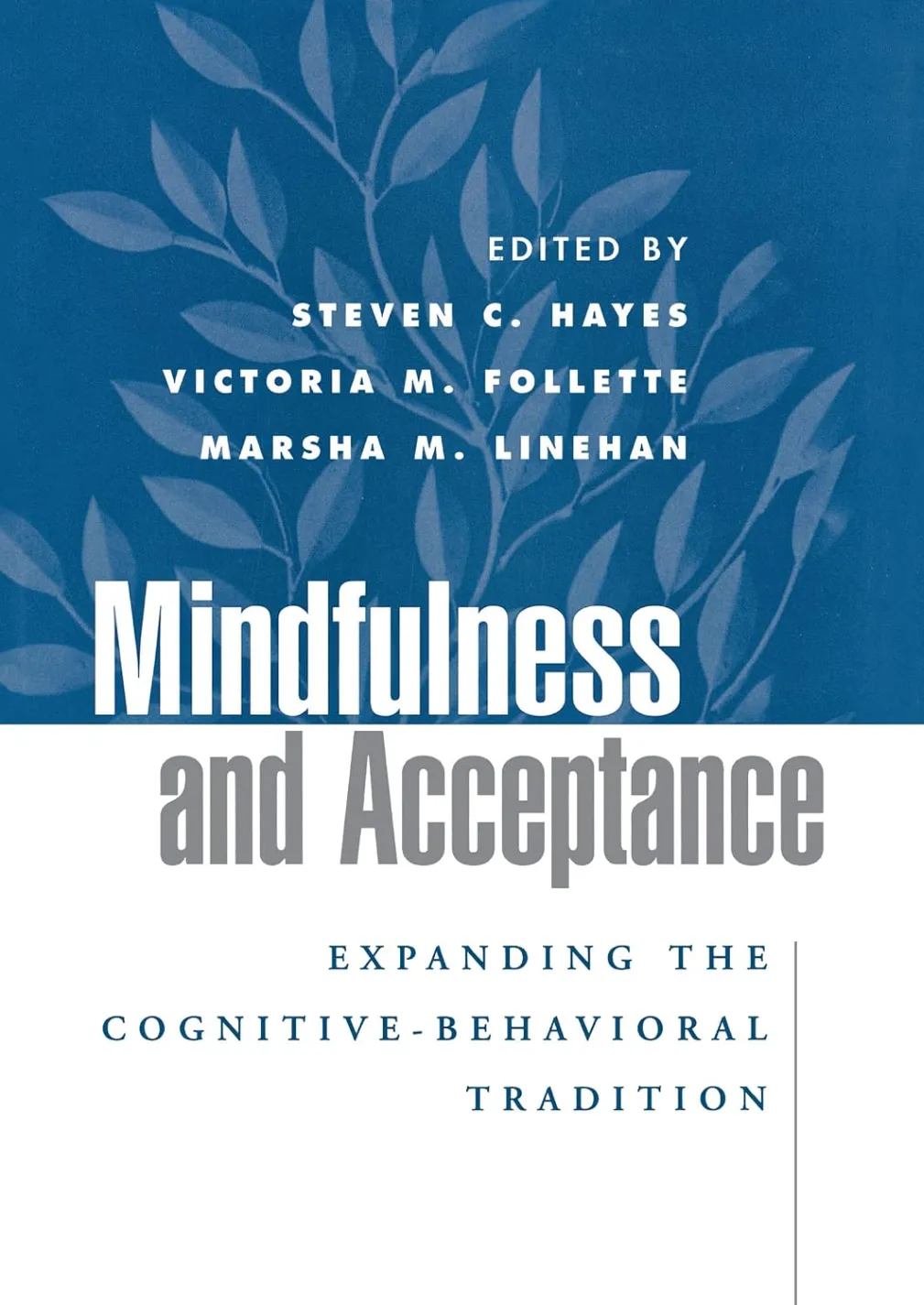
Mindfulness and Acceptance: Expanding the Cognitive-Behavioral Tradition
 Marsha M. Linehan
This edited volume, with a foreword by Linehan, documents the convergence of mindfulness and acceptance strategies with traditional cognitive-behavioral therapy, arguing that the field has undergone a 'third wave' of development beyond simple cognitive change. The book's central mechanism is the integration of acceptance-based processes—mindfulness, experiential avoidance reduction, values clarification, and dialectical thinking—into empirically supported treatments including DBT, ACT, MBCT, and FAP. Each chapter examines the theoretical rationale and clinical methods of a specific approach, showing how these therapies shift the therapeutic target from changing thought content to changing one's relationship to thoughts.
Key Details
Related Books
View AllSimilar books from the same category, ranked by shared topics and reader engagement.


Key Insights — Read in 10 Minutes
What is the 'third wave' of cognitive-behavioral therapy, and what does this book argue about it?
The third wave refers to a family of therapies that emerged in the 1990s and early 2000s—including Dialectical Behavior Therapy (DBT), Acceptance and Commitment Therapy (ACT), Mindfulness-Based Cognitive Therapy (MBCT), Functional Analytic Psychotherapy (FAP), and Integrative Behavioral Couple Therapy (IBCT)—that share an emphasis on mindfulness, acceptance, values, and the therapeutic relationship . The book's central argument is that these approaches do not merely add techniques to standard CBT but represent a genuine conceptual shift: where traditional CBT targets the content of maladaptive thoughts and beliefs, third-wave therapies target the individual's relationship to thoughts, emphasizing acceptance rather than change of content. A PsycCRITIQUES review noted the book provides 'a very comprehensive and lucid review of the development of behavior therapy and the movement toward acceptance-based procedures' .
What is the role of Steven C. Hayes in the book, and how does his ACT framework figure in it?
Steven C. Hayes is the first editor of the volume and a co-developer of Acceptance and Commitment Therapy. He contributes the introductory chapter, which frames the third-wave movement and situates the book within the broader history of behavior therapy and cognitive therapy. A PsycCRITIQUES review described the first chapter by Hayes as 'a clear, concise review of the development of behavior therapy and the integration of mindfulness and acceptance approaches' . The book also includes chapters by Hayes and colleagues on ACT specifically. Hayes's theoretical contribution—particularly relational frame theory and the concept of psychological flexibility—provides a foundational rationale for the acceptance-based approaches documented throughout the volume .
What role does Linehan play in the book, and how does DBT feature in it?
Linehan is the third editor and contributed the foreword and a chapter on DBT. Her chapter, co-authored with Linda Dimeff, presents DBT's mindfulness and acceptance components, showing how these elements are integrated with change-oriented strategies in the treatment of borderline personality disorder and suicidal behavior . The book's structure gives DBT a central place as one of the earliest and most thoroughly researched acceptance-based therapies. Linehan's foreword frames the volume's project, noting that the convergence of acceptance and change strategies was foreshadowed in DBT's development in the late 1980s and early 1990s, before the third wave became a recognized movement. A reviewer observed that the chapter on DBT, titled 'Dialectical Behavior Therapy: A Mindfulness and Acceptance-Based Treatment,' is among the book's clearest contributions .
What distinguishes mindfulness and acceptance-based approaches from traditional cognitive therapy?
Traditional cognitive therapy seeks to change the content of dysfunctional thoughts—identifying distortions, testing them against evidence, and generating rational alternatives. Mindfulness and acceptance-based approaches shift the target: rather than changing what one thinks, they cultivate a different relationship to thinking itself. The book's chapters describe this as moving from 'change' to 'acceptance' as the primary therapeutic stance . Clients learn to observe thoughts and feelings without automatically acting on them, to accept internal experiences rather than avoid them, and to commit to valued actions regardless of distressing mental content. A PsycCRITIQUES review observed that the book's chapters by Roemer and Orsillo on GAD and by Segal, Teasdale, and Williams on MBCT for depression provide 'excellent summaries of the theoretical models and intervention strategies' of these approaches .
What are the documented limitations or criticisms of the third-wave framework presented in the book?
A PsycCRITIQUES review of the volume noted that some chapters 'could have presented more evidence for the efficacy of the described treatments' and that the book is 'written more for the clinician or researcher who is already familiar with these approaches' . More broadly, critics of the third-wave framework have argued that the distinction between second-wave and third-wave CBT is overstated, that the mechanisms of change in acceptance-based therapies remain underspecified, and that the empirical base for some third-wave treatments is less developed than for traditional CBT. The book acknowledges that research on third-wave therapies was at an early stage of development, and several chapters call for future studies on mechanisms of change and comparative efficacy .
What is the book's publication history and academic significance?
Mindfulness and Acceptance was published in 2004 by The Guilford Press, edited by Steven C. Hayes, Victoria M. Follette, and Marsha M. Linehan . It was among the first edited volumes to systematically document and theorize the third-wave movement, appearing at a point when ACT, DBT, and MBCT had established empirical support but had not yet been collectively described as a coherent family of approaches. The book is widely cited in the third-wave literature and is often referenced as a foundational statement of the movement's theoretical rationale and clinical methods. A PsycCRITIQUES reviewer concluded that the book 'provides a very comprehensive and lucid review' and recommended it for clinicians and researchers interested in these approaches .
Show 1 more insights
How does the book address the concept of experiential avoidance, and which chapter is most associated with it?
Experiential avoidance—the tendency to escape or avoid unwanted internal experiences such as thoughts, feelings, and bodily sensations—is a central construct in the acceptance-based literature. The book includes a chapter by Hayes and colleagues on 'Experiential Avoidance and Behavioral Disorders,' which presents the construct as a functional diagnostic dimension cutting across multiple forms of psychopathology. The chapter argues that many clinical problems, from panic disorder to substance abuse, can be understood as maladaptive attempts to control or avoid distressing internal experiences. This transdiagnostic framing was influential in shifting attention from symptom-specific treatments to underlying processes that maintain psychopathology across diagnoses, a perspective that became central to the third-wave movement and to later transdiagnostic approaches.
Wealthy Psyche is an intellectual archive. We do not host, distribute, or sell book copies — physical or digital. We provide structured knowledge to help you think better, faster.