


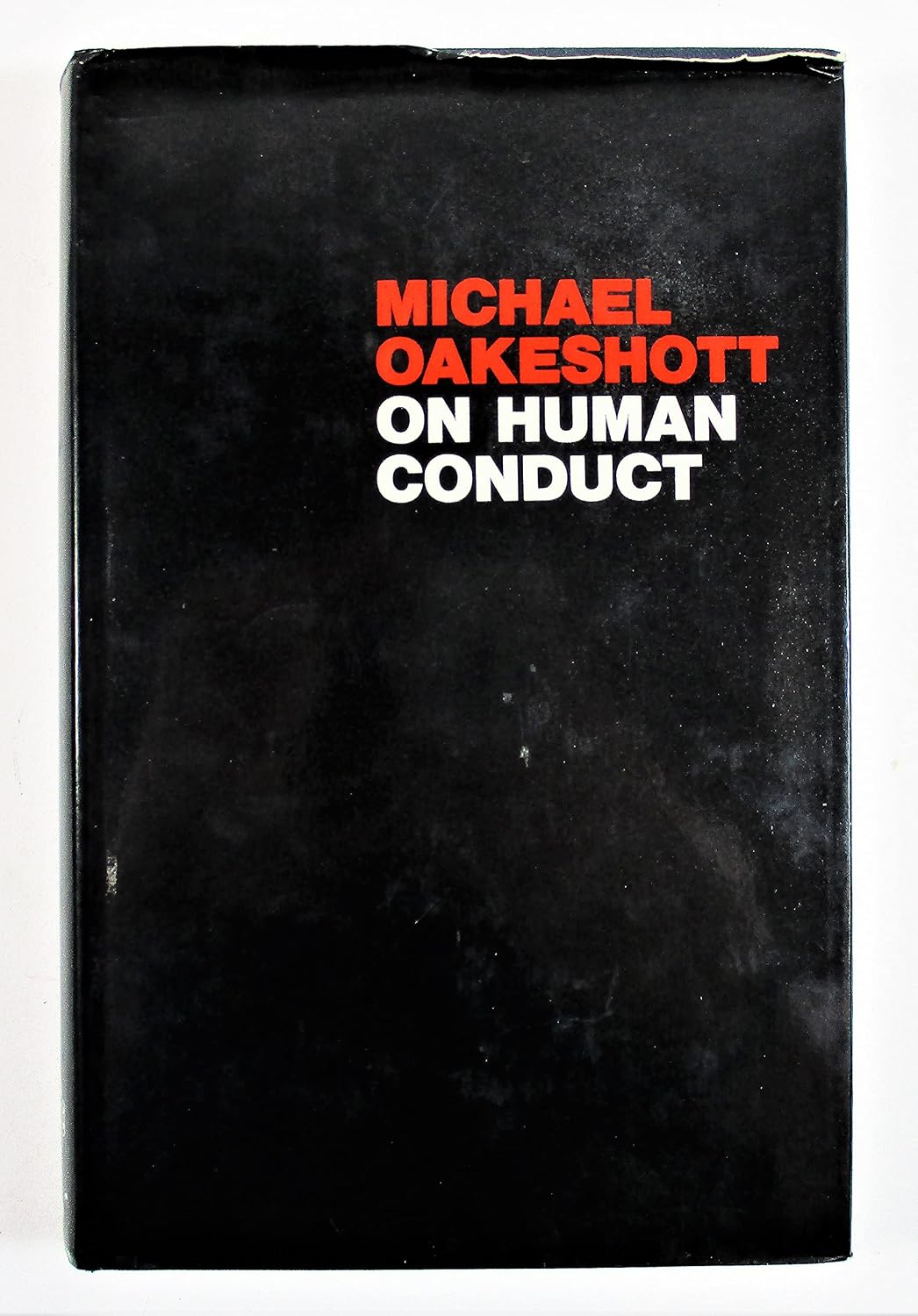
On Human Conduct
 Michael Oakeshott
Oakeshott's central argument is that human conduct is intelligible only through the concept of a practice—a set of moral and procedural conditions that agents subscribe to in pursuing their own purposes, not a shared goal they jointly pursue. The book's core distinction is between civil association, where people are related solely through the authority of non-instrumental rules (lex), and enterprise association, where they are bound by a common substantive purpose. Oakeshott argues that the modern European state's corruption consists in its drift from the civil condition toward compulsory enterprise, treating law as a managerial instrument rather than an authoritative practice.
Key Details
Related Books
View AllSimilar books from the same category, ranked by shared topics and reader engagement.



Key Insights — Read in 10 Minutes
What is the central distinction Oakeshott draws between civil association and enterprise association?
Civil association is a mode of human relationship in which people are related solely through their acknowledgment of the authority of non-instrumental rules, called lex. These rules specify conditions to be subscribed to in pursuing one's own purposes; they do not prescribe any common substantive goal. Enterprise association, by contrast, binds participants through a shared purpose they jointly pursue. Oakeshott's argument is that the modern European state has increasingly understood itself as a compulsory enterprise association, thereby sacrificing the formal equality of citizens to a 'national purpose' and degrading law into a managerial instrument.
What did Oakeshott mean by replacing 'tradition' with 'practice' in this work?
In On Human Conduct, Oakeshott abandoned the language of 'tradition' that had characterized his earlier work in favor of 'practice.' The shift was deliberate: 'tradition' suggested unconscious habit and natural growth, while 'practice' emphasizes the intelligent, reflective responses of agents. A practice provides a context of moral and procedural conditions that makes individual choice meaningful, but it is not a fixed inheritance to be passively received. This conceptual change marks Oakeshott's move toward a more contingent, less historicist understanding of political life, though he retained a belief in theorizing relatively permanent ideals like civil association.
Why is On Human Conduct considered a departure from Oakeshott's earlier conservative writings?
In works like Rationalism in Politics, Oakeshott defended tradition against rationalist reconstruction. On Human Conduct takes a more theoretical and abstract approach, focusing on the conditions of human agency and the character of civil association rather than defending inherited practices. The book's three essays—on theoretical understanding, on the civil condition, and on the modern European state—aim to disclose the conditions of understanding rather than to prescribe political conduct. Oakeshott himself insisted he was a theorist, not a 'theoretic,' and the work resists reduction to a simple conservative program.
How does Oakeshott's civil association differ from Hayek's spontaneous order?
Both Oakeshott and Hayek emphasize the limits of central planning and the importance of non-purposive rules, but they ground their arguments differently. Hayek's spontaneous order is an empirical claim about how decentralized knowledge produces superior outcomes; rules are justified by their contribution to market coordination. Oakeshott's civil association is an ideal character independent of historical circumstance: lex commands authority not because it produces desirable results but because it is the formal condition of moral equality. Oakeshott is less concerned with economic efficiency than with preserving the possibility of individual self-determination through non-instrumental law.
What is the 'modern European state' essay actually arguing about the state's historical trajectory?
The third essay traces the modern European state's development as an ambiguous association oscillating between the civil condition and the enterprise condition. Oakeshott argues that the state's historical tendency has been toward 'universitas'—a corporate body defined by a common purpose—at the expense of 'societas'—a formal association under non-instrumental rules. This drift, in his view, culminates in the twentieth-century state that takes itself to be purposive, managing society toward collective goals. The essay is not a historical narrative but a theoretical analysis of the state's defining tension, and it concludes with a qualified defense of the civil condition as the only morally tolerable form of compulsory association.
Wealthy Psyche is an intellectual archive. We do not host, distribute, or sell book copies — physical or digital. We provide structured knowledge to help you think better, faster.