


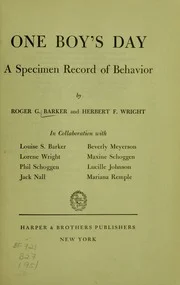
One Boy's Day: A Specimen Record of Behavior
Barker and Wright's 1951 book presents a minute-by-minute specimen record of a seven-year-old boy's behavior over fourteen waking hours in a small Midwestern town. Eight trained observers recorded Raymond Birch's actions, interactions, and settings at one-minute intervals, producing what the authors called raw data for a field they termed psychological ecology. The book's central claim is methodological: that a complete, objective record of one child's day in his natural habitat can serve as a scientific specimen, preserving behavior for later analysis the way a botanist preserves a pressed flower.
Key Details
Related Books
View AllSimilar books from the same category, ranked by shared topics and reader engagement.



Key Insights — Read in 10 Minutes
What is a 'behavior specimen record,' and what did Barker and Wright intend it to accomplish?
A behavior specimen record is a continuous, minute-by-minute account of an individual's behavior in natural settings, recorded by trained observers. Barker and Wright explain in the introduction that One Boy's Day is a scientific document—an objective record of what a seven-year-old boy did and what his environment did to him from waking to sleeping . The authors describe the record as a specimen of behavior and of the child's cultural and psychological habitat, comparing it to a pressed flower in an herbarium: parts of the original are altered and lost in preservation, but the specimen remains useful to scientists . The goal was to create raw data for psychological ecology, a field they were defining through this very practice.
How did contemporary reviewers respond to the book's lack of theoretical framing?
Reviewers were divided. Celia Stendler's Psychological Bulletin review noted that the theoretical framework within which observations were collected is not included in the volume, concluding that One Boy's Day contains only raw data and therefore cannot really be evaluated . Pauline Young's review in American Journal of Sociology similarly asked how one can evaluate such materials without a theoretical framework and whether another day would have produced different patterns . Samuel Strong in the American Journal of Sociology was more charitable, noting no doubt that Barker and Wright would follow with an interpretation and thus render the volume a valuable contribution to knowledge of child behavior .
What was the actual town and boy behind the pseudonyms 'Midwest' and 'Raymond Birch'?
The town was Oskaloosa, Kansas, a community of about 725 people at the time of the study. The boy was Gary Morgan, who was seven years and four months old on April 26, 1949, when the record was made . Morgan, now in his seventies, told Harper's Magazine he remembered waking to find a stranger with a notepad in his bedroom and feeling embarrassed at having to dress in front of an observer . The field station cloaked the town's identity to protect residents' privacy. Barker, Wright, and their wives later signed a copy of the book for Morgan with the inscription: 'To the Morgans, especially Gary, the real author of this' .
What does 'psychological ecology' mean in the context of this book?
Barker and Wright use the term to describe their field of study: the relationship between behavior and its environmental context, understood as a natural habitat rather than a laboratory. They state that One Boy's Day is a field study in psychological ecology, analogous to ecological fieldwork in biology . The term was relatively new and reviewers noted that the authors used it without further explanation, leaving readers to infer its meaning . Psychological ecology later developed into the more systematic framework of behavior settings, where the unit of analysis shifted from the individual's stream of behavior to the standing patterns of behavior that characterize specific places at specific times.
How did the specimen record method influence later research?
The method was directly applied in subsequent studies by Barker and his collaborators. A 2003 research report from Technische Universität Berlin explicitly revisits the behavior specimen record method pioneered by Barker and Wright, applying it with video recording to observe a mother and infant for one full day . The Berlin study used the same conceptual orientation toward behavior settings that Barker developed. Cross-cultural comparisons also drew on specimen records: researchers collected records in behavior settings in a small English town and compared them with Midwest data, finding striking similarities in the structure of children's social actions across the two cultures .
Why did reviewers consider the book's raw-data approach a problem for evaluating its contribution?
Reviewers identified a fundamental tension: the book presents a 425-page record with no interpretive framework, leaving readers unable to assess its significance. Young's review asked whether the wanderings of one boy during one day could produce material sufficient for generalizations about children's behavior . Stendler's review concluded it was unfortunate that the authors did not enlarge the volume to include their formulation of the meaning and task of psychological ecology . The reviewers acknowledged the meticulous method—eight observers recording at one-minute intervals—but found that without the theoretical framework the observations were collected within, the specimen remained inert data awaiting an interpretation that Barker and Wright would publish separately.
Show 2 more insights
How does One Boy's Day relate to Barker's later development of behavior settings theory?
One Boy's Day documents a single child's behavior across the many settings of his day—home, school, neighborhood, church—without yet naming 'behavior settings' as the analytic unit. Barker later formalized this concept, defining behavior settings as standing patterns of behavior that are independent of the particular individuals occupying them at any given moment. The specimen record method provided the empirical raw material from which behavior settings theory could be built. The 1955 companion volume Midwest and Its Children applied the method systematically to an entire community's children, and Barker's later work developed the theoretical apparatus that One Boy's Day deliberately withheld.
What specific details of the 1949 observation day does the book record?
The record was made on April 26, 1949, a Tuesday, in a town of 725 people in the central United States . The book documents Raymond's activities from waking until sleep, covering home, school, and play. The introduction describes the town's economic base: no manufacturing, a county seat, surrounded by farms, with 179 automobiles owned by 547 adult citizens . Raymond's parents had been told the evening before that observers would be present, and his mother explained to him that they would be interested in seeing what a seven-year-old boy did all day . The record includes not only Raymond's actions but also the physical and social conditions of his life that could be seen and heard by the observers .
Wealthy Psyche is an intellectual archive. We do not host, distribute, or sell book copies — physical or digital. We provide structured knowledge to help you think better, faster.