


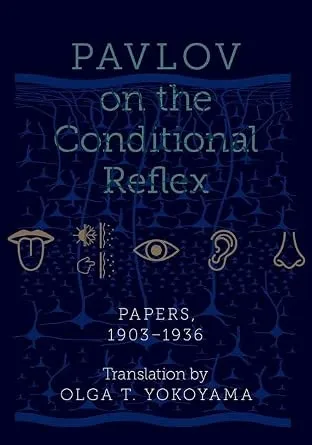
Pavlov on the Conditional Reflex: Papers, 1903–1936
 Ivan Petrovich Pavlov
This collection argues that the conditional reflex is the fundamental unit for an objective physiology of higher nervous activity, and that its laws—excitation, inhibition, irradiation, concentration, and the analysis and synthesis of stimuli—govern learning, discrimination, and even personality. Spanning Pavlov's papers from 1903 until his death, the volume traces his shift from digestive physiology to the study of the cerebral hemispheres, his extension of conditioned-reflex principles to experimental neurosis and human psychiatry, and his concept of the second signal system. The editor argues that these translations correct persistent misunderstandings of Pavlov's actual claims.
Key Details
Related Books
View AllSimilar books from the same category, ranked by shared topics and reader engagement.



Key Insights — Read in 10 Minutes
What is the central argument of this collection, and what does it claim to correct?
The collection's central argument is that the conditional reflex is the fundamental unit for an objective physiology of higher nervous activity, and that its laws govern learning, discrimination, inhibition, and the organization of behavior. The editor, Olga T. Yokoyama, argues that the standard translations of Pavlov's work have introduced persistent misunderstandings—particularly the widespread belief that Pavlov reduced all learning to simple stimulus substitution, and the use of the term 'conditioned' rather than 'conditional.' The volume aims to restore Pavlov's actual positions by presenting his papers from 1903 to 1936 with new translations and commentary. It situates Pavlov as a physiologist of the cerebral hemispheres rather than as the founder of a psychological doctrine.
Why does the editor insist on 'conditional reflex' rather than 'conditioned reflex,' and what difference does it make?
Yokoyama argues that Pavlov's Russian term uslovnyi refleks is properly translated as 'conditional reflex,' not 'conditioned reflex.' The distinction matters because 'conditioned' suggests that the reflex has been conditioned or trained, emphasizing the process of acquisition. 'Conditional' suggests that the reflex depends on a condition—the pairing of the neutral stimulus with the unconditioned stimulus—and is not a separate type of reflex but a functional relationship. This translation choice reflects Pavlov's own emphasis on the dependence of the response on a specific condition rather than on a process of training. The editor contends that the mistranslation has contributed to misunderstandings of Pavlov's theory, including the conflation of classical conditioning with simple associationism.
What does the collection reveal about Pavlov's extension of his findings to human psychiatry?
The papers document Pavlov's increasing willingness in his later years to apply conditioned-reflex principles to human psychiatric phenomena. He compared experimental neuroses in dogs—produced by difficult discriminations or conflicting signals—to human neurasthenia, and he argued that schizophrenia resembles chronic hypnotic states and paranoia a pathological inertia of cortical points. He also developed the concept of the second signal system, according to which words function as conditioned stimuli that can substitute for the objects and events they signify, and he proposed that the second signal system is the physiological basis of human language and thought. These extensions were speculative and were criticized by contemporaries, but they represent Pavlov's attempt to unify physiology, psychology, and psychiatry under a single framework.
How does this volume differ from the standard English translations of Pavlov's work?
The standard English translations, including G. V. Anrep's Conditioned Reflexes (1927) and W. Horsley Gantt's Lectures on Conditioned Reflexes (1928), were prepared by physiologists and were influential in shaping the Anglophone reception of Pavlov. Yokoyama, a linguist and specialist in Japanese and Russian, argues that these translations smoothed over ambiguities and introduced terminology that does not correspond precisely to Pavlov's own usage. Her new translations aim for greater fidelity to the Russian, including the distinction between 'conditional' and 'conditioned,' and they are accompanied by annotations explaining historical and conceptual contexts. The volume also presents papers that were not included in the earlier collections, offering a more complete picture of Pavlov's development. It is thus both a new translation and an editorial reinterpretation.
What is the significance of the papers spanning 1903 to 1936 for understanding Pavlov's development?
The chronological span shows the evolution of Pavlov's thought from his early work on digestive physiology through the systematic study of conditioned reflexes and into his later psychiatric and theoretical speculations. The papers from 1903 to the 1910s establish the basic phenomenon and its laws. The 1920s papers develop the physiology of inhibition, the analysis and synthesis of stimuli, and the typology of nervous systems. The 1930s papers extend the framework to human language and psychopathology, and they also contain Pavlov's reflections on the relationship between his work and Soviet ideology. By presenting the papers in sequence, the volume allows readers to see which positions Pavlov held consistently and which he revised, providing a more nuanced picture than the standard systematic monographs.
How does the collection position Pavlov in relation to behaviorism and to the psychology of his time?
The volume presents Pavlov as a physiologist who consistently resisted identification with any psychological school, including behaviorism. Pavlov insisted that his work was physiology, and he was critical of American behaviorists for what he saw as their neglect of physiological mechanisms and their tendency to theorize beyond the data. Yet his work was adopted by behaviorists, particularly John B. Watson, as a foundation for a science of behavior. The papers show Pavlov engaging critically with psychology while insisting on the physiological level of analysis. This position—sympathetic to an objective science of behavior but committed to physiological explanation—distinguishes Pavlov from both the introspective psychologists he rejected and the radical behaviorists who later claimed him.
Show 1 more insights
What is the reception of this volume among historians and scientists?
The volume has been reviewed as a significant contribution to Pavlov scholarship. Reviewers have praised Yokoyama's careful translations and her extensive annotations, which situate the papers in their historical and conceptual contexts. The collection has been welcomed for making available in English a more complete and accurate representation of Pavlov's work than the earlier translations provided. Some reviewers have noted that the editorial commentary is extensive and sometimes intervenes heavily in the interpretation of the texts, but most agree that the volume is now the most reliable English-language resource for studying Pavlov's original papers. It has become essential reading for historians of psychology and neuroscience and for researchers interested in the foundations of classical conditioning.
Wealthy Psyche is an intellectual archive. We do not host, distribute, or sell book copies — physical or digital. We provide structured knowledge to help you think better, faster.