


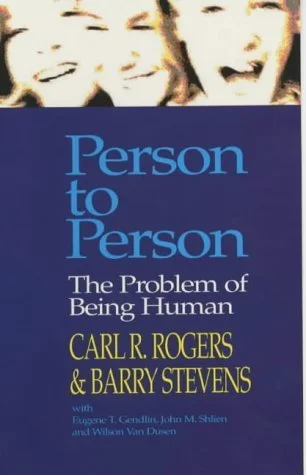
Person to Person: The Problem of Being Human — A New Trend in Psychology
 Carl Rogers
This collaborative volume pairs Rogers's professional papers on the client-centered approach with Barry Stevens's autobiographical reflections, arguing that the core of guidance and growth lies in the interpersonal relationship itself. The book's mechanism is the interleaving of two voices: Rogers presents theoretical and clinical work—including the valuing process, learning to be free, and treating schizophrenia—while Stevens responds with first-person narratives of becoming authentic. It rejects the idea that psychotherapy belongs only to professionals, insisting that genuine person-to-person encounter is available to everyone and that the problem of being human is fundamentally relational.
Key Details
Related Books
View AllSimilar books from the same category, ranked by shared topics and reader engagement.


Key Insights — Read in 10 Minutes
What makes Person to Person structurally unusual for a Rogers book?
The book alternates between Rogers's professional papers and Barry Stevens's autobiographical reflections, which she wrote in response to reading the papers . A 1975 review in Vidvajyoti described the structure as 'rather peculiar,' consisting of lectures by professional counsellor-psychotherapists interspersed with Stevens's reflections 'triggered off' as she read them . Stevens, a writer with no formal psychological training, provides the 'Curtain Raiser' and interleaved personal sections, while Rogers contributes the theoretical core. The result is a dialogue between the professional and the experiential, embodying the book's argument that the person-to-person encounter is the substance of growth, not a technique only therapists can perform.
What professional papers by Rogers are included in the book?
Rogers contributes several key papers from the early 1960s. 'Toward a Modern Approach to Values: The Valuing Process in the Mature Person' develops his theory of the organismic valuing process. 'Learning to be Free' addresses education and autonomy. 'The Interpersonal Relationship: The Core of Guidance' states his central thesis about the helping relationship. The book also includes three papers on the client-centered approach to schizophrenia: Rogers's 'Some Learnings from a Study of Psychotherapy with Schizophrenics,' Eugene Gendlin's 'Subverbal Communication and Therapist Expressivity,' and John Shlien's 'A Client-Centered Approach to Schizophrenia: First Approximation' . Wilson Van Dusen contributes 'The Natural Depth in Man,' and the volume closes with 'The End: A Commencement' .
How does the book's treatment of schizophrenia fit into Rogers's broader work?
The schizophrenia papers emerged from a research project Rogers conducted at the University of Wisconsin in the late 1950s and early 1960s, applying client-centered therapy to hospitalized psychotic patients—a population considered beyond the reach of non-directive methods . A 1975 theological review noted that these papers were written before 1963 and that 'their value is rather historical; for since then, much further work has been done in this area' . Rogers's contribution was to demonstrate that even severely disturbed individuals could be approached with the same core conditions of congruence, acceptance, and empathy, challenging the assumption that psychosis required purely directive or biological intervention. The book's inclusion of these papers gives it a dual identity as both humanistic manifesto and historical research document.
What critical reception did the book receive from professional reviewers?
A PsycCRITIQUES review by I. Jay Knopf in 1968 noted that although the book brings together previously published papers by Rogers, Gendlin, and Van Dusen, it is 'quite unlike the typical edited compilation' . A Vidvajyoti reviewer in 1975 praised Rogers's contributions as needing 'no recommendation,' calling him 'clear, perceptive and realistic' and singling out 'Learning to be Free' and 'The Interpersonal Relationship' for special attention . The same reviewer recommended the book to those interested in personal growth and existential-humanistic counselling, noting that Stevens's contributions are 'therapeutic in themselves.' The reviewer also observed that Rogers's main contributions date from 1960-1964 and that neo-Rogerian developments by scholars like Carkhuff had since extended his work .
What is Barry Stevens's role in the book, and how did reviewers respond to her contributions?
Barry Stevens was a writer and 'dropout from college' with no formal training in psychology, yet the book's structure makes her voice equal in weight to Rogers's . She provides the opening 'Curtain Raiser,' interleaved personal reflections, and the closing sections. A Vidvajyoti reviewer described her as 'an exceptional woman' who, though an 'amateur,' has 'put her imprint on all the fields she has touched' . The reviewer warned that some may find her 'very personal way of writing disconcerting at first,' but predicted that 'as he proceeds, the reader will soon become fascinated' . Stevens explicitly hoped readers would find 'permission to be and to become more of himself,' and her sections challenge the reader to 'be authentic, to be "I" and not what others expect' .
How does the book relate to Rogers's earlier major works?
Person to Person extends the person-centered principles developed in Client-Centered Therapy (1951) and On Becoming a Person (1961) into new territory: the treatment of schizophrenia, the philosophy of valuing, and the application of the core conditions beyond the professional therapeutic relationship . The book's distinctive contribution is its insistence that the 'problem of being human' is not a clinical problem but a universal one, and that the same relational qualities that facilitate therapeutic growth are available to everyone in everyday life. Stevens's contributions make this argument experientially rather than theoretically, as she describes her own process of becoming authentic without professional training. The book thus bridges Rogers's clinical work and his broader humanistic vision.
Show 1 more insights
What is the publication history of the book across editions?
The book was first published in 1967 by Real People Press, based in Walnut Creek, California, and later Lafayette, California . A UK edition appeared in 1973 from Souvenir Press (Educational & Academic) as a 'Condor Book' . A Pocket Books mass market edition followed in 1975 . The original hardcover runs 276 pages with ISBN 0911226001; the paperback is ISBN 091122601X . A 1971 reprint from Real People Press is also recorded in library catalogs . The book has been translated into multiple languages, with Japanese editions present in library collections . The 1973 Souvenir Press edition is 288 pages and includes the note that the book 'consists mainly of reprints of articles from various books and periodicals' .
Wealthy Psyche is an intellectual archive. We do not host, distribute, or sell book copies — physical or digital. We provide structured knowledge to help you think better, faster.