


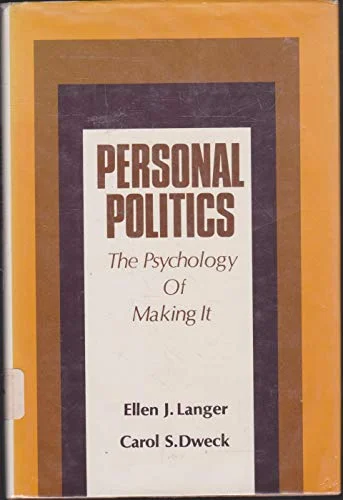
Personal Politics: The Psychology of Making It
 Ellen Langer
Langer and Dweck's early collaboration argues that success is not a matter of insight into personal history but of learning specific, testable strategies for reading social situations and exerting control over one's environment. Rejecting the therapeutic emphasis on self-understanding as sufficient for change, the book treats interpersonal effectiveness as a teachable skill set—how to request information, search for alternatives, and apply reinforcement principles with precision. Written for a general audience but grounded in experimental social psychology, it represents both authors' early interest in the cognitive and behavioral mechanics of perceived control and malleability.
Key Details
Related Books
View AllSimilar books from the same category, ranked by shared topics and reader engagement.


.webp?alt=media&token=e122db12-881d-4348-827b-bc8f8f60d681)
Key Insights — Read in 10 Minutes
What is the central claim of Personal Politics, and what does it reject?
The book argues that achieving personal and interpersonal goals depends on acquiring specific behavioral and cognitive strategies—how to frame requests, search for alternatives, and apply reinforcement principles—rather than on achieving deep insight into one's past. Langer and Dweck explicitly reject the therapeutic premise that understanding the origins of one's difficulties is sufficient for change, using the example of a woman who discovers her relationship problems stem from her father but remains unable to form new relationships because she has not learned new behaviors. The emphasis falls on generalization from concrete examples to one's own life and on active practice rather than passive understanding.
How does Personal Politics relate to Langer's later work on mindfulness and Dweck's later mindset theory?
The book anticipates both authors' mature frameworks without using the terminology they later became known for. Langer's later mindfulness research, developed through the 1970s and published in her 1989 book, centers on active noticing and the creation of new categories as a route to well-being and control; Personal Politics already treats rigid assumptions and premature explanations as obstacles to effective action. Dweck's later work on fixed versus growth mindsets formalizes the distinction between believing one's traits are static and believing they are malleable; Personal Politics presumes malleability throughout, treating interpersonal competence as learnable rather than innate. The book thus serves as a transitional text bridging their early collaboration and their divergent later careers.
Why is this book rarely cited in discussions of either author's major contributions?
Personal Politics occupies an unusual position in both authors' bibliographies: it is a trade-oriented self-help book written early in their careers, before either had developed the distinctive theoretical frameworks that made them influential. Langer's citation counts are dominated by her mindfulness research and her counterclockwise aging studies; Dweck's by her implicit theories of intelligence and mindset interventions. The book's practical, scenario-based format and its focus on general interpersonal effectiveness place it outside the experimental literature that defines their academic reputations. It remains a historical curiosity for scholars tracing the intellectual origins of their later ideas rather than a frequently cited source in either body of work.
Wealthy Psyche is an intellectual archive. We do not host, distribute, or sell book copies — physical or digital. We provide structured knowledge to help you think better, faster.