


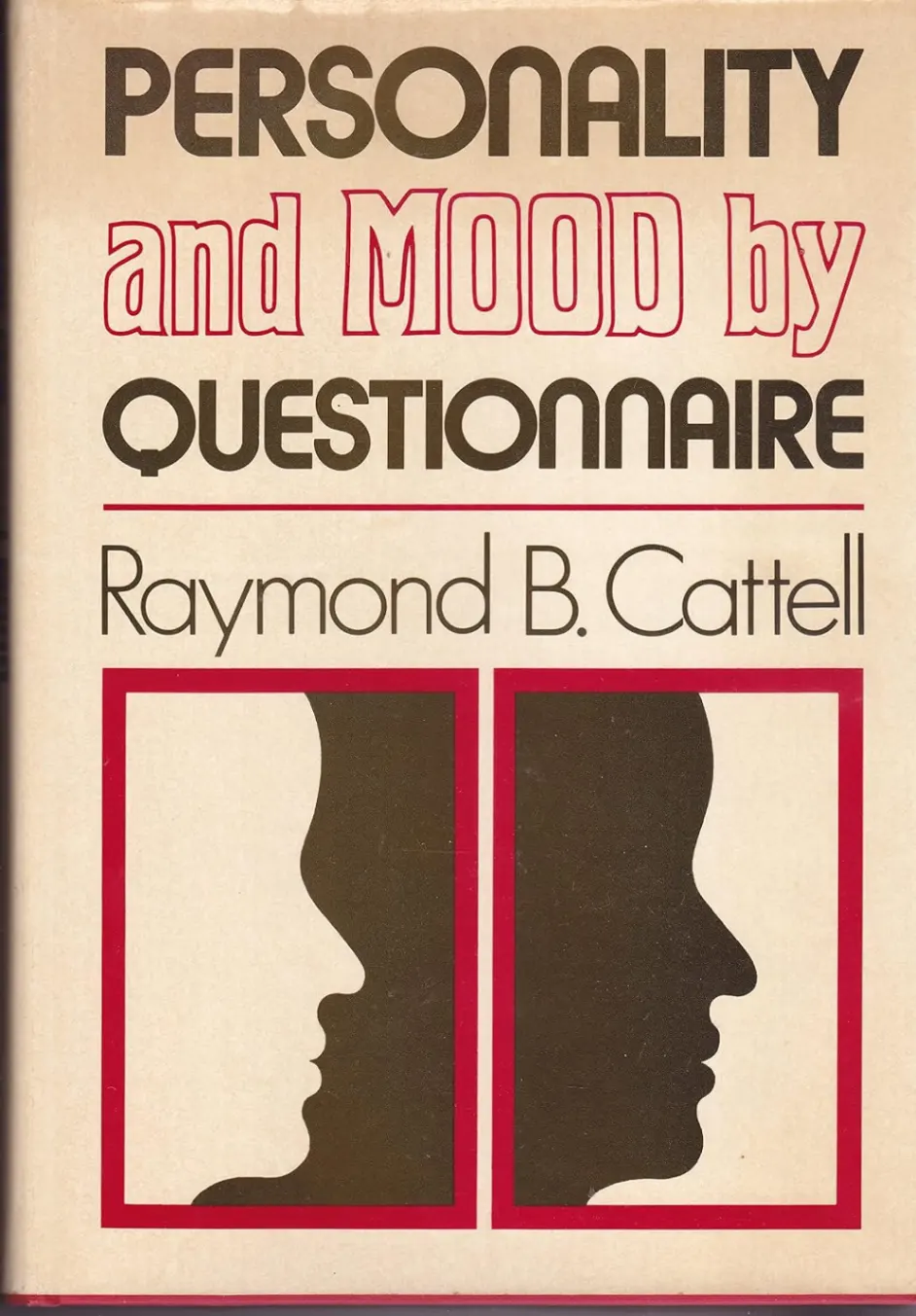
Personality and Mood by Questionnaire
 Raymond Bernard Cattell
Cattell argues that questionnaires must function as 'ambassadors for a theory of personality' rather than isolated measurement devices. The book integrates psychometric technique with his broader structural theory, treating self-report data (Q-data) as one leg of a tripod alongside objective tests and life ratings. It details the construction, validation, and interpretation of the 16PF and related instruments, defending the primacy of factor-analytically derived primary traits against both minimalist rival models and purely empirical test-building.
Key Details
Related Books
View AllSimilar books from the same category, ranked by shared topics and reader engagement.

.webp?alt=media&token=413f638b-4d70-40f1-8217-367deb754ca8)

Key Insights — Read in 10 Minutes
What is the central claim of Personality and Mood by Questionnaire, and what does it reject?
The book's spine is Cattell's insistence that a questionnaire should be an 'ambassador for a theory of personality,' not a stand-alone predictive gadget. He rejects the practice of building scales from item pools selected purely for empirical correlation with a criterion, which he derided as producing 'the prolific rabbits of the psychometric world.' Instead, questionnaire construction must proceed from an empirically established structural taxonomy—the primary and higher-order factors derived from factor analysis across Q-data, T-data, and L-data. The 16PF is presented as the working embodiment of this principle, and the book details how its scales were derived, validated, and should be interpreted within the broader theory of traits and states.
How does Cattell's position in this book differ from Eysenck's approach to personality measurement?
The disagreement is structural and methodological. Cattell argues for the necessity and distinct importance of the primary factors—the sixteen dimensions of the 16PF—as real, causally efficacious personality constructs. He presents the higher-order factors as useful but derivative summaries. Eysenck's model, by contrast, treats three broad dimensions (Extraversion, Neuroticism, Psychoticism) as the fundamental level, with narrower traits subsumed under them. Cattell explicitly designed his presentation, including the placement of the higher-order factor discussion after the primary-factor findings, to persuade readers that the primaries are not mere fragments of broader dimensions. A reviewer at the time noted that Cattell makes this point 'again' in subsequent chapters, revealing how central this differentiation was to his argument .
How has the book's argument held up given later developments in personality psychology?
The book's central methodological argument—that questionnaire scales should be grounded in a validated structural model—has aged well, even as the specific 16PF taxonomy has been revised and the Five Factor Model became the dominant consensus structure. Later research by Cattell's collaborators and successors, notably Gregory Boyle, demonstrated that the 16PF primary factors could be reduced to roughly five broad factors, effectively aligning Cattell's system with the Big Five while preserving the primaries as useful lower-order facets . Cattell himself oversaw the Fifth Edition of the 16PF, which incorporated updated norms and some structural refinements. The book remains historically important as the most complete statement of his mature psychometric philosophy, though the 16PF's clinical and industrial prominence has declined relative to newer instruments.
What does Cattell mean by the 'tripod' model of personality data, and why does it matter for questionnaire interpretation?
Cattell conceptualized personality measurement as resting on three legs: Q-data (self-report questionnaires), T-data (objective tests of behavior), and L-data (life records and observer ratings). In this book he argues that questionnaire scores have meaning only insofar as they can be integrated with findings from the other two media. A Q-data factor that cannot be cross-validated against T-data or L-data is a methodological artifact, not a personality dimension. This is why the book includes a chapter on cross-media comparisons and why Cattell was skeptical of scales that existed only within the self-report domain. The tripod principle is the theoretical justification for the book's detailed treatment of factor interpretation, and it explains Cattell's enduring preference for objective tests even as he wrote a handbook for questionnaire users.
What role did the 16PF play in the book, and how does the book relate to the instrument's development?
Personality and Mood by Questionnaire is effectively the theoretical and procedural companion to the 16PF. The book uses the 16PF throughout as the illustrative case for questionnaire construction, validation, and interpretation. It outlines the 'natural history' of each primary and secondary factor, describes procedures for evaluating the structural quality of scales item by item, and presents Cattell's arguments against highly homogeneous scales that produce narrow 'bloated specific' factors. The 16PF had been in use since the late 1940s, but this 1973 volume gathered and updated the accumulated psychometric evidence in one place. For researchers using the 16PF or its downward extensions (the HSPQ and CPQ), the book was intended as the definitive interpretive guide .
How was the book received by Cattell's contemporaries, and what criticisms were raised?
Reviews were respectful of its comprehensiveness but noted its partisan character. A review in Educational and Psychological Measurement described Cattell as writing with 'missionary zeal and partisan zealotry,' forcefully defending his psychometric program against rival approaches . The same reviewer observed that much of the material had appeared elsewhere in Cattell's many articles and books, gathered here and often updated. Fred Damarin, reviewing in Contemporary Psychology, called it a key resource for 16PF users but suggested the book might serve as a catalyst to engage the instrument in more scientifically productive employment than he found in most psychology departments at the time . The main implicit criticism was that the book presupposed commitment to Cattell's framework rather than arguing for it from first principles.
Wealthy Psyche is an intellectual archive. We do not host, distribute, or sell book copies — physical or digital. We provide structured knowledge to help you think better, faster.