


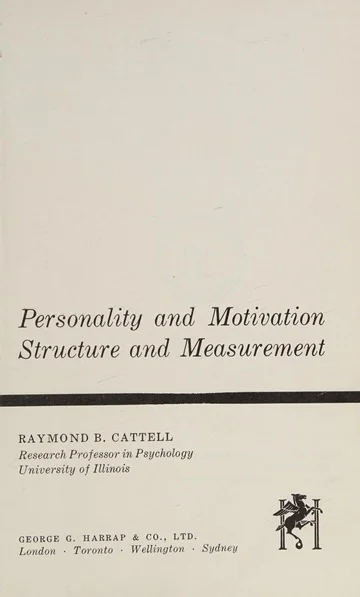
Personality and Motivation Structure and Measurement
 Raymond Bernard Cattell
This 948-page volume is Cattell's monumental synthesis of his factor-analytic research program, arguing that personality and motivation share a single, measurable structure discoverable through multivariate methods. The book integrates ability factors, temperament traits, and dynamic motivation factors—ergs, sentiments, and the dynamic lattice—into one comprehensive taxonomy, and it presents structured measurement as the only path to a genuinely predictive science of personality. It is less a textbook than a definitive statement of Cattell's life work to date, aimed at converting psychologists to his methodological vision.
Key Details
Related Books
View AllSimilar books from the same category, ranked by shared topics and reader engagement.


.webp?alt=media&token=413f638b-4d70-40f1-8217-367deb754ca8)
Key Insights — Read in 10 Minutes
What is the central argument of this book, and what does it reject?
Cattell argues that personality and motivation are not separate domains but a single, structured system discoverable through factor analysis, and that measurement must precede and ground theory. He rejects ad hoc, non-factored tests and the gadget-centered practices of clinical diagnosis, insisting that predictions should be based on well-established factors covering the entire range of ability, personality, and dynamic trait modalities . The book presents structured measurement as the only route to a genuinely predictive science, and Cattell positions it as a corrective to psychologists who rely on intuition, isolated instruments, or unfactored constructs rather than an integrated taxonomy of the whole person.
What specific frameworks and concepts does the book consolidate?
The book consolidates Cattell's mature taxonomy across three modalities: approximately 14 ability factors, 16 personality (temperament) factors, and 20 interest-motivation factors—roughly 50 factor measures in total . Its distinctive conceptual contribution is the dynamic lattice, a hierarchical model in which attitudes are subsidiated to sentiments, which in turn serve innate ergs. The book's table of contents lists chapters on "Dynamic structure: ergs, sentiments, and the dynamic lattice" and "The dynamic calculus of conflict," indicating that the integration of motivation into the factor-analytic framework is a central structural feature, not an afterthought . This architecture treats motivation as measurable structure rather than theoretical speculation.
How was the book received by contemporary reviewers, and what criticisms were raised?
Reviews acknowledged its monumental scope but were sharply critical of its prose. Charles Hanley, writing in Contemporary Psychology, called it "an advanced text and a proselyting tract" whose "energy, audacity, and enthusiasm cannot fail of admiration," yet concluded that "Cattell, the writer, is hardly the equal of Cattell, the psychologist" . Hanley noted the paradox that "the simplest material is made extraordinarily difficult" while some mathematically demanding sections are clear and neat. A review in the American Journal of Psychology summarized the five parts as "a monumental summary of the major portion of Cattell's life work to date" . The book's ambition was recognized; its accessibility was not.
What does the book mean by "ergs" and "sentiments," and how do they relate to the dynamic lattice?
Ergs are Cattell's term for innate, constitutional motivational dispositions—the psychological equivalent of instincts or drives, but defined operationally through factor analysis rather than speculation. Sentiments are acquired dynamic structures that develop through experience and become organized around objects or goals of value. The dynamic lattice describes how these structures relate hierarchically: an attitude is a specific expression of a sentiment, and a sentiment is subsidiated to one or more ergs, meaning it serves as a learned pathway to the satisfaction of innate drives. This architecture allows Cattell to explain how biological motivations become transformed into the complex, culturally shaped interests and values of adult life without abandoning the premise that motivation is a measurable structure.
What is the relationship between this book and Cattell's earlier An Introduction to Personality Study (1950)?
The 1957 volume supersedes and greatly expands the earlier introductory work. An Introduction to Personality Study was explicitly a concise, abridged presentation of Cattell's system, running to a fraction of the length of this 948-page synthesis . The 1957 book provides the full technical and empirical documentation that the 1950 volume summarized, including detailed factor-analytic evidence, the complete taxonomy of ability, temperament, and dynamic factors, and extended treatment of measurement methodology. Readers seeking a brief overview should consult the 1950 introduction; readers seeking the definitive mid-career statement of Cattell's system, with its supporting evidence and methodological arguments, must engage with this larger work.
What is a common misconception about this book that readers should avoid?
A frequent misconception is that the book is a neutral textbook or a comprehensive survey of competing personality theories. It is not. Hanley's review describes it explicitly as a "proselyting tract" aimed at informing and converting psychologists, and Cattell's methodological position—that only factored measures should ground prediction—is argued polemically against alternative approaches . Another misconception treats the 16PF as the book's central contribution. While the 16 personality factors are indeed consolidated here, the book's larger ambition is the integration of personality and motivation into a single structural taxonomy, encompassing ergs and the dynamic lattice alongside temperament and ability. The 16PF is one instrument within a much broader system, not the system's entirety.
Wealthy Psyche is an intellectual archive. We do not host, distribute, or sell book copies — physical or digital. We provide structured knowledge to help you think better, faster.