


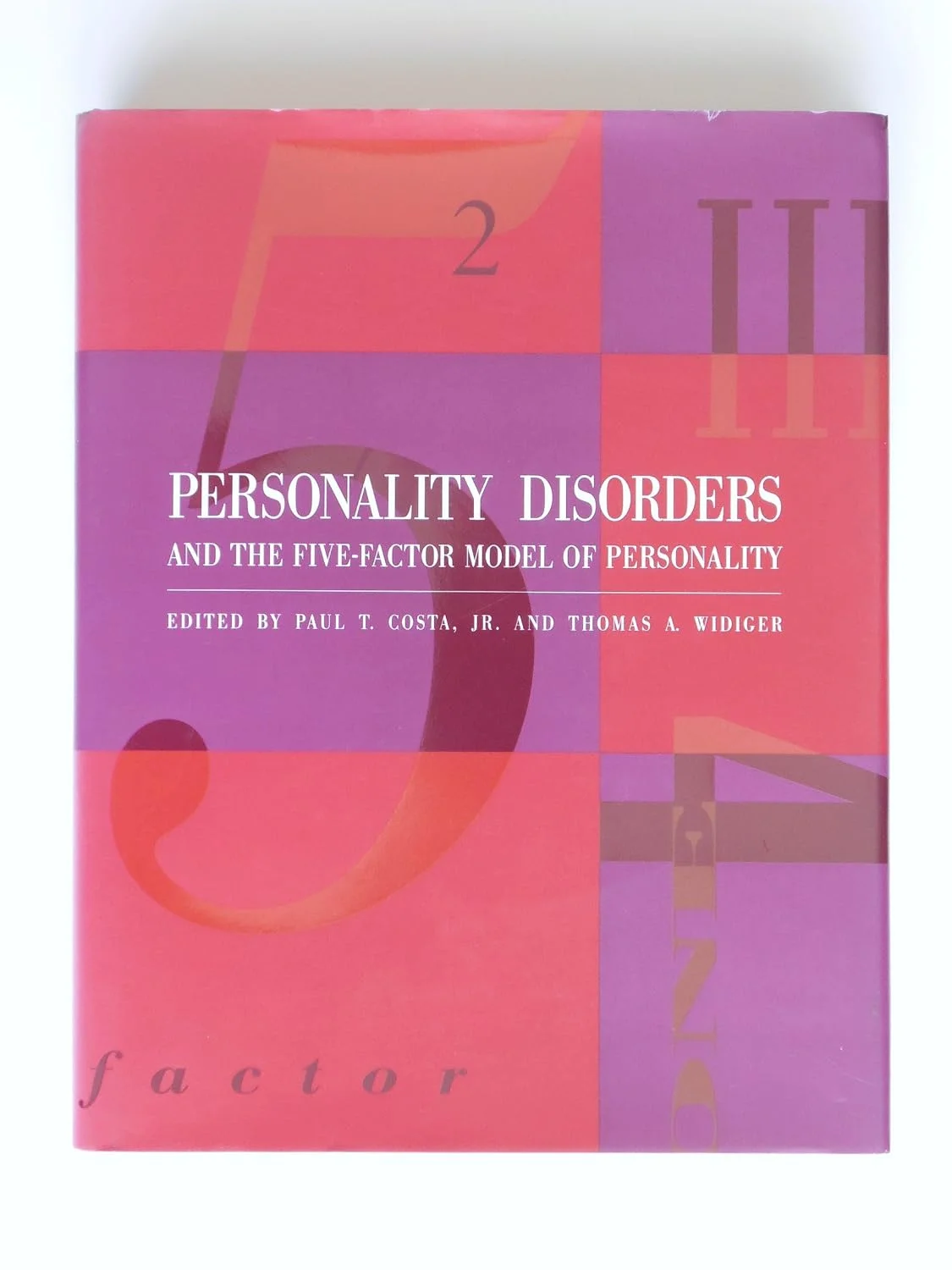
Personality Disorders and the Five-Factor Model of Personality
 Paul T. Costa Jr.
This edited volume, first published in 1994 and revised through three editions, argues that personality disorders are best understood not as categorical diseases but as maladaptive variants of the normal-range Five-Factor Model. Editors Costa and Widiger assemble chapters showing that DSM personality disorder diagnoses can be mapped onto extreme poles and facets of Neuroticism, Extraversion, Openness, Agreeableness, and Conscientiousness, providing a dimensional alternative to the categorical diagnostic system. The book's distinctive contribution is its sustained demonstration that a general taxonomy of personality can integrate normal and abnormal functioning within a single framework, with direct implications for assessment, diagnosis, and treatment planning.
Key Details
Related Books
View AllSimilar books from the same category, ranked by shared topics and reader engagement.


.webp?alt=media&token=413f638b-4d70-40f1-8217-367deb754ca8)
Key Insights — Read in 10 Minutes
What is the central argument unifying this edited collection, and what does it reject?
The unifying thesis is that personality disorders can be understood as extreme or maladaptive variants of the five broad domains and thirty facets of the Five-Factor Model, rather than as qualitatively distinct categorical diseases. The editors and contributors reject the categorical logic of the DSM's Axis II, which treats personality disorders as discrete diagnoses separated by clear boundaries from normal personality and from one another. Instead, they argue for a dimensional model in which pathology is a matter of degree along continuous trait dimensions . The 1994 first edition established this framework; the 2002 second edition added a summary of fifty-five empirical studies conducted since the first edition, and the 2013 third edition expanded coverage to include additional disorders and clinical applications .
What specific empirical and conceptual contribution did the first (1994) edition make to the field?
The 1994 edition was the first book-length treatment systematically applying the Five-Factor Model to personality disorders, and it became a definitive resource for researchers and clinicians interested in this application . Its contribution was twofold. Conceptually, it provided a framework for translating DSM personality disorder criteria into FFM trait profiles, showing, for example, that borderline personality disorder involves high Neuroticism combined with low Agreeableness and low Conscientiousness. Empirically, it gathered studies demonstrating predictable relationships between FFM domains and facets and personality disorder symptomatology. The book thus gave the dimensional critique of categorical diagnosis a concrete, empirically grounded alternative, moving beyond abstract advocacy to specific trait-level mappings that clinicians and researchers could test and apply.
How did the second and third editions revise and expand the original argument?
The second edition (2002) was a substantial revision rather than a mere reprint. It reprints fifteen chapters from the first edition with updated references, adds nine new chapters, and includes a comprehensive summary by the editors of fifty-five empirical studies published since 1994 . The third edition (2013) further expands the scope, with new chapters on childhood antecedents of personality disorder from an FFM perspective, the universality of the Five-Factor Model across cultures, and specific disorders including psychopathy, borderline personality disorder, narcissism, schizotypal personality disorder, and alexithymia . It also adds sections on assessment methods—including informant reports and prototype matching—and clinical applications such as dialectical behavior therapy viewed through the FFM lens. The trajectory across editions shows the argument moving from proof of concept to clinical implementation.
How does this book relate to the NEO-PI-R, and what role does that instrument play in the argument?
The NEO-PI-R is the operational backbone of the book's argument. The Five-Factor Model as presented here is measured primarily through the NEO-PI-R's thirty facet scales, which provide the granularity needed to map personality disorders onto specific trait combinations . The book's appendixes in the second edition include a description of the NEO-PI-R facet scales, and the third edition retains this material . The relationship is not merely instrumental, however: Costa co-authored both the NEO-PI-R manual and this volume, and the theoretical commitment to a hierarchical trait structure—five domains, six facets each—is shared across both works. Critics who question whether the NEO-PI-R exhausts the personality space would extend that skepticism to the book's claim that the FFM provides an adequate taxonomy for personality disorders.
What criticisms have been made of the Five-Factor Model approach to personality disorders presented in this volume?
Several criticisms have been raised. First, some argue that the FFM, developed to describe normal-range personality, may not capture the full phenomenology of personality disorders, particularly features like identity disturbance, self-harm, and interpersonal chaos that seem qualitatively distinct from trait extremes. Second, the model's clinical utility has been questioned: translating a DSM diagnosis into an FFM profile may be empirically informative but practically cumbersome for clinicians accustomed to categorical labels. Third, Widiger himself has acknowledged debates about whether all five domains are equally relevant to personality disorder, with Openness to Experience being the most contested . Fourth, the broader DSM-5 dimensional trait model, while influenced by the FFM, ultimately adopted a different structure (the PID-5), suggesting that consensus on the precise dimensional architecture remains elusive .
What is a common misconception about this book that readers should avoid?
A frequent misconception is that the book argues personality disorders are simply 'just' normal traits taken to extremes, implying that diagnosis is trivial or that suffering is not real. This misreads the argument. The contributors take personality disorders seriously as clinically significant conditions; their claim is about classification, not severity. They argue that the categorical system misrepresents the nature of the phenomena—creating false boundaries and excessive comorbidity—not that personality disorders are less disabling than the DSM implies. A related misconception is that the book is a polemic against the DSM. In fact, it engages closely with DSM criteria, and the third edition includes chapters on diagnosing personality disorder using the FFM in the context of the proposed DSM-5 . The book is an immanent critique, working from within the diagnostic tradition to reform its underlying model.
Wealthy Psyche is an intellectual archive. We do not host, distribute, or sell book copies — physical or digital. We provide structured knowledge to help you think better, faster.