


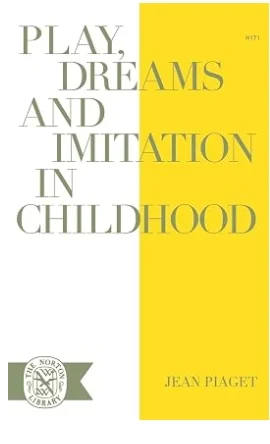
Play, Dreams and Imitation in Childhood
 Jean Piaget
Piaget's central argument is that imitation, play, and dreams are three manifestations of a single emerging "semiotic function"—the capacity to represent absent objects and situations through symbols. He traces how imitation develops from sporadic reflex-like copying into deferred imitation, which then provides the model for symbolic play and the imagery of dreams. Play is analyzed as the primacy of assimilation over accommodation, where the child bends reality to fit existing schemas. Together, these activities bridge sensorimotor intelligence and operational thought, showing how representation emerges from action before language fully takes over.
Key Details
Related Books
View AllSimilar books from the same category, ranked by shared topics and reader engagement.


.webp?alt=media&token=34bd26c3-d0b0-4cd7-a235-153b0182ef19)
Key Insights — Read in 10 Minutes
What is the central claim of Play, Dreams and Imitation in Childhood, and what does it reject?
Piaget's central claim is that imitation, play, and dreams are not separate phenomena but three interrelated expressions of the emerging "semiotic function"—the child's new capacity to represent absent objects and events through symbols. The book rejects theories that treat play as mere pre-exercise of adult instincts or as a recapitulation of ancestral activities. Instead, Piaget argues that symbolic play arises when assimilation dominates accommodation: the child bends reality to fit existing schemas rather than adapting schemas to reality. A 1953 review in Psychological Bulletin identified two theses: that the transition from primitive assimilation to operational adaptation can be studied through imitation and play, and that imitation, symbolic activity, and cognitive representation are interacting processes .
What specific concept or framework did this book introduce, and where is it used today?
The book introduced the concept of the "semiotic function" (fonction sémiotique)—the ability to evoke an absent object or situation through a differentiated signifier, whether imitation, symbolic play, drawing, or language. Piaget argued that deferred imitation provides the crucial bridge: when a child reproduces an absent model's behavior after a delay, the action becomes a sign of the original, enabling representation. The semiotic function remains a foundational concept in developmental psychology and is cited in research on pretense, theory of mind, and the cognitive underpinnings of language acquisition. The book also established a detailed six-stage sequence of imitation development and a classification of play into practice games, symbolic games, and games with rules that continues to structure observational research.
How does Piaget's account of play differ from Lev Vygotsky's?
Piaget and Vygotsky fundamentally disagree about play's origins and function. For Piaget, symbolic play emerges from the child's individual cognitive development, specifically from the disequilibrium between assimilation and accommodation; social imitation plays only an indirect role. Vygotsky, by contrast, argues that play is socially constituted—the child creates an imaginary situation from internalized social roles and rules, and the adult's teaching directly shapes what is played. A 1988 comparative analysis notes that Piaget offers "no motivation for play beyond the general disequilibrium between assimilation and accommodation," while Vygotsky gives play a crucial role in development that Piaget does not . Piaget also treats the imagination of play as egocentric and destined to fade before logical thought, whereas Vygotsky sees imaginative play as a lasting creative resource.
What is the relationship between this book and Piaget's two earlier volumes on infancy?
Play, Dreams and Imitation in Childhood is the third volume in Piaget's series on early development, following The Origins of Intelligence in Children and The Construction of Reality in the Child. All three are based on detailed observations of the same three children from birth through early childhood. The earlier volumes analyzed sensorimotor intelligence and the child's construction of object permanence, space, and causality. This third volume addresses what Piaget himself described as the question of how "representative activity" emerges from the sensorimotor foundations established in the earlier work. In his introduction to the French edition, Piaget states that the book's aim is to study the beginnings of the symbolic function and representative thought between approximately two and four years of age, before the construction of concrete operational thought .
What did contemporary reviewers identify as the book's most original contribution?
Reviews from the 1950s consistently identified the material on imitation as the book's most original contribution. Dorothy Tilden Spoerl, reviewing in The Journal of Abnormal and Social Psychology in 1955, wrote that "the material on imitation is the most original contribution, much of the other material having been discussed in various other previous books by Piaget" . Irving Sigel in Psychological Bulletin also emphasized the originality of Piaget's analysis of imitative development, noting that the book's basic goal was explaining the evolution of representative activity, which he characterized as going "beyond the present, extending the field of adaptation both in space and in time" . The detailed stage-by-stage account of imitation from reflex preparation to deferred imitation was recognized as a genuinely new contribution to developmental psychology.
What is the most common misconception about Piaget's theory of play?
The most common misconception is that Piaget regarded play as either merely trivial amusement or as a pre-exercise for adult skills. In fact, Piaget assigned play a significant cognitive role: symbolic play, once the semiotic function emerges, allows the child to assimilate experience to existing schemas without the pressure of accommodation. As Helene Guldberg notes, Piaget argued that with the introduction of symbols, play "goes far beyond practice"—children are not merely rehearsing adult roles but making sense of past experiences and integrating them into their understanding of the world . Piaget explicitly rejected the "theory of pre-exercise" that treated play as instinctual practice, arguing instead that symbolic play serves an assimilative, meaning-making function.
Wealthy Psyche is an intellectual archive. We do not host, distribute, or sell book copies — physical or digital. We provide structured knowledge to help you think better, faster.