


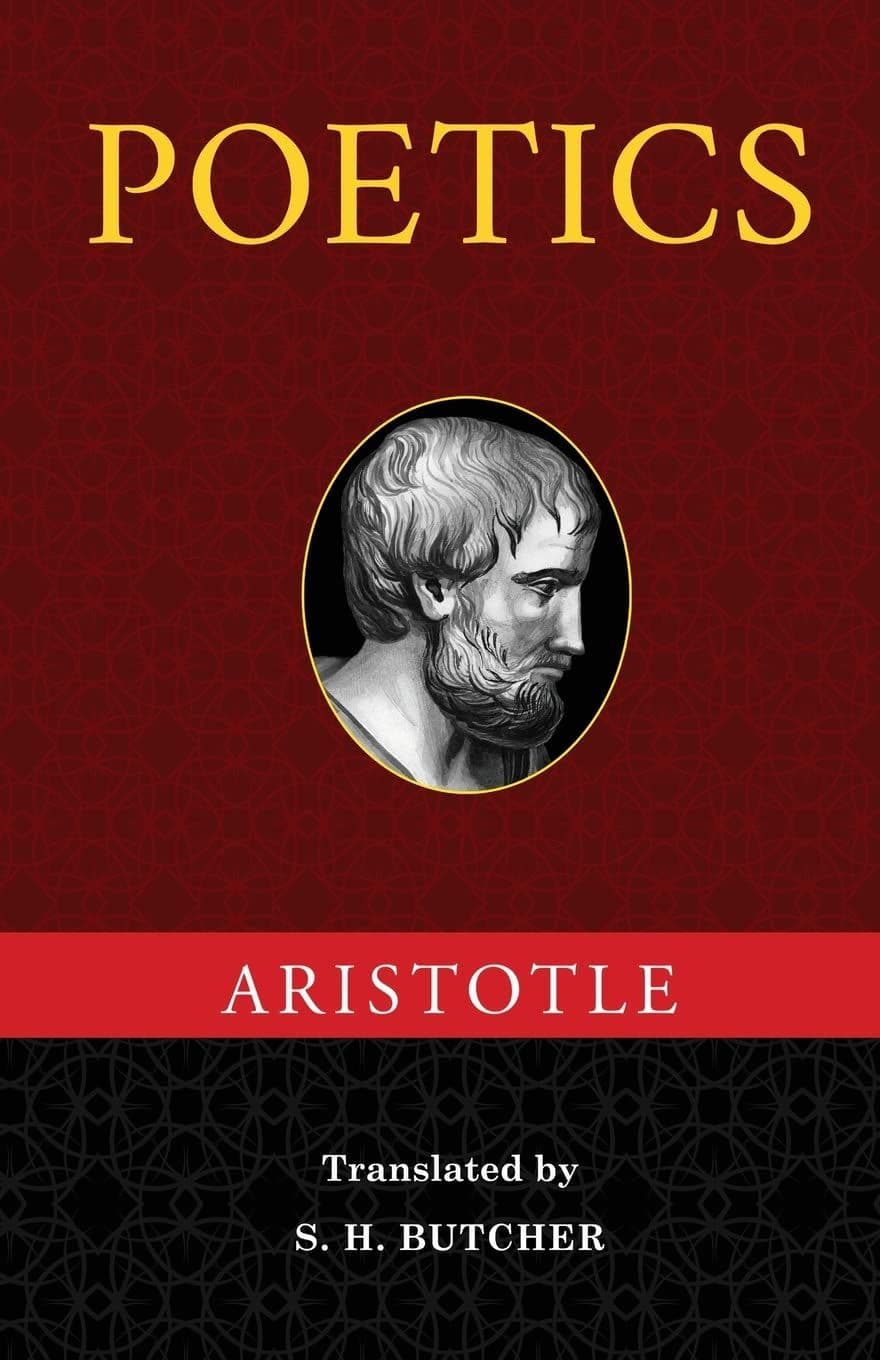
Poetics
Aristotle's Poetics is not a rulebook for playwrights but an inductive inquiry into what makes tragedy effective. Its mechanism is a structural analysis: tragedy is an imitation of an action, not of men, and plot (mythos) is its most important element—more important than character, diction, or spectacle. The treatise's central concepts—mimesis, hamartia, and katharsis—are introduced not as prescriptions but as analytical tools for understanding why certain dramatic structures produce pity and fear. Aristotle rejects Plato's charge that poetry is a mere copy of a copy, arguing instead that imitation is a natural human activity with cognitive value. The work's influence has been immense, though often through misreadings that turned its observations into neoclassical rules.
Key Insights
✦What is the central claim of the Poetics, and what does it reject?
The treatise's spine is the argument that tragedy is an imitation of an action, not of persons, and that plot (mythos) is therefore the most important of its six elements—more important than character, thought, diction, song, or spectacle . Aristotle rejects Plato's critique of poetry as a third-hand imitation of truth, arguing instead that mimesis is a natural human activity and that tragedy, properly structured, produces katharsis—the purging of pity and fear . The Poetics also rejects the assumption that dramatic excellence depends on spectacle or character alone; without a well-constructed plot, Aristotle insists, there is no tragedy at all. The work is descriptive and analytical, not prescriptive.
✦What is katharsis, and why has its meaning been so contested?
Katharsis is the process by which tragedy, through the arousal of pity and fear, purges or purifies those emotions in the audience. The term appears only once in the extant Poetics, and Aristotle does not define it, which has made it one of the most disputed concepts in literary theory . Interpretations range from a medical metaphor (purgation as a therapeutic release of emotion) to a moral one (purification of the emotions, tempering them to a moderate condition) . Neoclassical critics often treated katharsis as a form of poetic justice—virtue rewarded and vice punished—a reading that modern scholars largely reject as foreign to Aristotle's text . The ambiguity may be deliberate: Aristotle's account is structural rather than psychological, and the precise mechanism of katharsis remains open.
✦How has the text of the Poetics been transmitted, and what does its textual history reveal?
The Poetics is the least well transmitted of Aristotle's extant works. Only two Greek manuscripts survive: MS A (mid-10th century) and MS B (redated to the mid-12th century), alongside a Latin translation by William of Moerbeke (1278) and an Arabic translation by Abū Bišr (before 934) made from a lost Syriac version . The textus receptus is often corrupt, with grammatical errors and puzzling readings that require conjectural repair. Leonardo Tarán and Dimitri Gutas's 2012 editio maior, based on all primary sources including the Arabic tradition, has been praised as a major contribution, though reviewers note that its extreme conservatism leaves many passages in need of emendation . The textual instability of the Poetics is a reminder that its reception rests on fragile foundations.
✦How does the Poetics relate to Plato's critique of poetry in the Republic?
The relationship is more complex than the standard narrative of Aristotle defending poetry against Plato's attack. Aristotle does establish poetry's independence from philosophy, but a 2009 study in The Review of Politics argues that this independence should not be read as a straightforward defense . Aristotle is at least as critical as Plato of poetry's depiction of the city and the gods; his aim is to establish philosophy's complete autonomy from poetry, not to vindicate poetry against philosophy . Both thinkers agree that poetry is mimetic and that it has powerful effects on its audience. The difference lies in their conclusions: Plato banishes the poets from the ideal city, while Aristotle analyzes tragedy's structure to understand how it works, without recommending its banishment or its unqualified embrace.
✦What was the first English translation of the Poetics, and how did it shape later readings?
The first English translation was published in London in 1705 as Aristotle's Art of Poetry, translated according to Theodore Goulston's edition and accompanied by D'Acier's notes translated from the French . A 1973 doctoral thesis at the Australian National University is devoted to a study of this translation, indicating its significance for the history of English criticism . Earlier translations into other languages, particularly the Latin renderings and the Italian commentaries of the sixteenth century, had already shaped the neoclassical reading of the Poetics as a set of rules. The 1705 English version participated in this tradition, and its rendering of key terms—hamartia as 'fault' or 'error,' katharsis as 'purgation'—influenced how English critics from Dryden onward understood Aristotle's meaning.
✦What is a common misreading of the Poetics that persists today?
A persistent misreading treats the Poetics as a prescriptive rulebook—a set of laws that tragedy must obey, including the 'three unities' of time, place, and action. Aristotle mentions unity of action, but he says nothing about the other two; the three unities were codified by later Italian and French critics who read their own requirements back into his text . Similarly, hamartia is often mistranslated as 'tragic flaw,' suggesting a moral defect in the hero's character, when Aristotle's term is closer to an 'error' or 'mistake' that precipitates the reversal of fortune . These misreadings have shaped pedagogy and criticism for centuries, but they obscure the Poetics' actual method: an inductive analysis of existing tragedies, not a prescription for future ones.
Wealthy Psyche is an intellectual archive. We do not host, distribute, or sell book copies — physical or digital. We provide structured knowledge to help you think better, faster.