


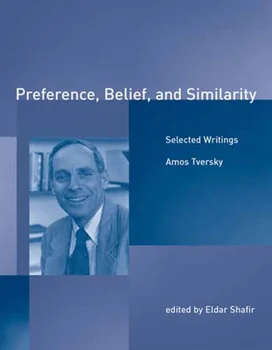
Preference, Belief, and Similarity: Selected Writings
 Amos Tversky
This volume collects forty articles selected by Amos Tversky himself in the final months of his life, organized into three domains: Similarity, Judgment, and Preference. The spine of the collection is Tversky's distinctive method: first articulate a normative ideal (whether for similarity assessment, probability judgment, or rational choice), then demonstrate experimentally how human processing systematically violates it. Rather than a retrospective compilation, the book functions as Tversky's own curated statement of which arguments he considered most essential to his legacy, including foundational papers with Daniel Kahneman and the introduction of prospect theory.
Key Details
Related Books
View AllSimilar books from the same category, ranked by shared topics and reader engagement.


.webp?alt=media&token=34bd26c3-d0b0-4cd7-a235-153b0182ef19)
Key Insights — Read in 10 Minutes
What distinguishes this collection from other Tversky anthologies or the Kahneman and Tversky edited volume?
The critical difference is curatorial authorship. Tversky selected these forty articles himself in collaboration with editor Eldar Shafir during the last months of his life, making the volume his own retrospective statement about which work mattered most. The 1982 Kahneman, Slovic, and Tversky edited collection focused specifically on the heuristics and biases program, whereas this volume spans Tversky's entire career across similarity theory, probability judgment, and preference modeling. The inclusion of articles on the 'hot hand' in basketball and arthritis pain beliefs alongside prospect theory demonstrates Tversky's own sense of his intellectual range, not an editor's posthumous guess at what belonged together.
What specific framework did Tversky introduce for understanding similarity, and how does it differ from earlier geometric models?
Tversky's feature-based contrast model, presented in the 1977 'Features of Similarity,' rejected the assumption that similarity can be represented as distance in a multidimensional space. Instead, he argued that similarity judgments depend on the weighting of common and distinctive features, and critically, that these weights are context-dependent and asymmetric. The similarity of A to B is not necessarily the same as B to A. This framework, developed across several papers in the volume's Similarity section, provided a more psychologically plausible account than spatial models and directly influenced later work on categorization, analogy, and prototype theory. The section includes collaborations with Shmuel Sattath, Itamar Gati, and J. Wesley Hutchinson that extend and test the model.
How does the Preference section's organization reflect Tversky's evolving views on rational choice?
The Preference section is subdivided into three phases: probabilistic models of choice, choice under risk and uncertainty, and contingent preferences. This structure traces a trajectory from Tversky's early work on intransitivity and elimination-by-aspects, through the prospect theory papers with Kahneman that challenged expected utility theory, to later work on preference reversals, reason-based choice, and context-dependence in legal decision-making. The section demonstrates that Tversky did not simply critique rational choice models from outside; he engaged with their mathematical formalisms, as evidenced by papers like 'Advances in Prospect Theory: Cumulative Representation of Uncertainty' which proposes a technical alternative to expected utility rather than merely documenting anomalies.
How has Tversky's heuristics-and-biases framework been critiqued or revised since his death?
The most sustained critique came from Gerd Gigerenzer and the ABC Research Group, who argued in works like 'Bounded Rationality: The Adaptive Toolbox' that heuristics should be understood as ecologically rational strategies rather than sources of systematic error. Gigerenzer contended that Tversky and Kahneman's experimental designs often stripped away environmental structure that makes heuristics effective in real-world settings. This debate, documented across multiple review articles and books, reshaped how researchers frame the 'biases' language. Within the volume itself, Tversky's papers on support theory and the conjunction fallacy provide the primary material that subsequent researchers have either extended or contested in this ongoing debate about ecological rationality versus error.
What does the inclusion of applied papers like the basketball 'hot hand' and arthritis pain beliefs reveal about Tversky's research program?
These papers demonstrate Tversky's commitment to testing cognitive principles in domains where statistical reasoning has practical consequences. The 'hot hand' papers with Thomas Gilovich examined whether basketball fans and players misperceive streakiness in shooting performance, finding that the belief in hot streaks is largely a cognitive illusion imposed on essentially random sequences. The arthritis pain study with Donald Redelmeier showed that patients' beliefs about weather-pain correlations were driven by selective memory rather than actual symptomatic patterns. These papers, sometimes overlooked by readers who focus on the theoretical pieces, exemplify Tversky's method of using vivid, culturally salient examples to demonstrate that intuitive statistical reasoning fails even when the stakes are personal and immediate.
How did this book come to be published posthumously, and what editorial choices shaped it?
Tversky died in June 1996. According to the volume's front matter, he had selected the articles in collaboration with Eldar Shafir, a former student, close friend, and collaborator, during the final months of his life. The book finally appeared through MIT Press in November 2003. Editorial choices included retaining original article formatting rather than rewriting for consistency, adding brief introductory remarks before each section, and including a complete chronological bibliography of Tversky's work. The delay between Tversky's death and publication reflects the scale of the project and the editorial labor required to assemble and contextualize four decades of technical papers. The resulting volume is therefore both an authored and edited work, with Shafir's mediating role shaping how Tversky's legacy is presented.
Show 2 more insights
How does this volume relate to the broader 'heuristics and biases' research program that Tversky and Kahneman founded?
The volume contains the foundational papers of that program, including 'Judgment under Uncertainty: Heuristics and Biases' and 'Belief in the Law of Small Numbers,' but its structure places them within a wider intellectual arc. The Similarity section precedes the Judgment section, suggesting that Tversky's work on how people assess resemblance and category membership provided conceptual foundations for understanding why probability judgments deviate from normative standards. The Judgment section then shows how representativeness, availability, and anchoring produce systematic errors. This organization implicitly argues that heuristics-and-biases research should be understood as part of Tversky's broader investigation into the structure of psychological similarity and its consequences for reasoning, not as an isolated critique of statistical intuition.
What is the most common misreading of Tversky's work that this collection might help correct?
A frequent oversimplification treats Tversky (and Kahneman) as arguing that humans are simply irrational, full stop. The papers in this volume consistently demonstrate something more precise: that human judgment exhibits systematic, predictable deviations from normative models, and that these deviations are cognitively explicable. Tversky's method was to first master the normative ideal—whether expected utility theory, probability axioms, or multidimensional scaling—and then show how information processing constraints produce consistent departures. The prospect theory papers, for example, propose a formal alternative to expected utility that describes decision weights and value functions, not merely a catalogue of errors. Reading the technical papers alongside the applied ones makes clear that Tversky's target was the mismatch between normative theory and psychological reality, not human intelligence as such.
Wealthy Psyche is an intellectual archive. We do not host, distribute, or sell book copies — physical or digital. We provide structured knowledge to help you think better, faster.