


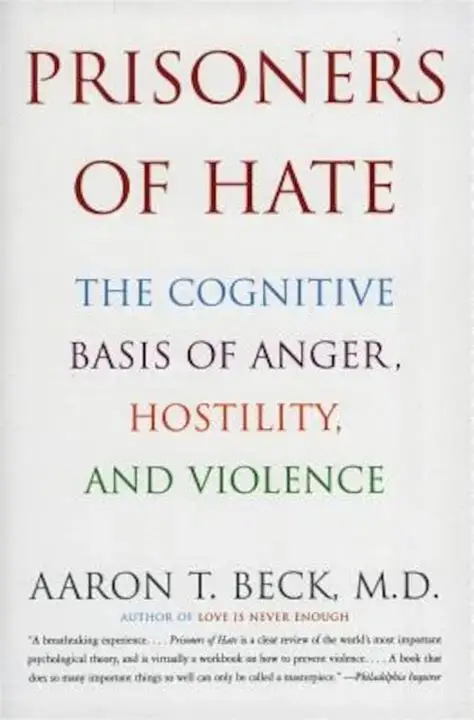
Prisoners of Hate: The Cognitive Basis of Anger, Hostility, and Violence
 Aaron Beck
Beck extends cognitive therapy from individual psychopathology to the social world, arguing that anger, hostility, and violence follow a predictable cognitive sequence: a perceived threat or insult, a feeling of weakness, blame directed outward, and finally attack. The same cognitive distortions—personalization, selective attention, overgeneralization—that operate in depressed or anxious individuals, Beck contends, also drive domestic abuse, ethnic conflict, and even genocide. The book's central mechanism is the identification and correction of the hostile cognitive appraisals that imprison individuals, groups, and nations in cycles of retaliation.
Key Details
Related Books
View AllSimilar books from the same category, ranked by shared topics and reader engagement.


Key Insights — Read in 10 Minutes
What is the cognitive sequence Beck identifies as leading from insult to violence?
Beck describes a rapid but analyzable train of thoughts: a perceived attack on self-esteem, followed by a feeling of weakness and being wronged, then blame fixed outward, culminating in counterattack. A review in the American Journal of Psychiatry outlines this progression clearly, noting that it applies from couple arguments to international conflict . The key cognitive distortions—personalization, selective attention, overgeneralization—are the same mechanisms identified in cognitive therapy for depression and anxiety. Beck's innovation is demonstrating that the hostile appraisal pattern is not merely a symptom of individual pathology but a universal cognitive vulnerability that can be triggered in groups and nations under conditions of threat or humiliation.
How does Beck apply individual cognitive therapy concepts to mass violence like the Holocaust?
Beck engages seriously with Daniel Goldhagen's Hitler's Willing Executioners, arguing that the Holocaust occurred partly because a set of cognitive distortions about Jewish people had been held by many Germans for at least a century, then were 'primed' by Hitler's rhetoric and Germany's post-WWI sense of weakness . A reviewer in American Journal of Psychotherapy found this integration compelling, calling it a 'virtually unassailable model' for explaining the social psychology of genocide . Beck's claim is not that cognitive therapy could have prevented the Holocaust, but that the same psychological mechanisms operating in a violent marriage operate at scale when cultural narratives supply the target and historical humiliation supplies the motive.
What limitations do reviewers identify in the book's clinical recommendations?
The clinical intervention section is only nineteen pages, which a reviewer in American Journal of Psychotherapy called disappointing for clinicians hoping to treat physically abusive couples or violent offenders . Library Journal criticized Beck for oversimplifying when he argues that anger and hostility are 'the same whether the conflict is between spouses or nations,' and for giving short shrift to the constructive aspects of anger . The book also makes no reference to borderline personality disorder in its discussion of anger-prone patients, despite the centrality of anger dysregulation to that diagnosis .
How does Beck's approach to anger differ from the shame-based account offered by James Gilligan?
Beck cites Gilligan's Violence: Reflections on a National Epidemic extensively, and the two frameworks are complementary rather than contradictory. Gilligan, a psychiatrist who worked extensively with violent offenders, argued that violence is often a response to shame and humiliation—a desperate attempt to restore self-esteem . Beck's cognitive sequence begins with a perceived attack on self-esteem and proceeds through weakness and blame to attack, which is essentially a cognitive decomposition of Gilligan's shame-to-violence pathway. Where Gilligan emphasizes the affective core of shame, Beck emphasizes the cognitive appraisals that translate shame into hostile action. Beck's contribution is showing that those appraisals can be identified and corrected through cognitive techniques.
What distinguishes this book from Beck's earlier work on depression and anxiety?
The earlier books address intrapsychic disorders—depression, anxiety, personality problems—and provide detailed treatment manuals for individual therapy. Prisoners of Hate shifts scale dramatically, applying the same cognitive principles to interpersonal violence, ethnic conflict, and war. The book opens with a six-page summary of cognitive therapy for readers unfamiliar with his approach, indicating that Beck is writing for a broader audience than clinicians . The clinical techniques are largely adapted from couples therapy and individual anger management, but the ambition is social and political. This scale shift is both the book's originality and, according to some reviewers, its vulnerability to oversimplification.
What role does empathy training play in Beck's proposed remediation of hostility?
Beck identifies empathy training as a central remediation strategy, describing it as a way of establishing social reinforcers that increase empathic rather than destructive relationship behaviors . The logic is cognitive and behavioral: hostile appraisals are maintained by selective attention to threat cues and discounting of the other's perspective; empathy training forces a more balanced appraisal by requiring the hostile person to consider the other's experience and motives. Beck also discusses typical cognitive interventions for individuals and couples, though the limited space devoted to these techniques suggests that the book is more a conceptual framework for understanding violence than a practical treatment manual for violent populations.
Wealthy Psyche is an intellectual archive. We do not host, distribute, or sell book copies — physical or digital. We provide structured knowledge to help you think better, faster.