


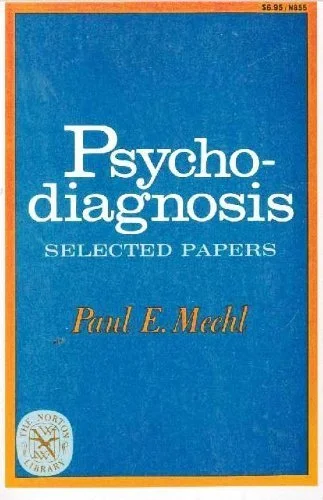
Psychodiagnosis: Selected Papers
 Paul Everett Meehl
This collection gathers thirteen of Meehl's papers on the logic and limits of clinical diagnosis, unified by a single question: how does a clinician maintain intellectual integrity while practicing an art built on a primitive science? Two essays appear here for the first time—'Why I Do Not Attend Case Conferences,' a pointed critique of diagnostic conference methods, and a new statistical procedure for detecting loose syndromes. The volume's spine is Meehl's insistence that clinical judgment must be examined by the same empirical standards applied to any other predictive instrument, not defended by professional intuition.
Key Details
Related Books
View AllSimilar books from the same category, ranked by shared topics and reader engagement.


Key Insights — Read in 10 Minutes
What unifying theme does Meehl himself identify for this collection?
In the preface, Meehl states that the unifying theme of the selected papers is the question of how one maintains a reasonable degree of intellectual integrity when practicing an art that applies a primitive science . This is not a methodological slogan but an existential problem for the clinician: the science underpinning psychodiagnosis is incomplete and probabilistic, yet decisions must be made about real patients. The collection is therefore not a systematic treatise but a record of one psychologist wrestling with that tension across different problems—construct validation, actuarial prediction, schizophrenia research, and the social rituals of case conferences. The papers are unified by a stance, not a doctrine.
What is the significance of 'Why I Do Not Attend Case Conferences,' one of the two new papers in this volume?
'Why I Do Not Attend Case Conferences' is a sustained critique of how psychiatric case conferences are typically conducted and participated in, written with Meehl's characteristic combination of logical rigor and polemical bite. The publisher's description notes that the paper was expected to provoke controversy among clinical psychologists, psychiatrists, and neurologists who participate in such conferences . Meehl does not merely complain; he offers specific suggestions for improving conference procedures, aiming to bring the reinforcement schedule and cognitive feedback of the psychiatric case conference closer to the standards of the clinicopathological conference in general medicine . The essay is a case study in Meehl's broader concern: that clinical institutions often reward confidence and fluency over accuracy and accountability.
How does this collection relate to Meehl's Clinical versus Statistical Prediction?
Psychodiagnosis extends the program initiated in the 1954 monograph. Where Clinical versus Statistical Prediction established the empirical case that actuarial rules generally match or outperform clinical judgment, the selected papers here address the surrounding questions: how psychological constructs are validated (the classic paper with Cronbach on construct validity), how clinicians actually think (the cognitive activity of the clinician), and how diagnostic institutions function or fail (the case conference critique). The collection includes 'Wanted—A Good Cookbook,' a key follow-up essay in the actuarial prediction debate . Psychodiagnosis thus contextualizes the prediction finding within a broader account of what clinical science can and cannot yet deliver.
What papers are included, and do they represent Meehl's range beyond prediction?
The thirteen papers span Meehl's major interests. They include 'Construct validity in psychological tests' (with Lee J. Cronbach), 'Antecedent probability and the efficiency of psychometric signs, patterns, or cutting scores,' 'Wanted—A good cookbook,' 'When shall we use our heads instead of the formula?,' 'The cognitive activity of the clinician,' 'Schizotaxia, schizotypy, schizophrenia,' and 'MAXCOV-HITMAX: a taxonomic search method for loose genetic syndromes' . The range is deliberately wide: from the logic of construct validation to a substantive theory of schizophrenia's genetic basis, and from the psychology of clinical inference to a statistical method for detecting latent taxa. The collection is not a prediction book but a portrait of a psychologist working across philosophy of science, psychometrics, and clinical theory.
How was the collection received by contemporaries?
A review by Erasmus L. Hoch in Contemporary Psychology (1974) described the book as a collection of Meehl's teachings, 'some old, some new, all in the Meehl genre' . Hoch noted that the selection was proposed by the University of Minnesota Press and necessarily involved a selection process, and that while some clinicians might speculate about what the particular subset chosen reveals about the author, the unifying theme is the integrity question Meehl himself identifies. Hoch observed that the selections fall into clusters, with some pieces having become 'almost classic' by citation standards—the 'cookbook' article being a prime example . The review's tone is appreciative without being uncritical, recognizing the collection as a curated intellectual portrait rather than a systematic new argument.
What is a common misreading of this collection's purpose?
A frequent misreading treats Psychodiagnosis as a sequel or companion volume to Clinical versus Statistical Prediction, a further installment in the prediction debate. It is better understood as a retrospective self-curation: Meehl selecting the papers that, in his view, represent his thinking on the integrity problem of clinical practice. Some of the papers predate the 1954 monograph; others address topics far removed from prediction, such as the taxometric method and schizophrenia theory. The collection is not organized to advance a single thesis but to display a body of work unified by a stance toward clinical science. Readers seeking a systematic argument should look to the monographs; readers seeking Meehl's intellectual range and style will find it here.
Wealthy Psyche is an intellectual archive. We do not host, distribute, or sell book copies — physical or digital. We provide structured knowledge to help you think better, faster.