


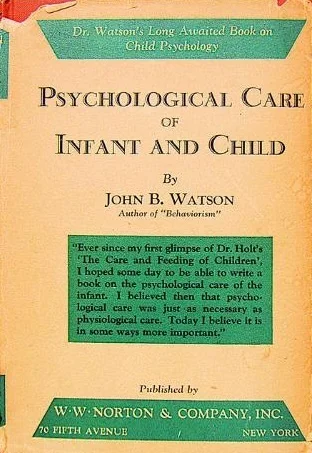
Psychological Care of Infant and Child
 John B. Watson
Watson argues that child-rearing should be conducted as an applied behavioral science: parents should arrange environments and consequences to shape habits, rather than rely on instinct, affection, or tradition. The book advises treating children as young adults, keeping emotional attachment to a minimum, and scheduling feeding, sleeping, and play according to systematic routines. Its central claim is that the child's personality is a product of conditioning, and that excessive mother-love and coddling produce dependency and maladjustment. Watson presents behaviorist principles as practical guidance for raising emotionally self-reliant, productive adults.
Key Details
Related Books
View AllSimilar books from the same category, ranked by shared topics and reader engagement.



Key Insights — Read in 10 Minutes
What is the central argument of Psychological Care of Infant and Child, and what does Watson reject?
Watson argues that child-rearing should be conducted as an applied behavioral science: parents should arrange environments and consequences to shape habits, rather than rely on instinct, affection, or tradition. He rejects the prevailing view that maternal instinct and parental love are sufficient guides to raising children, and he rejects the indulgence and protectiveness that he believed characterized American child-rearing. The book advises treating children as young adults, keeping emotional attachment to a minimum, and scheduling feeding, sleeping, and play according to systematic routines. Its central claim is that the child's personality is a product of conditioning, and that excessive mother-love and coddling produce dependency and maladjustment. Watson presents behaviorist principles as practical guidance for raising emotionally self-reliant, productive adults.
What specific advice does Watson give parents, and how does it follow from behaviorist principles?
Watson's advice follows directly from the behaviorist premise that habits are formed by environmental contingencies. He recommends feeding on a strict schedule rather than on demand, to establish regular habits and avoid reinforcing crying. He advises against rocking, cuddling, and playing with the infant during care routines, to prevent the formation of excessive attachment. He suggests that parents should keep a certain emotional distance and treat the child with the courtesy they would extend to a adult guest. He recommends that children be given their own sleeping arrangements early and that fears be addressed by conditioning rather than reassurance. The overarching principle is that parents should focus on shaping behavior through consistent routines and consequences rather than responding to the child's emotional demands.
How was the book received at the time, and what was its influence on American parenting?
The book was a commercial success and became one of the most influential child-rearing manuals of the late 1920s and 1930s. It was widely reviewed in both professional and popular press, and Watson's advice was taken seriously by many middle-class parents who saw science as the path to better child-rearing. The book's influence was amplified by Watson's earlier popular works on behaviorism and by his reputation as a leading psychologist. However, its advice was controversial from the start, with critics arguing that it neglected the emotional needs of children and that the behaviorist model was too narrow for the complexities of family life. Its influence declined in the 1940s, as Benjamin Spock's Baby and Child Care (1946) offered a more permissive and warmth-oriented approach that came to dominate American parenting advice.
How did Watson's own experiences as a parent and his personal life shape the book?
The book's tone and recommendations were shaped by Watson's personal history and his professional commitments. His own childhood in South Carolina was marked by poverty and a strict religious upbringing, and his later relationship with his children was reported to be strained. His son William Rayner Watson later described his childhood as one in which he was deprived of emotional warmth, and he attempted suicide as a young man—an outcome that was widely cited by critics of Watson's methods. The book's emphasis on emotional detachment and the avoidance of coddling reflected both Watson's behaviorist convictions and his own temperament. His divorce and departure from academia in 1920, and his subsequent career in advertising, also influenced his faith in the power of systematic environmental control to shape behavior.
What did critics, particularly psychoanalysts and developmental psychologists, say about the book?
Critics argued that Watson's approach neglected the emotional and relational dimensions of child development. Psychoanalysts objected that the advice to avoid cuddling and emotional warmth would produce insecurity and neurosis rather than self-reliance. Developmental researchers later provided evidence that secure attachment, responsive caregiving, and physical affection are essential for healthy emotional development—findings that contradicted Watson's recommendations. The pediatrician Benjamin Spock, whose Baby and Child Care (1946) became the dominant parenting manual of the postwar era, offered a warmer, more flexible alternative that implicitly rejected Watson's model. Even within behaviorism, later theorists recognized the importance of social reinforcement and the role of the caregiver in providing positive consequences. The book became a cautionary example of the dangers of applying a narrow scientific framework to complex human relationships.
How does the book relate to Watson's other works, particularly Behaviorism (1924/1930)?
Psychological Care of Infant and Child (1928) is the practical application of the behaviorist principles Watson developed in Psychology from the Standpoint of a Behaviorist (1919) and popularized in Behaviorism (1924/1930). Where Behaviorism presented the general program and its philosophical implications, the child-care book translated those principles into specific advice for parents. Watson had long argued that personality is a product of environmental conditioning, and the book demonstrates what that means in the domestic sphere. It is thus a case study in applied behaviorism, and it shows both the ambitions and the limitations of Watson's attempt to make psychology a technology of behavior control. The book's fate—enormous influence followed by decisive rejection—parallels the broader trajectory of Watson's reputation.
Show 1 more insights
What does the book's reception tell us about the relationship between scientific authority and parenting advice?
The book's reception illustrates the cultural power of scientific authority in the early twentieth century and the limits of that authority when it conflicts with widely shared intuitions about care. Watson's status as a leading psychologist gave his advice credibility, and the promise of a scientific approach to child-rearing appealed to parents who wanted to raise competent, self-reliant children. Yet the advice conflicted with the emotional realities of family life, and its eventual repudiation by Spock and others showed that scientific expertise cannot easily override the relational needs of children and parents. The episode became a standard example in discussions of scientific overreach and the importance of attending to the ethical and emotional dimensions of applied psychology. It remains a cautionary tale for any attempt to reduce complex human relationships to a set of behavioral procedures.
Wealthy Psyche is an intellectual archive. We do not host, distribute, or sell book copies — physical or digital. We provide structured knowledge to help you think better, faster.