


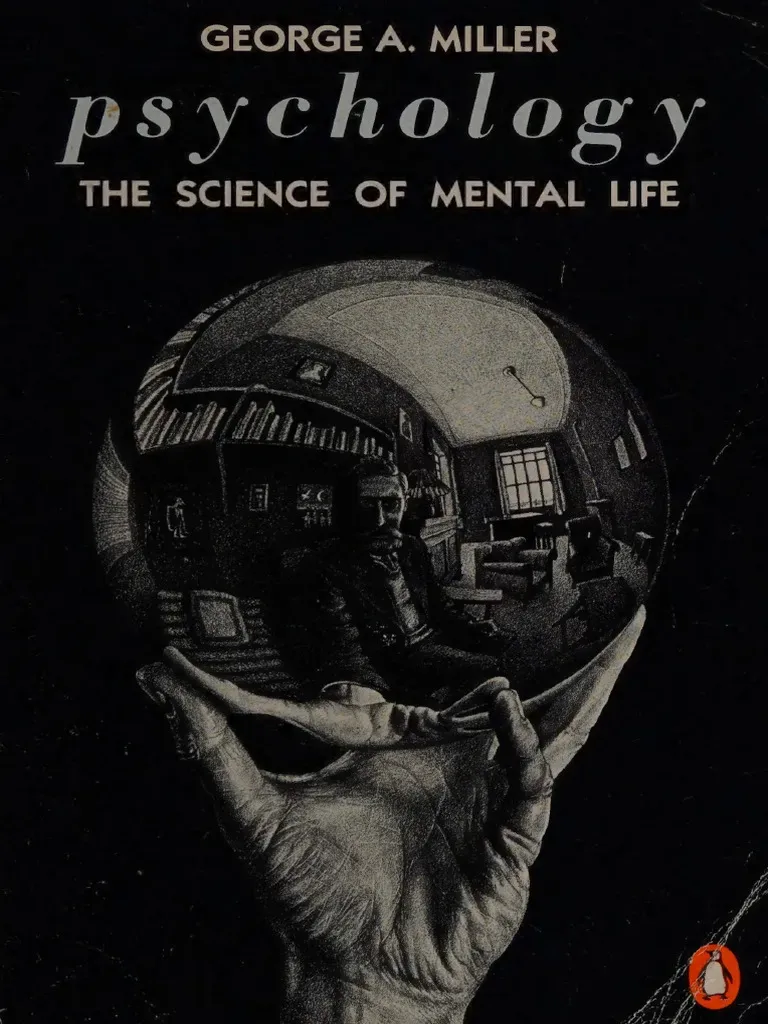
Psychology: The Science of Mental Life
 George A. Miller
Miller's introductory text approaches psychology through the intellectual biographies of six pioneers—Wundt, James, Galton, Pavlov, Freud, and Binet—rather than through topical chapters. Its central method is to show how each figure's personal insights and milieu shaped the concepts that became modern psychology's foundation. The book argues that the science of mental life is best understood historically, as ideas developed in particular minds responding to particular intellectual climates, not as a neutral catalog of findings. This biographical architecture distinguishes it from standard introductory surveys and gives the text its characteristic emphasis on the human sources of psychological knowledge.
Key Details
Related Books
View AllSimilar books from the same category, ranked by shared topics and reader engagement.

.webp?alt=media&token=34bd26c3-d0b0-4cd7-a235-153b0182ef19)

Key Insights — Read in 10 Minutes
What is the central method of Psychology: The Science of Mental Life, and how does it differ from conventional introductory texts?
The book's organizing method is biographical rather than topical. Miller structures the text around six pioneers—Wilhelm Wundt, William James, Francis Galton, Ivan Pavlov, Sigmund Freud, and Alfred Binet—and uses their intellectual development as the entry point into major areas of psychology. The essay on Wundt leads into consciousness research, Pavlov into learning theory, Freud into motivation and drives. A contemporary review in the British Journal of Psychology noted that this approach's value lies not in comprehensive coverage of modern research but in surveying major lines of thought and relating each figure's ideas to their intellectual milieu . This differs from standard introductory surveys, which typically organize by topic rather than by the historical actors who shaped those topics.
What role did Robert Buckhout play in the book's publication history?
Robert Buckhout, a psychologist, became a co-author for the second edition, published by Harper & Row in 1973. The first edition, published in 1962, was authored by Miller alone. The second edition expanded the text to 561 pages and included Buckhout as a collaborator . A review in PsycCRITIQUES noted that the second edition continued the biographical approach, examining how personal insight shaped the science of mental life . Buckhout was known for his work on eyewitness testimony and memory, which aligned with the book's broader focus on psychology as an empirical discipline. The second edition is the version most commonly found in university library catalogs today.
How has the book's biographical approach been received by readers and reviewers?
Reception has been mixed. A 1966 review in the British Journal of Psychology praised the book as 'among the small number of books that give a balanced and above all an historical perspective on current psychological thought,' noting that Miller's chapters on Wundt and James were particularly successful . However, a Goodreads reviewer observed that the historical background is not Miller's strength and that the book lacks a narrative connecting the different elements into a coherent account of psychology as a science . The reviewer also noted that the biographical chapters, while interesting, do not create a sense of scientific dialogue or developing inquiry. The book has been described as a 'textbook for mind geeks' rather than a comprehensive survey.
What is a common misconception about the book, given Miller's later reputation as a cognitive psychologist?
Readers familiar with Miller's foundational contributions to cognitive psychology—particularly his 1956 paper on the 'magical number seven' and his role in the cognitive revolution—might expect this book to reflect that cognitive orientation. It does not. Published in 1962, the book is an introductory text rooted in the history of psychology as a discipline, with substantial attention to figures like Freud, Pavlov, and Binet whose work predates or diverges from the information-processing paradigm Miller later helped establish. The book reflects Miller's earlier role as a Harvard lecturer tasked with presenting psychology's breadth rather than his later specialized focus on language and cognition. It should be read as a historical introduction, not as a statement of the cognitive program Miller would later champion.
How does this book relate to Miller's other writings on language and communication?
Psychology: The Science of Mental Life occupies a distinct position in Miller's oeuvre. His 1951 book Language and Communication was a technical treatment of psycholinguistics and information theory . His 1967 collection The Psychology of Communication gathered seven essays on related themes . The 1962 textbook is his only sustained attempt at a general introduction to psychology as a whole, written for students rather than specialists. Its biographical method reflects his belief that understanding a science requires understanding the people who built it—a position he would later revisit in Spontaneous Apprentices, his 1977 account of a failed research project. The textbook thus represents Miller's engagement with pedagogy and disciplinary history, distinct from his experimental and theoretical contributions.
Wealthy Psyche is an intellectual archive. We do not host, distribute, or sell book copies — physical or digital. We provide structured knowledge to help you think better, faster.