


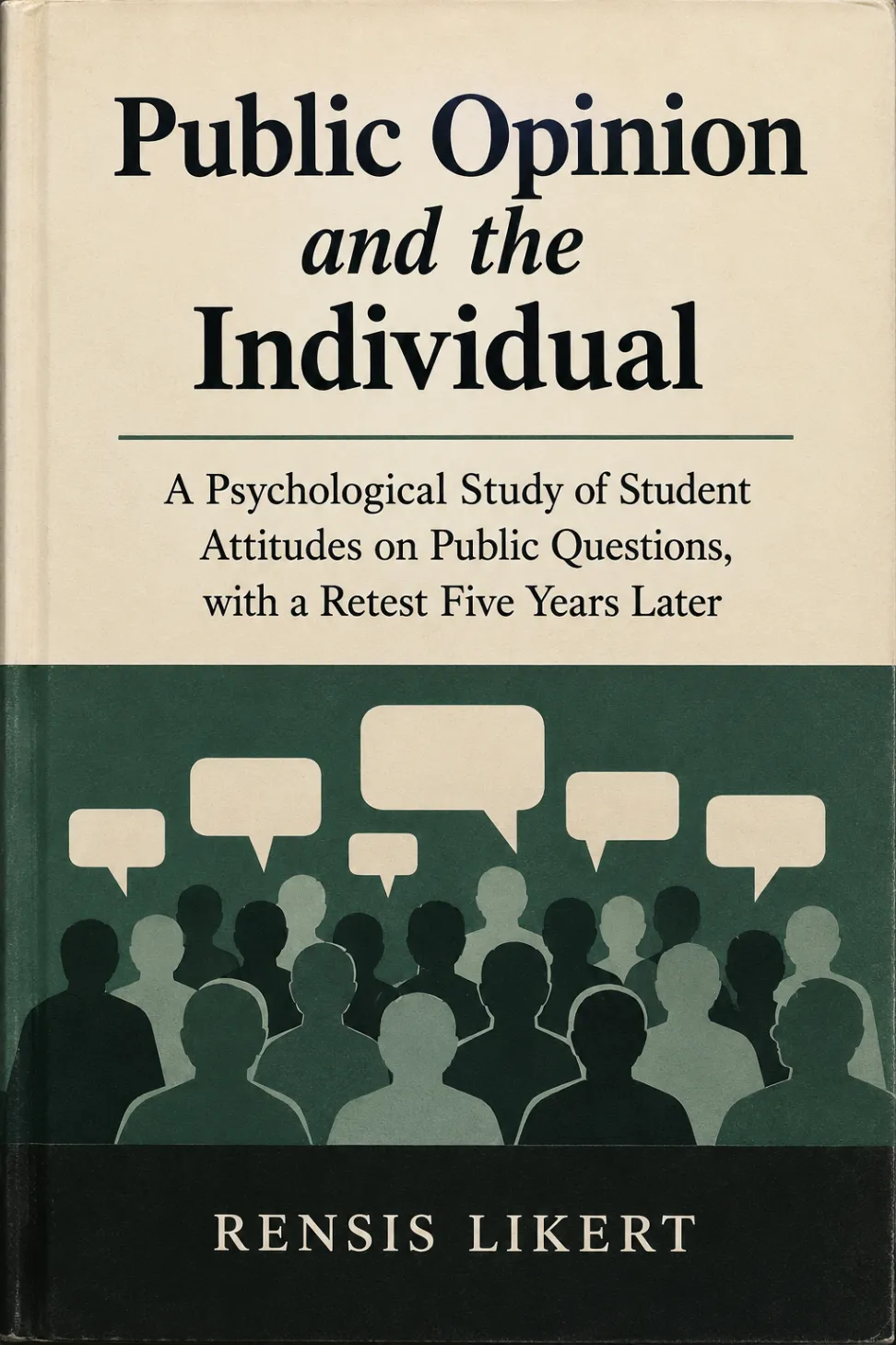
Public Opinion and the Individual: A Psychological Study of Student Attitudes on Public Questions, with a Retest Five Years Later
 Rensis Likert
Murphy and Likert's monograph reports a longitudinal study of student attitudes on internationalism, race, and economic questions, begun in 1929 and retested five years later. Its distinctive contribution is methodological: the book contains the early statement of the Likert scale, which replaced Thurstone's panel-of-judges approach with a simpler five-point agree-disagree format, demonstrating comparable reliability at lower cost. The authors pair quantitative attitude scales with qualitative life histories, arguing that attitudes are acquired chiefly through contact with other attitudes rather than direct experience. The retest finding that attitudes shifted toward radicalism over five years supports their interest in attitude genesis and change.
Key Details
Related Books
View AllSimilar books from the same category, ranked by shared topics and reader engagement.


Key Insights — Read in 10 Minutes
What is the central claim of Public Opinion and the Individual, and what does it reject?
The central claim is that attitudes can be measured reliably with a simple five-point agree-disagree scale and that attitudes are acquired chiefly through contact with other attitudes rather than through direct experience with the objects of those attitudes . Murphy and Likert reject the assumption, common in earlier attitude research, that elaborate measurement procedures requiring expert judges are necessary for reliable results. Their study, conducted with college students beginning in 1929 and retested five years later, also rejects the idea that parental income or social-science coursework shapes attitudes; they found no correlation between parental income and student attitudes, and no effect of coursework concentration . The book's distinctive contribution is thus methodological and substantive at once.
What specific measurement technique did this book introduce, and where is it used today?
The book contains the early statement of what became known as the Likert scale, presented as Chapter 3 and derived from Likert's 1932 doctoral dissertation . The technique presents respondents with a statement and asks them to rate agreement on a five-point continuum from strong disagreement to strong agreement, then sums the responses to produce an attitude score. This dispensed with the panel of judges required by Thurstone's method and proved comparably reliable with fewer items . The Likert scale is now ubiquitous in survey research, opinion polling, personality testing, and organizational assessment, and it remains one of the most widely used psychometric formats in the social sciences .
What did the five-year retest find, and how did the authors interpret it?
The retest, conducted approximately five years after the initial 1929 survey, found that attitudes had shifted generally toward radicalism . The authors cautiously interpreted this shift as possibly resulting from the subjects' better and wider acquaintance with political and economic problems of the day, rather than from personal economic circumstances . This finding supported their broader argument that attitudes are shaped more by exposure to ideas and social contact than by material conditions. It also illustrated the value of longitudinal design in attitude research, a relatively uncommon approach at the time. The interpretation was tentative, reflecting the authors' methodological caution about generalizing from a student sample.
How does the book's method compare with Thurstone's approach to attitude measurement?
Thurstone's method required a panel of judges to sort statements by their apparent attitude value before constructing a scale, a laborious procedure. The Murphy-Likert approach dispensed with judges entirely, relying instead on respondents' direct self-placement on a five-point continuum, and it produced reliability comparable to Thurstone's with fewer items . This made attitude measurement cheaper, faster, and more scalable. Contemporary reviewers recognized this as the book's chief contribution, with one noting that the Murphy-Likert method was 'much simpler than the epochal method perfected by Professor L. L. Thurstone' . The simplification helped democratize attitude research, allowing surveys to be conducted without specialized psychometric expertise.
What are the main limitations or criticisms of the study?
Criticisms concern the sample, the assumptions, and the theoretical framing. The sample consisted of college students, limiting generalizability, and the authors themselves treated the work as preliminary rather than definitive . A contemporary review noted that the authors assumed attitudes are normally distributed, an assumption 'sharply in dispute among specialists' . Another reviewer observed that the authors began with a 'conviction' of high attitude specificity, only to discover a generalized radicalism-conservatism dimension running across attitudes, and that they neglected the theoretical implications of finding abbreviated measures as reliable as full Thurstone scales . These limitations mean the book is best read as a methodological landmark and a rich empirical record rather than a definitive account of attitude formation.
Wealthy Psyche is an intellectual archive. We do not host, distribute, or sell book copies — physical or digital. We provide structured knowledge to help you think better, faster.