


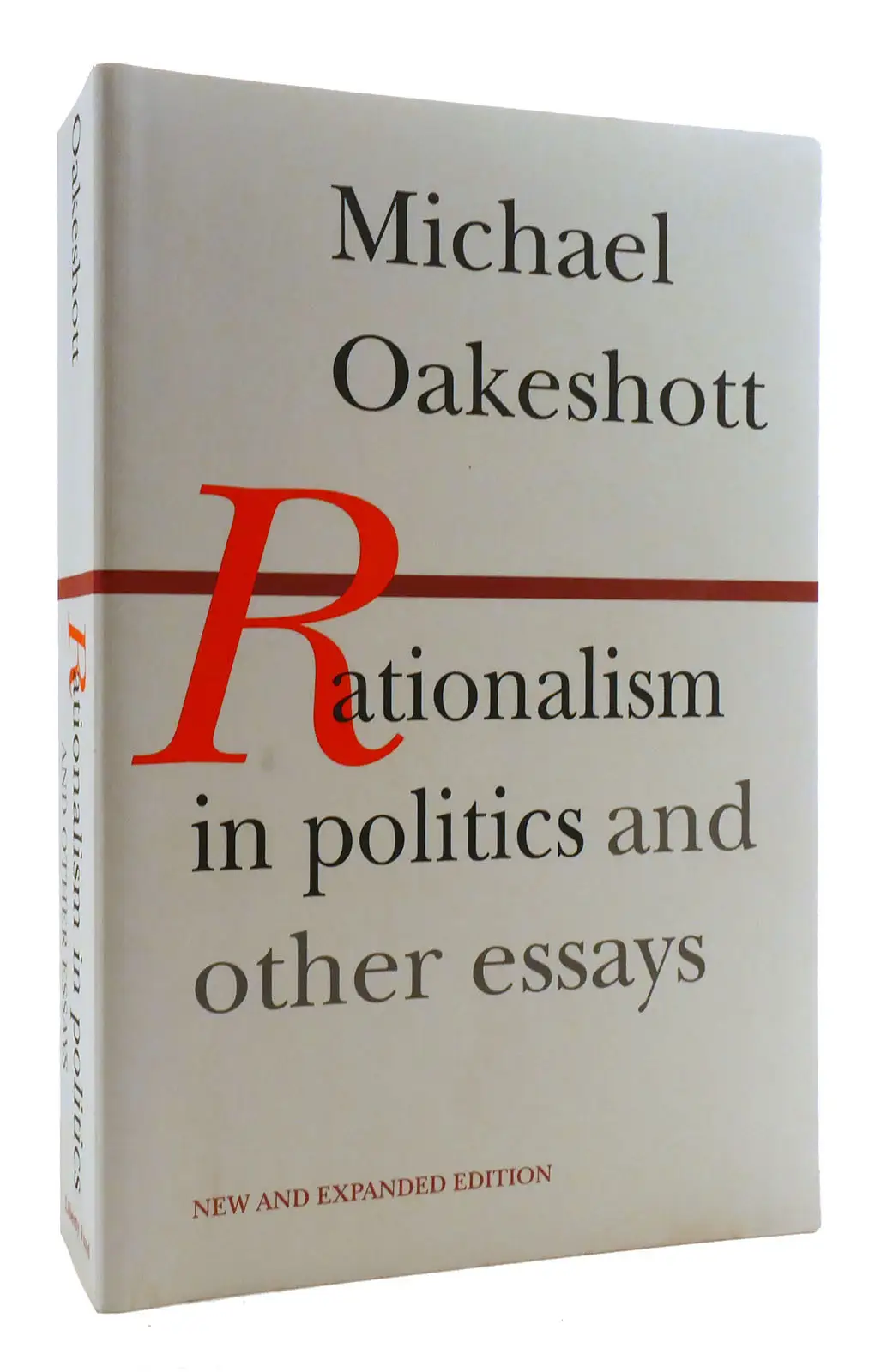
Rationalism in Politics and Other Essays
 Michael Oakeshott
Oakeshott's central argument is that rationalism in politics rests on a misconception about the nature of human knowledge. The Rationalist recognizes only technical knowledge—rules, formulas, and ideologies that can be taught and applied—while dismissing practical knowledge, which exists only in the activity of doing and cannot be reduced to rules. Because political activity depends on inherited traditions of behavior rather than on abstract principles, the rationalist who seeks to reconstruct society from a blueprint succeeds only in undermining the institutions that hold it together. Politics, properly understood, is the pursuit of intimations within a tradition, not the application of a technique.
Key Details
Related Books
View AllSimilar books from the same category, ranked by shared topics and reader engagement.



Key Insights — Read in 10 Minutes
What is the central claim of Rationalism in Politics, and what does it reject?
Oakeshott's central claim is that rationalism in politics rests on a false theory of knowledge: it recognizes only technical knowledge—rules, formulas, and ideologies that can be formulated and applied—while ignoring practical knowledge, which resides only in the activity of doing and cannot be written down. Political activity, he argues, is learned by participating in an inherited tradition of behavior, not by mastering a technique. He rejects the rationalist assumption that society can be reconstructed from abstract principles, insisting that the abridgment of a tradition is never a sufficient guide to political conduct.
What specific distinction did Oakeshott introduce, and where has it been applied?
Oakeshott introduced the distinction between technical knowledge and practical knowledge as the foundation of his critique. Technical knowledge can be formulated as rules and learned from a book; practical knowledge exists only in use, like the cookery of a cook or the conduct of a politician, and is acquired by apprenticeship to a master. This distinction has been applied in political theory to critique centralized planning, in philosophy of science to analyze tacit knowledge, and in conservative thought to defend inherited institutions against rationalist reform. It parallels and predates Michael Polanyi's later concept of tacit knowledge.
How does Oakeshott differ from Hayek and Popper on the role of tradition?
Oakeshott's approach constitutes a middle path between Popperian rationalism and Hayekian anti-rationalism. Popper treats traditions instrumentally, assessing them by their efficiency in promoting independently specifiable goals. Hayek defends traditions by their contribution to cultural survival, a standard that may be opaque even to those within the culture. Oakeshott rejects both: traditions are not goal-oriented, and goals cannot be specified independently of the form of life in which they are embedded. Tradition is not a means to an end but the medium within which political activity and its purposes become intelligible.
What does Oakeshott mean when he calls political activity 'the pursuit of intimations'?
The phrase captures Oakeshott's view that political activity does not begin from a blank slate or aim at a premeditated destination. Instead, it consists in exploring and developing what is already suggested—intimated—within an existing tradition of behavior. The political actor attends to the arrangements already in place and asks what they point toward, adjusting and extending them in ways that are potential within the tradition itself. This is why Oakeshott describes politics as sailing a boundless and bottomless sea without harbor or anchorage; there is no external standard to guide the voyage, only the tradition's own intimations.
Why is Oakeshott often mischaracterized as simply a 'conservative philosopher'?
Oakeshott himself resisted the label. In 'On Being Conservative,' he argued that a conservative disposition in politics is compatible with radicalism in every other sphere of life, and he explicitly stated that he was not a conservative philosopher but a philosopher who happened to find conservative politics intelligible. His critique of rationalism is not a defense of any particular political program but an epistemological argument about the limits of technical knowledge in human affairs. In later work he even moved away from the language of tradition, preferring to speak of 'practices,' further distancing himself from any fixed ideological identity.
What was the original context and reception of the book?
The title essay was originally Oakeshott's inaugural lecture as Professor of Political Science at the London School of Economics, delivered in 1951 and published in the collection in 1962. The book established Oakeshott as the leading conservative political theorist in modern Britain and remains his most widely cited work. Its critique of rationalism resonated in postwar debates about planning and the welfare state, and it has since been invoked in discussions of expertise, centralization, and the limits of technocratic governance. An expanded edition appeared in 1991.
Wealthy Psyche is an intellectual archive. We do not host, distribute, or sell book copies — physical or digital. We provide structured knowledge to help you think better, faster.