


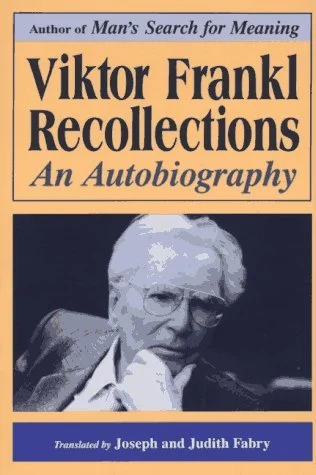
Recollections: An Autobiography
 Viktor Emil Frankl
Frankl's autobiography is not a chronological narrative of his life but a series of vignettes and reflections intended to fill the gaps left by his published works. Its distinctive mechanism is the deliberate selection of formative moments—his childhood in Vienna, his break with Freud and Adler, the development of logotherapy, his deportation and loss of his family, and his postwar rebuilding—presented not as confession but as evidence for his central claim that meaning is found in the specific, concrete moments of a life. The book is brief, written in a relaxed conversational style, and illustrated with photographs from his private archives, making it a companion to Man's Search for Meaning rather than a substitute for it.
Key Details
Related Books
View AllSimilar books from the same category, ranked by shared topics and reader engagement.


Key Insights — Read in 10 Minutes
What is the central claim or purpose of Recollections, and what does it reject?
The book's purpose is not to provide a comprehensive chronological account of Frankl's life but to fill in the personal and intellectual background that his published works left out. Frankl writes in a relaxed, conversational style, selecting formative experiences and encounters rather than offering a continuous narrative . He rejects the confessional mode of autobiography; the book is brief, often anecdotal, and focuses on the moments that shaped his thinking rather than on self-revelation for its own sake. The title's German original, Was nicht in meinen Büchern steht ('What is not in my books'), makes this explicit: the volume is a supplement to his systematic writings, not a replacement for them .
What is the publication and translation history of the book?
The book was first published in German in 1995 by Psychologie Verlags Union in Weinheim, under the title Was nicht in meinen Büchern steht . The English translation, by Joseph Fabry and Judith Fabry, was published in 1997 by Insight Books/Plenum Press in New York, with a foreword by Joseph Fabry . A paperback edition followed from Perseus Publishing in 2000 . The translation matters because Frankl's German prose has a particular texture, and the English version necessarily mediates his voice for a different audience. Readers should note that the volume is short—around 143 pages in the English edition—and includes photographs from Frankl's private archives, which are integral to its documentary character .
How does the autobiography relate to Man's Search for Meaning?
The relationship is one of historicizing and supplementation. Man's Search for Meaning combines Frankl's concentration camp testimony with a compressed outline of logotherapy; Recollections supplies the earlier and later context that the memoir brackets—his Vienna childhood, his teenage correspondence with Freud, his break with Adler, and the postwar reconstruction of his life and reputation . Frankl himself described the book as filling in what his other books left out. Readers who have not read Man's Search for Meaning may find Recollections comparatively flat, as one reviewer observed; it is best approached as a companion volume that deepens an existing acquaintance with Frankl's life and thought rather than as an introduction .
How was the book received, and what are its limitations?
Reception has been generally positive but measured. Booklist called it 'an enlightening look at an important twentieth-century intellectual,' and Publishers Weekly praised its 'clearly written prose' and its portrait of a man who 'obviously practices what he preaches' . The Toronto Globe and Mail described it as 'as simple, spontaneous, short and humble an autobiography as I have ever come across' . Limitations include its brevity and selectivity: the book does not attempt a full account of Frankl's life, and readers seeking detailed historical context or a sustained treatment of logotherapy's development will need to look elsewhere. A reviewer noted that some of what Frankl chooses to tell is 'unaccountably mundane,' while most of it is worthwhile . It is a supplement, not a standalone life.
What is a common misconception about this book?
A common misconception is that Recollections is a full autobiography in the conventional sense, offering a continuous narrative of Frankl's life from birth to old age. It is not. Frankl selects vignettes and reflections, and the book's German title explicitly frames it as what is not in his other books. Another misconception treats it as an introduction to logotherapy; the theory is discussed, but the book assumes some familiarity with Frankl's work and is organized around personal experience rather than systematic exposition. Readers expecting the emotional intensity of Man's Search for Meaning may be surprised by the lighter, more anecdotal tone. It is best read as a companion volume for those who already know Frankl's central ideas and want to see the life that shaped them.
Wealthy Psyche is an intellectual archive. We do not host, distribute, or sell book copies — physical or digital. We provide structured knowledge to help you think better, faster.