


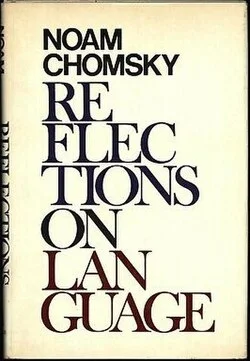
Reflections on Language
 Noam Chomsky
Chomsky argues that the human capacity for language is not a learned cultural artifact but a biologically determined 'mental organ' whose growth follows a genetically prescribed course. The book extends this nativist framework beyond linguistics, claiming that the same rationalist approach that explains language acquisition also illuminates broader questions about human cognition and the limits of empirical inquiry. Chomsky explicitly ties this scientific position to a political one, arguing that the empiricist conception of the mind as a blank slate is not only false but serves reactionary social doctrines by denying a fixed human nature.
Key Details
Related Books
View AllSimilar books from the same category, ranked by shared topics and reader engagement.


.webp?alt=media&token=34bd26c3-d0b0-4cd7-a235-153b0182ef19)
Key Insights — Read in 10 Minutes
What is the central claim of Reflections on Language, and what does it reject?
Chomsky's central claim is that language is a 'mental organ' whose growth is analogous to the development of a bodily organ—largely predetermined by genetic factors rather than shaped by environmental input. This directly rejects the behaviorist and empiricist assumption that language is acquired through conditioning, imitation, or general learning mechanisms. Chomsky argues that the poverty of the stimulus available to children cannot account for the rich, highly structured grammatical knowledge they attain, and therefore the mind must contain innate principles that constrain the form of possible human languages. This nativist position is presented as part of a broader rationalist tradition in the study of mind.
What specific concept or framework did the book introduce or popularize?
Reflections on Language was not the first work to introduce Universal Grammar, but it was one of the clearest and most widely read nontechnical presentations of the case for it. Chomsky uses the example of structure-dependent rules—such as the rule for forming yes/no questions—to argue that children operate with abstract syntactic principles that could not have been learned from the linguistic data available to them. The book develops the argument that the child's mind contains an innate instruction to construct structure-dependent rules, a claim that became a cornerstone of the nativist research program in cognitive science.
How does Chomsky connect his linguistic theory to political and social arguments?
Chomsky explicitly argues that the empiricist conception of human nature as infinitely malleable is not merely scientifically false but serves reactionary social doctrines. If human beings have no fixed nature, the argument goes, then existing social arrangements can be justified as the product of free choice rather than constraint. Chomsky contends that a scientifically grounded understanding of human nature, including the innate structures of mind, provides a rational basis for critiquing oppressive social institutions. This political dimension distinguishes Reflections on Language from more narrowly technical works in linguistics, though critics have questioned whether the political argument follows from the scientific claims.
How has the book's argument held up since its publication?
The nativist framework Chomsky defended remains a major research program in cognitive science and linguistics, but its specific claims have been contested. Reviewers at the time challenged the empirical basis of some arguments, including the claim that children never make errors in forming complex questions . Subsequent research in developmental psychology and cognitive neuroscience has confirmed that some aspects of language development are biologically constrained, while also demonstrating that environmental input and statistical learning play significant roles. The strong 'mental organ' analogy has been questioned by researchers who emphasize the plasticity and interactive nature of cognitive development.
How does Reflections on Language differ from Chomsky's earlier and later work?
The book occupies a transitional position in Chomsky's corpus. It extends the themes of Language and Mind (1968) and earlier technical work, restating core nativist arguments for a non-specialist audience. However, it also contains replies to critics and responds to developments in generative syntax from the mid-1970s. Compared to later works like Knowledge of Language (1986), which introduced principles-and-parameters and minimalism, Reflections on Language presents a less formalized version of Universal Grammar. Its accessible lecture format makes it one of the best entry points to Chomsky's thought, but scholars seeking his mature technical framework will find it dated in its syntactic specifics.
What common misreading or oversimplification of the book's argument exists?
A frequent oversimplification is that Chomsky claims language is entirely innate and that experience plays no role in acquisition. This misreads his position: Chomsky consistently argues that language grows through an interaction between innate principles and environmental triggering, much as an organ develops through interaction with its environment. The 'mental organ' analogy is meant to emphasize that the basic structure is predetermined, not that input is irrelevant. Another common misreading treats the book as purely a work of linguistics, when a substantial portion is devoted to philosophy of mind, the sociology of knowledge, and political critique.
Wealthy Psyche is an intellectual archive. We do not host, distribute, or sell book copies — physical or digital. We provide structured knowledge to help you think better, faster.