


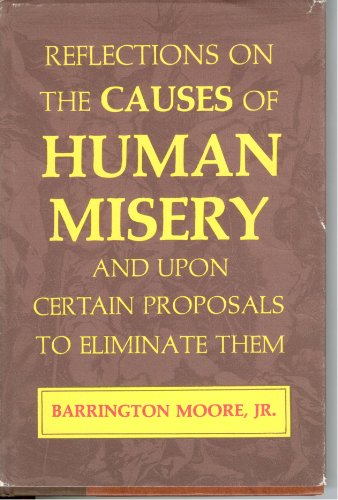
Reflections on the Causes of Human Misery and Upon Certain Proposals to Eliminate Them
 Barrington Moore Jr.
Barrington Moore Jr.'s pessimistic essay argues that human misery—war, cruelty, hunger, and oppression—is not a problem awaiting a technical fix but a permanent feature of social organization. Moore rejects the major proposed solutions of his era, including elite pluralism, participatory democracy, Marxian socialism, and neo-anarchism, finding each either ineffectual or prone to producing new forms of centralized coercion. He identifies a 'predatory democracy' in the United States, sustained by war and waste, and suggests that meaningful change would require a cultural mutation that no existing political framework can deliver without unacceptable costs.
Key Details
Key Insights — Read in 10 Minutes
What is Moore's central argument about the causes of human misery?
Moore argues that misery is not a problem awaiting the right solution but a persistent feature of social organization. He identifies its sources in war, cruelty, hunger, toil, injustice, and oppression, and examines the major proposals advanced to eliminate them. His conclusion is deeply pessimistic: elite pluralism perpetuates existing inequities, Marxian socialism requires a repressive apparatus, and neo-anarchism offers no mechanism for coordination without authority . Moore contends that the alleviation of scarcity and the resolution of injustice both risk producing massive centralized control, leaving no escape from the dilemma of arbitrary authority.
Why does Moore call the United States a 'predatory democracy'?
Moore argues that American democracy is 'predatory' because it sustains itself through war and waste. He claims that military spending and consumerism function to soften economic crises and minimize demands for income redistribution . This system, which he describes as a form of 'people's imperialism,' is popular and engenders broad support, making profound transformation unlikely. The key to understanding American stability, Moore suggests, is not the impossibility of change but the 'absence of a demand for change'—a product of incoherence, apathy, and the fact that 'others pay the costs' of American prosperity .
What specific proposals to eliminate misery does Moore consider and reject?
Moore systematically examines and rejects four major alternatives. Elite pluralism is dismissed as inherently conservative because it perpetuates the prevailing distribution of inequities . Direct democracy is rejected as degenerating into revolutionary terror. Participatory democracy fails to address the problem of coordination because self-management is not a satisfactory substitute for central authority. Marxian or centralized socialism is rejected because it requires a repressive apparatus to enforce allocative decisions against substantial portions of the population and to control the re-emergence of market behavior. Neo-anarchism, which he criticizes most scathingly, offers no mechanisms for avoiding inter-community conflict or preventing differential wealth among communities .
What does Moore mean by a 'cultural mutation' and why does he think it is necessary?
Moore argues that the elimination of scarcity would require a significant cultural mutation that severely restricts the tendencies of consumerism, waste, and pollution inherent in technological society . However, he sees this mutation as unlikely and potentially catastrophic: rolling back technology would produce unprecedented famine and disease, while sustaining the mutation would require centralized coordination of totalitarian proportions to prevent 'backsliding' into acquisitiveness and consumerism . The concept captures Moore's view that no existing political framework can deliver the transformation needed without unacceptable costs.
How was Reflections on the Causes of Human Misery received by reviewers?
Reviews were sharply divided. The Spectator's Kenneth Minogue criticized Moore as a 'soft head of naïveté trying to poke its vulnerable head out of the hard tortoise shell of militancy,' arguing the book was punditry rather than scholarship . Colin Barker in International Socialism dismissed it as pompous and argued Moore's 'major sociological generalisations' explained nothing . However, Contemporary Sociology called it 'brilliant, probably the most important sociological work of the past two or three years' . One reviewer in Political Quarterly described it as 'an impressive but sad book' showing 'a distinguished but perplexed mind' .
What is the significance of the book's title and its focus on misery rather than happiness?
Moore deliberately concentrates on misery rather than happiness because, as he notes, one man's meat is another man's poison—men will never agree on what makes them happy, but few enjoy being burned over a slow flame, starved to death, or living lives of quiet desperation . This negative focus is intended to provide a rock-solid value that all can agree upon. The Spectator's reviewer criticized this move as promoting truisms, noting that 'rock-solid values in social theory always turn out to be promoted truisms' . The title's structure—misery plus proposals to eliminate them—frames the book as a diagnostic exercise followed by a survey of failed remedies.
Show 1 more insights
Why does Moore discuss electricity blackouts as a potential source of revolutionary change?
In a passage that later proved prophetic, Moore suggests that a major collapse of the political apparatus might occur before mass support for serious social change emerges. He argues that in an urban environment, the creation of a revolutionary mass is a rapid transformation that occurs through a breakdown in the supply of goods and services on which a city depends . He specifically cites the 1965 Northeast blackout as a sociologically interesting possibility, noting that electrical energy is far more important for a modern city than wheat was for eighteenth-century Paris. The 1977 and 2003 blackouts later gave this passage renewed resonance .
Wealthy Psyche is an intellectual archive. We do not host, distribute, or sell book copies — physical or digital. We provide structured knowledge to help you think better, faster.